Nanyan Palace
⭐ 4.60
Nanyan Palace, Danjiangkou City, Shiyan, Hubei Province, China
 **Historical Context**
Nanyan Palace, formally known as "Great Sage Nanyan Palace," was established in 1285 during the Yuan Dynasty as the founding seat of Taoist cultivation on Wudang Mountain. Emperor Yongle of the Ming Dynasty lavishly rebuilt the complex in 1413, granting it its current imperial name. Much of what stands today remains Yuan and Ming fabric, placing it in the same era as the completion of Europe's great Gothic cathedrals such as Milan and Cologne. In 1996 it was designated a national key cultural relic, and in 2000 it joined UNESCO's World Heritage list as part of the Ancient Building Complex of Wudang Mountain.
**Architecture**
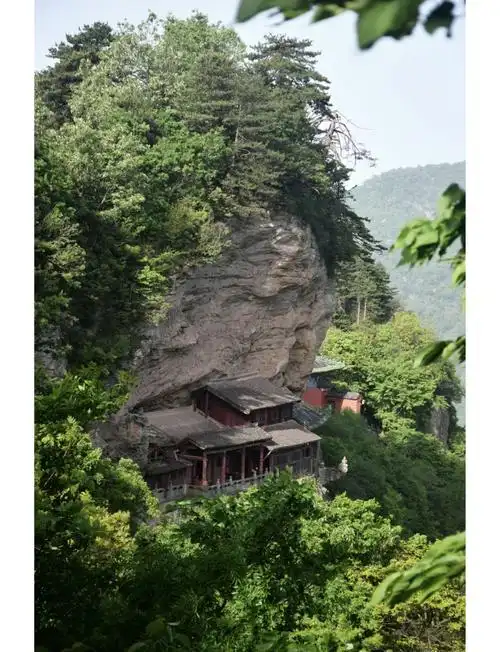
Unlike the rigid axial symmetry of most Chinese palaces—or, say, Versailles—Nanyan Palace cascades organically along the cliff edge, merging built form with natural rock. The centerpiece is the Tianyi Zhenqing Stone Hall, an eleven-meter-wide structure carved entirely from bluestone using mortise-and-tenon joinery. Standing 6.8 meters tall, its intricate dougong brackets and crisp carvings are an extraordinary showcase of thirteenth-century stone craftsmanship, all achieved without a single piece of wood or nail.
**Cultural Significance**
Nanyan is venerated as the place where Zhenwu, the Taoist supreme deity, achieved enlightenment and ascension. Inside, the Hall of Two Principles enshrines his parents, while scriptural halls safeguard rare Taoist canons. Cliff faces bear centuries of inscriptions such as "fortune, longevity, peace." Most striking is the Dragon Head Incense beam, a narrow stone ledge extending 2.9 meters outward above a sheer drop. Burning incense here was banned after the Kangxi era for safety, but the ledge remains a powerful symbol of the Taoist ideal of harmony between humanity and nature.
**Practical Information**
Entry is included in the Wudang Mountain scenic pass; opening hours typically run 07:00 to 17:00, with seasonal variations. From the scenic area, visitors can take an eco-bus to the Nanyan stop and walk five to ten minutes to the entrance, or hike from Zixiao Palace along the western trail. Multilingual audio guides are not standardly provided, so booking a human guide or reading ahead is recommended.
**Why Visit**
Set between the ascent to Wudang's Golden Summit, Nanyan Palace rewards travelers with a rare blend of cliff-top drama, architectural ingenuity, and living Taoist heritage—a site as breathtaking in its setting as the monasteries of Meteora in Greece, yet rooted in a completely different spiritual tradition.
**Historical Context**
Nanyan Palace, formally known as "Great Sage Nanyan Palace," was established in 1285 during the Yuan Dynasty as the founding seat of Taoist cultivation on Wudang Mountain. Emperor Yongle of the Ming Dynasty lavishly rebuilt the complex in 1413, granting it its current imperial name. Much of what stands today remains Yuan and Ming fabric, placing it in the same era as the completion of Europe's great Gothic cathedrals such as Milan and Cologne. In 1996 it was designated a national key cultural relic, and in 2000 it joined UNESCO's World Heritage list as part of the Ancient Building Complex of Wudang Mountain.
**Architecture**
Unlike the rigid axial symmetry of most Chinese palaces—or, say, Versailles—Nanyan Palace cascades organically along the cliff edge, merging built form with natural rock. The centerpiece is the Tianyi Zhenqing Stone Hall, an eleven-meter-wide structure carved entirely from bluestone using mortise-and-tenon joinery. Standing 6.8 meters tall, its intricate dougong brackets and crisp carvings are an extraordinary showcase of thirteenth-century stone craftsmanship, all achieved without a single piece of wood or nail.
**Cultural Significance**
Nanyan is venerated as the place where Zhenwu, the Taoist supreme deity, achieved enlightenment and ascension. Inside, the Hall of Two Principles enshrines his parents, while scriptural halls safeguard rare Taoist canons. Cliff faces bear centuries of inscriptions such as "fortune, longevity, peace." Most striking is the Dragon Head Incense beam, a narrow stone ledge extending 2.9 meters outward above a sheer drop. Burning incense here was banned after the Kangxi era for safety, but the ledge remains a powerful symbol of the Taoist ideal of harmony between humanity and nature.
**Practical Information**
Entry is included in the Wudang Mountain scenic pass; opening hours typically run 07:00 to 17:00, with seasonal variations. From the scenic area, visitors can take an eco-bus to the Nanyan stop and walk five to ten minutes to the entrance, or hike from Zixiao Palace along the western trail. Multilingual audio guides are not standardly provided, so booking a human guide or reading ahead is recommended.
**Why Visit**
Set between the ascent to Wudang's Golden Summit, Nanyan Palace rewards travelers with a rare blend of cliff-top drama, architectural ingenuity, and living Taoist heritage—a site as breathtaking in its setting as the monasteries of Meteora in Greece, yet rooted in a completely different spiritual tradition.