Taizi Slope
⭐ 4.60
Taizi Slope, Wudang Mountain Scenic Area, Danjiangkou City, Shiyan City, Hubei Province, China
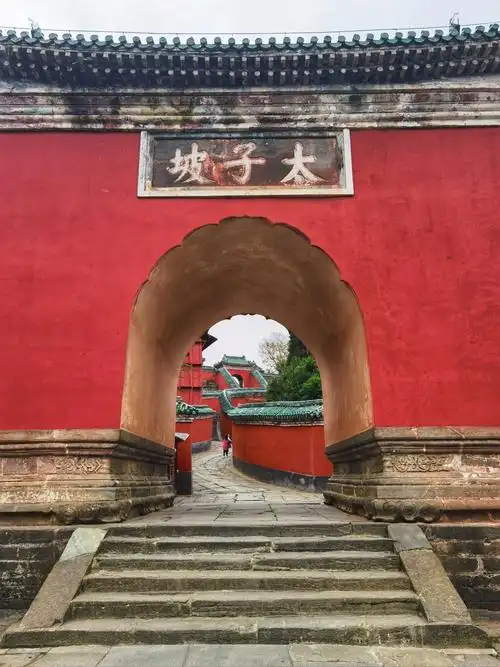 Built in 1412 under the Yongle Emperor (Zhu Di)—the same ruler who commissioned Beijing's Forbidden City and dispatched Admiral Zheng He on his ocean voyages—Fuzhen Temple is one of the architectural keystones of Wudang Mountain's grand imperial Taoist complex. Imagine a medieval European monastic precinct, then transplant it onto a near-vertical cliff face, and you begin to grasp what the Ming builders achieved here. Yet while European Gothic cathedrals strove heavenward in stone, Wudang's master craftsmen shaped entire monasteries from fragrant cedar and pine, transforming the mountain's ancient ridges into a sanctuary where emperors, scholars, and monks communed with the cosmos for six centuries.
The temple's showpiece is the celebrated Nine-Bend Yellow River Wall: a 71-metre ribbon of vermilion plaster that snakes up the slope in nine undulating switchbacks, its dark-tiled crest rising and dipping like the spine of a slumbering dragon. Step back with a wide-angle lens and the effect is pure theatre—comparable to the serpentine processional walls of St. Peter's Square in Rome, but pressed into the wild embrace of a sacred mountain. Photographers especially cherish the gentle morning and evening light, which paints the red curves in shifting shades of amber and crimson against the forested valley below.
Climb to the upper tier and you reach Five-Cloud Tower, a timber pavilion whose upper floor showcases the legendary "One Pillar, Twelve Beams" structure: a single central column supporting twelve crossbeams through pure mortise-and-tenon joinery, with not a single nail or drop of glue in the entire assembly. To appreciate the feat, picture the soaring hammer-beam roof of Westminster Hall in London, then subtract every iron cramp and metal tie. Six hundred years on, the carpentry still holds firm—a quiet masterclass in pre-industrial structural poetry that Wudang's master builders passed down as living tradition.
Beyond its architecture, Taizi Slope is steeped in legend. It was here, according to Taoist tradition, that the young prince Zhenwu once forsook royal life to cultivate immortality, and the temple still houses the largest surviving Ming-era painted wooden statue of the Warrior Deity, along with vivid murals depicting his martial and mystical exploits. Students flock here each year to pray for academic success, lending the place a homely, hopeful atmosphere that bridges solemn religious heritage with very human aspirations—a far cry from the stern formality of Europe's great cathedrals.
Practical planning is refreshingly straightforward. Taizi Slope has no ticket of its own; simply purchase the main Wudang Mountain entry pass plus the scenic shuttle bus ticket from the visitors' centre, and you'll be whisked to the temple in about 20 to 30 minutes. Allow between one and one-and-a-half hours for an unhurried walk through the wall gates, Five-Cloud Tower, the main halls, and nearby Mózhēn Well. The site opens daily from 7:30 a.m. to 5:30 p.m., and the gentle gradient makes it accessible to visitors of all ages.
In short, Taizi Slope is the rare masterpiece that rewards everyone: architecture lovers with its matchless joinery, history buffs with its imperial pedigree, culture seekers with its living Taoist traditions, and casual travellers with some of the most photogenic red walls in all of Asia. Pair it with the Golden Summit, Purple Cloud Palace, and South Rock Palace on a half- or full-day circuit, and you'll leave Wudang Mountain with the unforgettable image of crimson walls coiling like a dragon up toward the clouds.
Built in 1412 under the Yongle Emperor (Zhu Di)—the same ruler who commissioned Beijing's Forbidden City and dispatched Admiral Zheng He on his ocean voyages—Fuzhen Temple is one of the architectural keystones of Wudang Mountain's grand imperial Taoist complex. Imagine a medieval European monastic precinct, then transplant it onto a near-vertical cliff face, and you begin to grasp what the Ming builders achieved here. Yet while European Gothic cathedrals strove heavenward in stone, Wudang's master craftsmen shaped entire monasteries from fragrant cedar and pine, transforming the mountain's ancient ridges into a sanctuary where emperors, scholars, and monks communed with the cosmos for six centuries.
The temple's showpiece is the celebrated Nine-Bend Yellow River Wall: a 71-metre ribbon of vermilion plaster that snakes up the slope in nine undulating switchbacks, its dark-tiled crest rising and dipping like the spine of a slumbering dragon. Step back with a wide-angle lens and the effect is pure theatre—comparable to the serpentine processional walls of St. Peter's Square in Rome, but pressed into the wild embrace of a sacred mountain. Photographers especially cherish the gentle morning and evening light, which paints the red curves in shifting shades of amber and crimson against the forested valley below.
Climb to the upper tier and you reach Five-Cloud Tower, a timber pavilion whose upper floor showcases the legendary "One Pillar, Twelve Beams" structure: a single central column supporting twelve crossbeams through pure mortise-and-tenon joinery, with not a single nail or drop of glue in the entire assembly. To appreciate the feat, picture the soaring hammer-beam roof of Westminster Hall in London, then subtract every iron cramp and metal tie. Six hundred years on, the carpentry still holds firm—a quiet masterclass in pre-industrial structural poetry that Wudang's master builders passed down as living tradition.
Beyond its architecture, Taizi Slope is steeped in legend. It was here, according to Taoist tradition, that the young prince Zhenwu once forsook royal life to cultivate immortality, and the temple still houses the largest surviving Ming-era painted wooden statue of the Warrior Deity, along with vivid murals depicting his martial and mystical exploits. Students flock here each year to pray for academic success, lending the place a homely, hopeful atmosphere that bridges solemn religious heritage with very human aspirations—a far cry from the stern formality of Europe's great cathedrals.
Practical planning is refreshingly straightforward. Taizi Slope has no ticket of its own; simply purchase the main Wudang Mountain entry pass plus the scenic shuttle bus ticket from the visitors' centre, and you'll be whisked to the temple in about 20 to 30 minutes. Allow between one and one-and-a-half hours for an unhurried walk through the wall gates, Five-Cloud Tower, the main halls, and nearby Mózhēn Well. The site opens daily from 7:30 a.m. to 5:30 p.m., and the gentle gradient makes it accessible to visitors of all ages.
In short, Taizi Slope is the rare masterpiece that rewards everyone: architecture lovers with its matchless joinery, history buffs with its imperial pedigree, culture seekers with its living Taoist traditions, and casual travellers with some of the most photogenic red walls in all of Asia. Pair it with the Golden Summit, Purple Cloud Palace, and South Rock Palace on a half- or full-day circuit, and you'll leave Wudang Mountain with the unforgettable image of crimson walls coiling like a dragon up toward the clouds.