Golden Hall
⭐ 4.20
Wudang Mountain Scenic Area, Danjiangkou City, Shiyan City, Hubei Province, China
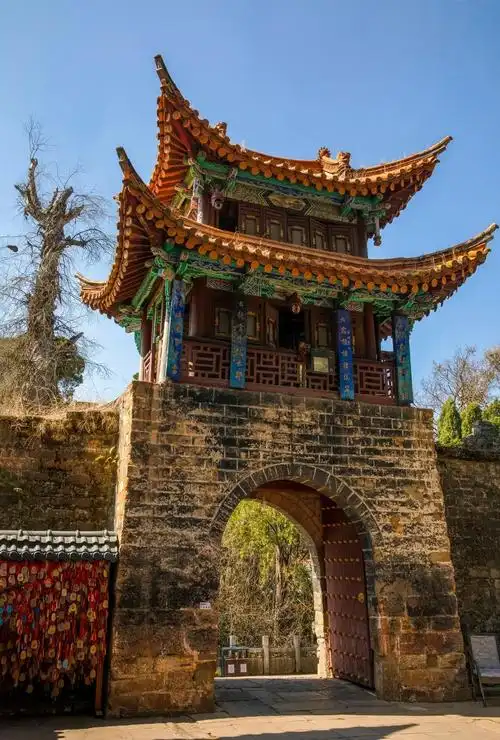 Commissioned in 1416 by the Yongle Emperor of the Ming dynasty, the Golden Hall emerged during a period that paralleled Europe's early Renaissance—contemporary with the completion of Brunelleschi's great dome in Florence. While Michelangelo was still a child, Chinese craftsmen were casting individual bronze components in Beijing, transporting them across the empire, and reassembling them atop a remote mountain peak with precision that still astonishes engineers today. The hall stands as physical proof of the Ming court's determination to elevate Wudang as the imperial family's spiritual home, dedicated to Zhenwu, the Daoist "True Warrior" deity who personifies water and the northern cosmos.
Standing 5.54 meters tall within a compact three-by-three-bay footprint, the hall employs a double-eaved hip roof—the highest architectural rank in traditional Chinese construction, normally reserved for imperial palaces. The entire structure, including beams, rafters, tiles, and decorative finials, is cast in bronze, with seams so tight that paper cannot pass between them. Comparable in ambition to Ghiberti's bronze doors at Florence's Baptistery, this is arguably the world's most ambitious religious metal-cast building, executed with techniques that were never fully replicated again.
Inside rests a nationally protected gilded statue of Zhenwu, and the hall itself was among the very first monuments listed as a National Key Cultural Relic in 1961. Local lore celebrates the "Thunder Fire Refining Hall" phenomenon, in which lightning circles the structure during storms without striking it—interpreted by devotees as evidence of celestial protection. The surrounding landscape reinforces this sanctity: Wudang's celebrated "seventy-two peaks" are said to orient themselves reverently toward the summit, and when sea-of-clouds conditions prevail, the golden roof floats ethereally above the world below.
Access requires booking through Wudang's main scenic area in advance, with separate quotas for the Golden Summit zone. A cable car is strongly recommended for the steep ascent; round-trip tickets run approximately 150 yuan. Foreign visitors must carry original passports at all times, and photography is strictly prohibited inside the hall. Traditional etiquette asks guests not to step on the central threshold but to enter from the sides, circumambulating clockwise. Sunrise viewing demands a pre-dawn departure and is highly weather-dependent—check forecasts carefully before committing.
The granite steps approaching the summit are steep and often slick, so sturdy hiking shoes are essential, along with sun protection and a light jacket (temperatures drop sharply once above the clouds). On-site dining centers on Buddhist-style vegetarian fare, so consider packing snacks. Hiring an English-speaking guide greatly enriches the experience, illuminating Daoist symbolism woven into the architecture. For Western travelers familiar with European cathedrals, the Golden Hall offers something rare: a living sacred space where pre-modern craftsmanship, imperial patronage, and mountain mysticism converge into a single golden glow.
Commissioned in 1416 by the Yongle Emperor of the Ming dynasty, the Golden Hall emerged during a period that paralleled Europe's early Renaissance—contemporary with the completion of Brunelleschi's great dome in Florence. While Michelangelo was still a child, Chinese craftsmen were casting individual bronze components in Beijing, transporting them across the empire, and reassembling them atop a remote mountain peak with precision that still astonishes engineers today. The hall stands as physical proof of the Ming court's determination to elevate Wudang as the imperial family's spiritual home, dedicated to Zhenwu, the Daoist "True Warrior" deity who personifies water and the northern cosmos.
Standing 5.54 meters tall within a compact three-by-three-bay footprint, the hall employs a double-eaved hip roof—the highest architectural rank in traditional Chinese construction, normally reserved for imperial palaces. The entire structure, including beams, rafters, tiles, and decorative finials, is cast in bronze, with seams so tight that paper cannot pass between them. Comparable in ambition to Ghiberti's bronze doors at Florence's Baptistery, this is arguably the world's most ambitious religious metal-cast building, executed with techniques that were never fully replicated again.
Inside rests a nationally protected gilded statue of Zhenwu, and the hall itself was among the very first monuments listed as a National Key Cultural Relic in 1961. Local lore celebrates the "Thunder Fire Refining Hall" phenomenon, in which lightning circles the structure during storms without striking it—interpreted by devotees as evidence of celestial protection. The surrounding landscape reinforces this sanctity: Wudang's celebrated "seventy-two peaks" are said to orient themselves reverently toward the summit, and when sea-of-clouds conditions prevail, the golden roof floats ethereally above the world below.
Access requires booking through Wudang's main scenic area in advance, with separate quotas for the Golden Summit zone. A cable car is strongly recommended for the steep ascent; round-trip tickets run approximately 150 yuan. Foreign visitors must carry original passports at all times, and photography is strictly prohibited inside the hall. Traditional etiquette asks guests not to step on the central threshold but to enter from the sides, circumambulating clockwise. Sunrise viewing demands a pre-dawn departure and is highly weather-dependent—check forecasts carefully before committing.
The granite steps approaching the summit are steep and often slick, so sturdy hiking shoes are essential, along with sun protection and a light jacket (temperatures drop sharply once above the clouds). On-site dining centers on Buddhist-style vegetarian fare, so consider packing snacks. Hiring an English-speaking guide greatly enriches the experience, illuminating Daoist symbolism woven into the architecture. For Western travelers familiar with European cathedrals, the Golden Hall offers something rare: a living sacred space where pre-modern craftsmanship, imperial patronage, and mountain mysticism converge into a single golden glow.