Wuyishan National Park
⭐ 4.60
Wuyishan National Park, Wuyishan City, Nanping City, Fujian Province, China
 Wuyishan was inscribed as a UNESCO World Heritage Site in 1999, recognized for both its natural splendor and cultural importance. The region's history stretches back to pre-Q antiquity, but it truly flourished during the Tang and Song dynasties when Confucian, Buddhist, and Daoist traditions converged here. The Southern Song philosopher Zhu Xi, a figure comparable to Thomas Aquinas in shaping Eastern thought, spent decades writing and teaching in these mountains, earning Wuyishan the honorific "Cradle of Neo-Confucianism." More than 450 cliff inscriptions and the remains of ancient academies still testify to this rich intellectual legacy.
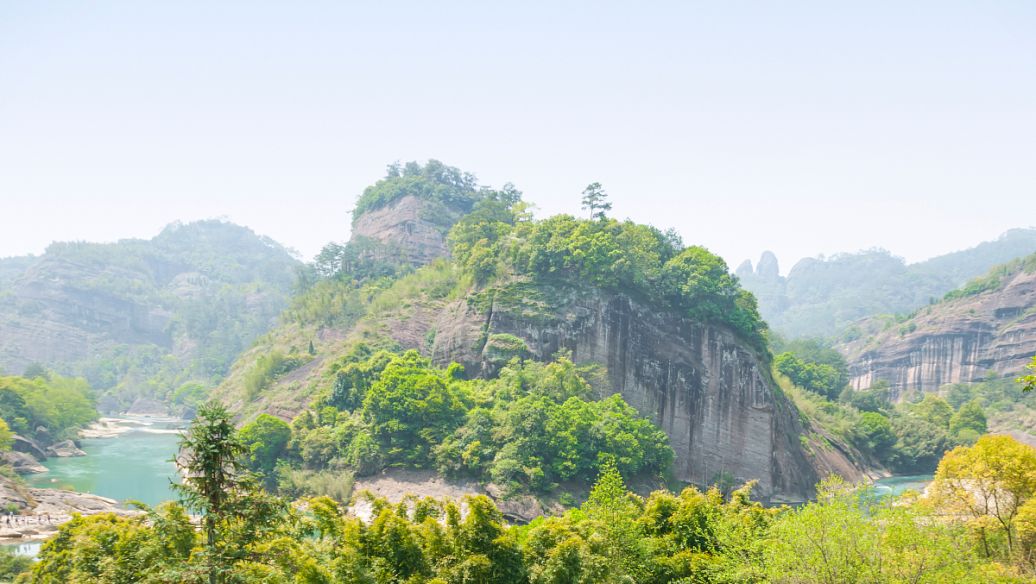
The park's signature "emerald waters and crimson cliffs" represent China's quintessential Danxia landform, sculpted over 140 million years. Thirty-six dramatic peaks pierce the sky, while ninety-nine peculiar rock formations dot the landscape. Tianyou Peak, the highest vantage point, commands sweeping views of the entire Nine-Bend Stream below—comparable to looking down from Switzerland's Matterhorn onto an Alpine valley. The forest coverage exceeds 96.7 percent, preserving the most intact mid-subtropical primary forest in China, with air so pure it ranks among the most oxygen-rich environments on Earth.
The Nine-Bend Stream is the soul of Wuyishan. Winding approximately 8 kilometers through eighteen dramatic bends, it offers a 90-minute bamboo rafting experience that reveals the park's finest scenery. As skilled boatmen narrate legends of the Jade Maiden Peak and other formations in local dialect, travelers drift past towering crimson cliffs reflected in jade-green waters. This gentle journey has been praised for centuries as the quintessential way to absorb Chinese landscape poetry in motion, an experience as essential to visiting Wuyishan as a gondola ride is to Venice.
Wuyishan is the ancestral homeland of both black and oolong teas. The legendary "Da Hong Pao" rock tea, among the world's most expensive varieties, originates here, with the original 350-year-old mother trees themselves designated a UNESCO heritage component. Visitors can tour traditional tea workshops, try hand-rolling leaves themselves, or stroll the "Rock-Bone Floral Fragrance" trail through terraced tea gardens. Summer brings pleasant coolness, making the area a refreshing escape from China's sweltering lowland cities.
Admission to the park itself is free, but visitors must purchase shuttle bus tickets (70 yuan for one day, 85 for two, 95 for three days) and the Nine-Bend Stream bamboo raft (130 yuan per person). Hours run 6:30 AM–6:00 PM from March through October, and 7:00 AM–5:00 PM from November through February. Advance reservations are required through the "China Wuyishan" mini-program, and private vehicles are prohibited—official shuttle buses handle all transport. Accommodation clusters around the Sangu Resort Area and Nanyuanling B&B Village.
From 2026 onward, the park will debut eight science museums covering tea culture, geology, and biodiversity, some featuring AR interactivity and robot-dog patrol demonstrations. Travelers should avoid peak summer crowds and take midday sun precautions seriously. A notable caution: the narrowest passage through the Sky-Splitting Rock measures just 30 centimeters, so larger visitors may struggle to pass. Off-trail hiking and camping in undeveloped zones are strictly prohibited for both safety and conservation reasons—stick to marked paths to preserve this extraordinary landscape for future generations.
Wuyishan was inscribed as a UNESCO World Heritage Site in 1999, recognized for both its natural splendor and cultural importance. The region's history stretches back to pre-Q antiquity, but it truly flourished during the Tang and Song dynasties when Confucian, Buddhist, and Daoist traditions converged here. The Southern Song philosopher Zhu Xi, a figure comparable to Thomas Aquinas in shaping Eastern thought, spent decades writing and teaching in these mountains, earning Wuyishan the honorific "Cradle of Neo-Confucianism." More than 450 cliff inscriptions and the remains of ancient academies still testify to this rich intellectual legacy.
The park's signature "emerald waters and crimson cliffs" represent China's quintessential Danxia landform, sculpted over 140 million years. Thirty-six dramatic peaks pierce the sky, while ninety-nine peculiar rock formations dot the landscape. Tianyou Peak, the highest vantage point, commands sweeping views of the entire Nine-Bend Stream below—comparable to looking down from Switzerland's Matterhorn onto an Alpine valley. The forest coverage exceeds 96.7 percent, preserving the most intact mid-subtropical primary forest in China, with air so pure it ranks among the most oxygen-rich environments on Earth.
The Nine-Bend Stream is the soul of Wuyishan. Winding approximately 8 kilometers through eighteen dramatic bends, it offers a 90-minute bamboo rafting experience that reveals the park's finest scenery. As skilled boatmen narrate legends of the Jade Maiden Peak and other formations in local dialect, travelers drift past towering crimson cliffs reflected in jade-green waters. This gentle journey has been praised for centuries as the quintessential way to absorb Chinese landscape poetry in motion, an experience as essential to visiting Wuyishan as a gondola ride is to Venice.
Wuyishan is the ancestral homeland of both black and oolong teas. The legendary "Da Hong Pao" rock tea, among the world's most expensive varieties, originates here, with the original 350-year-old mother trees themselves designated a UNESCO heritage component. Visitors can tour traditional tea workshops, try hand-rolling leaves themselves, or stroll the "Rock-Bone Floral Fragrance" trail through terraced tea gardens. Summer brings pleasant coolness, making the area a refreshing escape from China's sweltering lowland cities.
Admission to the park itself is free, but visitors must purchase shuttle bus tickets (70 yuan for one day, 85 for two, 95 for three days) and the Nine-Bend Stream bamboo raft (130 yuan per person). Hours run 6:30 AM–6:00 PM from March through October, and 7:00 AM–5:00 PM from November through February. Advance reservations are required through the "China Wuyishan" mini-program, and private vehicles are prohibited—official shuttle buses handle all transport. Accommodation clusters around the Sangu Resort Area and Nanyuanling B&B Village.
From 2026 onward, the park will debut eight science museums covering tea culture, geology, and biodiversity, some featuring AR interactivity and robot-dog patrol demonstrations. Travelers should avoid peak summer crowds and take midday sun precautions seriously. A notable caution: the narrowest passage through the Sky-Splitting Rock measures just 30 centimeters, so larger visitors may struggle to pass. Off-trail hiking and camping in undeveloped zones are strictly prohibited for both safety and conservation reasons—stick to marked paths to preserve this extraordinary landscape for future generations.