Manting Peak
⭐ 3.60
Manting Peak Scenic Area, Wuyishan National Park, Wuyishan City, Nanping, Fujian Province, China
 The mountain's fame rests on the legend of the "Manting Banquet," a mythical celebration said to have taken place in the second year of the Qin dynasty (around 220 BCE), an era contemporary with Rome's wars against Carthage. According to local lore, the immortal lord of Wuyi descended to host a vast feast for villagers here, an event immortalized in poetry and folklore. The half-mountain "Chessboard Stone" is venerated as the remains of a Han dynasty sacrificial altar (206 BCE–220 CE), an era that coincided with the height of the Roman Empire. These layered myths and rituals have earned the Manting legend a place on Nanping's intangible cultural heritage list.
At the summit's eastern cliff face, four monumental characters spelling "Manting" are carved into the red sandstone, each standing roughly thirteen meters tall — the height of a four-story building. They were inscribed during the Ming dynasty (1368–1644), a period contemporary with the Italian Renaissance, by the scholar-official Wu Sixue. The brushwork combines bold structure with flowing grace, recalling the monumental inscriptions found at Petra in Jordan or the cliff carvings of Indian Buddhist sites. Visitors approaching the summit are struck by how the calligraphy seems to channel the literary spirit of centuries past, making it an essential cultural landmark.
Beyond the inscriptions, Manting Peak embodies the Wuyi Mountains' deep fusion of Daoist mythology, imperial ritual, and natural beauty — a synthesis comparable to how Delphi merged Greek mythology with rugged terrain, or how sacred mountains have long served as bridges between earth and heaven. The peak features in classical Chinese poetry and appears in works by Song dynasty literati, who traveled here seeking inspiration. Even today, scholars and calligraphy enthusiasts make pilgrimages to study the giant characters. For Western visitors familiar with European pilgrimage routes or sites of ancient mystery, Manting offers a comparable spiritual resonance rooted in distinctly Chinese tradition.
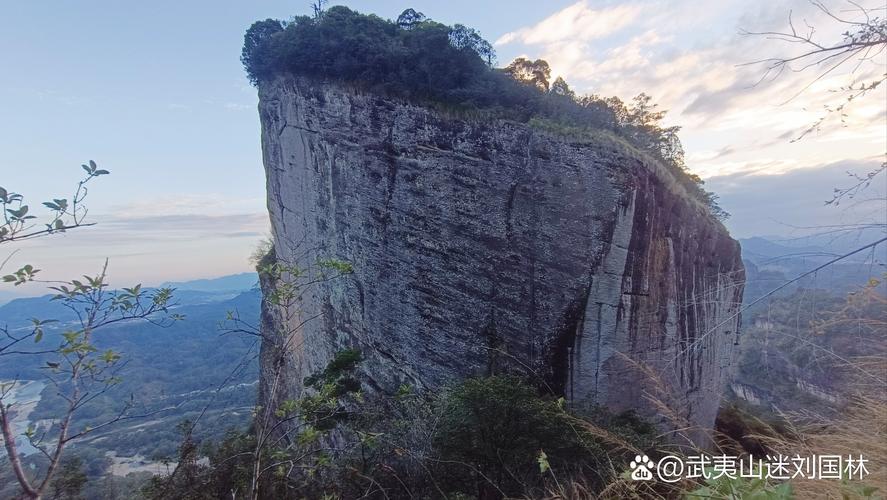
Manting belongs to the Danxia landform family — a UNESCO-listed geological category characterized by steep red cliffs and unusually flat summits, sometimes compared to the rock-cut façades of Petra or the fairy chimneys of Cappadocia. The peak's profile is dramatically two-tiered, with a sheer body rising to a remarkably level crown. In the early morning or after rainfall, low-lying clouds pour around the cliffs, lifting the summit into an ethereal island suspended in vapor — a sight Chinese poets have likened to an immortal's banquet hall floating above the mortal world. This atmospheric drama is one of Wuyi's most photographed phenomena.
Manting Peak is included in the main Wuyishan scenic area ticket; no separate admission is required. Two trails lead to the summit: one branching from the Shengzhen Cave beside Dawang Peak, the other climbing from the right side of Huanggu Rock. Both routes take thirty to fifty minutes and involve some steep scrambling requiring hands as well as feet. Most visitors combine Manting with Dawang Peak in a two-to-three-hour loop. Those short on time can admire the inscription from the base or from a mid-mountain platform, or even enjoy a distant view from the "Rainbow Bridge" lookout along the Chongyang Stream walking path.
Trails are unpaved and often mossy, with no railings on exposed sections — anti-slip hiking shoes, water, and sun protection are essential. Summer brings heat, humidity, and biting insects, while the rear-slope path is unofficial and best avoided. The peak is ideal for culture-minded travelers, moderate hikers, and landscape photographers rather than families with small children or anyone pressed for time. For those who make the climb, the reward is rare: a summit where commanding calligraphy, swirling Danxia mists, and the echo of a two-thousand-year-old banquet converge into a single, unforgettable moment.
The mountain's fame rests on the legend of the "Manting Banquet," a mythical celebration said to have taken place in the second year of the Qin dynasty (around 220 BCE), an era contemporary with Rome's wars against Carthage. According to local lore, the immortal lord of Wuyi descended to host a vast feast for villagers here, an event immortalized in poetry and folklore. The half-mountain "Chessboard Stone" is venerated as the remains of a Han dynasty sacrificial altar (206 BCE–220 CE), an era that coincided with the height of the Roman Empire. These layered myths and rituals have earned the Manting legend a place on Nanping's intangible cultural heritage list.
At the summit's eastern cliff face, four monumental characters spelling "Manting" are carved into the red sandstone, each standing roughly thirteen meters tall — the height of a four-story building. They were inscribed during the Ming dynasty (1368–1644), a period contemporary with the Italian Renaissance, by the scholar-official Wu Sixue. The brushwork combines bold structure with flowing grace, recalling the monumental inscriptions found at Petra in Jordan or the cliff carvings of Indian Buddhist sites. Visitors approaching the summit are struck by how the calligraphy seems to channel the literary spirit of centuries past, making it an essential cultural landmark.
Beyond the inscriptions, Manting Peak embodies the Wuyi Mountains' deep fusion of Daoist mythology, imperial ritual, and natural beauty — a synthesis comparable to how Delphi merged Greek mythology with rugged terrain, or how sacred mountains have long served as bridges between earth and heaven. The peak features in classical Chinese poetry and appears in works by Song dynasty literati, who traveled here seeking inspiration. Even today, scholars and calligraphy enthusiasts make pilgrimages to study the giant characters. For Western visitors familiar with European pilgrimage routes or sites of ancient mystery, Manting offers a comparable spiritual resonance rooted in distinctly Chinese tradition.
Manting belongs to the Danxia landform family — a UNESCO-listed geological category characterized by steep red cliffs and unusually flat summits, sometimes compared to the rock-cut façades of Petra or the fairy chimneys of Cappadocia. The peak's profile is dramatically two-tiered, with a sheer body rising to a remarkably level crown. In the early morning or after rainfall, low-lying clouds pour around the cliffs, lifting the summit into an ethereal island suspended in vapor — a sight Chinese poets have likened to an immortal's banquet hall floating above the mortal world. This atmospheric drama is one of Wuyi's most photographed phenomena.
Manting Peak is included in the main Wuyishan scenic area ticket; no separate admission is required. Two trails lead to the summit: one branching from the Shengzhen Cave beside Dawang Peak, the other climbing from the right side of Huanggu Rock. Both routes take thirty to fifty minutes and involve some steep scrambling requiring hands as well as feet. Most visitors combine Manting with Dawang Peak in a two-to-three-hour loop. Those short on time can admire the inscription from the base or from a mid-mountain platform, or even enjoy a distant view from the "Rainbow Bridge" lookout along the Chongyang Stream walking path.
Trails are unpaved and often mossy, with no railings on exposed sections — anti-slip hiking shoes, water, and sun protection are essential. Summer brings heat, humidity, and biting insects, while the rear-slope path is unofficial and best avoided. The peak is ideal for culture-minded travelers, moderate hikers, and landscape photographers rather than families with small children or anyone pressed for time. For those who make the climb, the reward is rare: a summit where commanding calligraphy, swirling Danxia mists, and the echo of a two-thousand-year-old banquet converge into a single, unforgettable moment.