Nine Bend River Rafting
⭐ 4.60
Wuyishan City, Nanping, Fujian Province, China
 The Nine-Bend Creek has been the spiritual heart of Mount Wuyi since the Southern Song Dynasty (12th–13th centuries), when the Neo-Confucian philosopher Zhu Xi—often compared to Europe's Thomas Aquinas for his towering influence on East Asian thought—penned his immortal "Nine-Bend Boat Songs" while drifting these very waters. For nearly a millennium, scholar-officials and poets have made this same pilgrimage by raft, weaving a literary tradition as old as the troubadour culture of medieval Provence. What began as an elite aristocratic pastime has become a beloved democratic pleasure, preserving a continuous thread of Chinese landscape poetry that few rivers in the world can claim.
The creek winds through the most spectacular section of the Wuyi Mountains' Danxia landform—a rare geological phenomenon whose crimson sandstone pillars and sheer cliffs evoke images of Norway's western fjords or Utah's canyon country, though softened by misty subtropical forest. Of the thirty-six named peaks, the slender Jade Girl Peak and the towering King Peak anchor the most celebrated legend: a tragic love story between a mortal king and a celestial maiden, often retold alongside tales of star-crossed lovers like Shakespeare's Romeo and Juliet. Crystal-clear waters mirror the cliffs so perfectly that the scene resembles a Chinese ink-wash painting made tangible.
What distinguishes this floating experience from mere sightseeing is the boatman himself—a folklorist, historian, and stand-up comedian rolled into one. As the raft silently threads between ancient cliffs, the boatman recites Zhu Xi's Confucian verses, explains the mystery of the cliff-hanging coffins (Bronze Age burials suspended hundreds of feet above the river, puzzling archaeologists much like Scotland's prehistoric brochs), and points out Tang and Song dynasty inscriptions carved into the rock face. The journey becomes a moving seminar on Chinese civilization, where a thousand years of mountain culture unfold in a single unhurried afternoon.
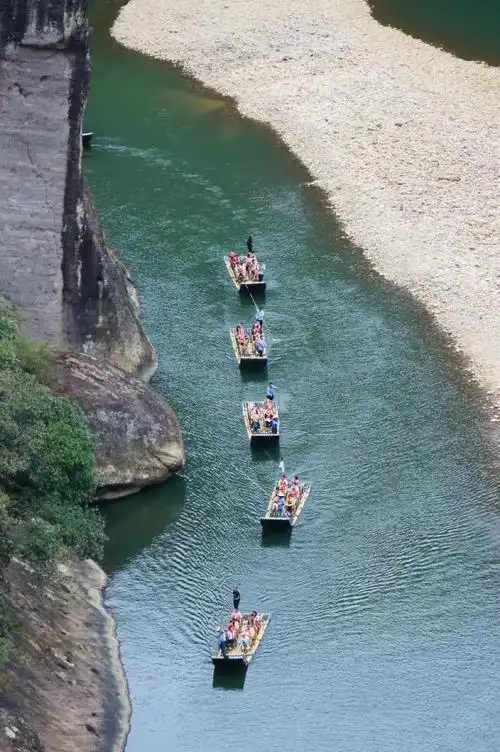
Unlike whitewater rafting, the Nine-Bend trip is remarkably gentle—more reminiscent of a Venetian gondola ride through a marble canyon than an adrenaline-pumping river adventure. Six passengers share each bamboo raft, propelled by a single boatman with a long pole. The flat current makes it suitable for grandparents and young children alike, while the cool mountain air and shaded gorges provide welcome relief from Fujian's humid summers. Locals call it the "mandatory course" for understanding Mount Wuyi's soul.
Rafts depart from Xingcun Village Pier (the Ninth Bend) and arrive at Wuyi Palace (the First Bend), a 1.5-hour journey. Tickets cost 130 RMB per person including insurance, with operations running daily from 7:30 AM to 5:00 PM. Advance booking through official channels is essential, ideally 3–7 days ahead, especially during peak season. Bring a waterproof phone case, sun protection, and non-slip shoes; trips may be cancelled during heavy rain. Rafts carry exactly six passengers, so solo travelers are typically grouped together.
The mountain's lighting transforms throughout the day—early morning departures (7:30–9:00 AM) and late afternoon returns (after 3:00 PM) catch the cliffs glowing honey-gold, ideal for photographers. After disembarking at Wuyi Palace, visitors can easily explore the reconstructed Song-style Old Street, the tranquil Zhizhi Hermitage, or catch a shuttle bus to Tianyou Peak and the One-Line Sky gorge. Allow at least half a day to combine the raft trip with these nearby attractions, making the journey a complete immersion into one of China's most underrated World Heritage wonders.
The Nine-Bend Creek has been the spiritual heart of Mount Wuyi since the Southern Song Dynasty (12th–13th centuries), when the Neo-Confucian philosopher Zhu Xi—often compared to Europe's Thomas Aquinas for his towering influence on East Asian thought—penned his immortal "Nine-Bend Boat Songs" while drifting these very waters. For nearly a millennium, scholar-officials and poets have made this same pilgrimage by raft, weaving a literary tradition as old as the troubadour culture of medieval Provence. What began as an elite aristocratic pastime has become a beloved democratic pleasure, preserving a continuous thread of Chinese landscape poetry that few rivers in the world can claim.
The creek winds through the most spectacular section of the Wuyi Mountains' Danxia landform—a rare geological phenomenon whose crimson sandstone pillars and sheer cliffs evoke images of Norway's western fjords or Utah's canyon country, though softened by misty subtropical forest. Of the thirty-six named peaks, the slender Jade Girl Peak and the towering King Peak anchor the most celebrated legend: a tragic love story between a mortal king and a celestial maiden, often retold alongside tales of star-crossed lovers like Shakespeare's Romeo and Juliet. Crystal-clear waters mirror the cliffs so perfectly that the scene resembles a Chinese ink-wash painting made tangible.
What distinguishes this floating experience from mere sightseeing is the boatman himself—a folklorist, historian, and stand-up comedian rolled into one. As the raft silently threads between ancient cliffs, the boatman recites Zhu Xi's Confucian verses, explains the mystery of the cliff-hanging coffins (Bronze Age burials suspended hundreds of feet above the river, puzzling archaeologists much like Scotland's prehistoric brochs), and points out Tang and Song dynasty inscriptions carved into the rock face. The journey becomes a moving seminar on Chinese civilization, where a thousand years of mountain culture unfold in a single unhurried afternoon.
Unlike whitewater rafting, the Nine-Bend trip is remarkably gentle—more reminiscent of a Venetian gondola ride through a marble canyon than an adrenaline-pumping river adventure. Six passengers share each bamboo raft, propelled by a single boatman with a long pole. The flat current makes it suitable for grandparents and young children alike, while the cool mountain air and shaded gorges provide welcome relief from Fujian's humid summers. Locals call it the "mandatory course" for understanding Mount Wuyi's soul.
Rafts depart from Xingcun Village Pier (the Ninth Bend) and arrive at Wuyi Palace (the First Bend), a 1.5-hour journey. Tickets cost 130 RMB per person including insurance, with operations running daily from 7:30 AM to 5:00 PM. Advance booking through official channels is essential, ideally 3–7 days ahead, especially during peak season. Bring a waterproof phone case, sun protection, and non-slip shoes; trips may be cancelled during heavy rain. Rafts carry exactly six passengers, so solo travelers are typically grouped together.
The mountain's lighting transforms throughout the day—early morning departures (7:30–9:00 AM) and late afternoon returns (after 3:00 PM) catch the cliffs glowing honey-gold, ideal for photographers. After disembarking at Wuyi Palace, visitors can easily explore the reconstructed Song-style Old Street, the tranquil Zhizhi Hermitage, or catch a shuttle bus to Tianyou Peak and the One-Line Sky gorge. Allow at least half a day to combine the raft trip with these nearby attractions, making the journey a complete immersion into one of China's most underrated World Heritage wonders.