Golmud Cultural Square
⭐ 2.00
No. 18, Kunlun Middle Road, Golmud City, Qinghai Province, China
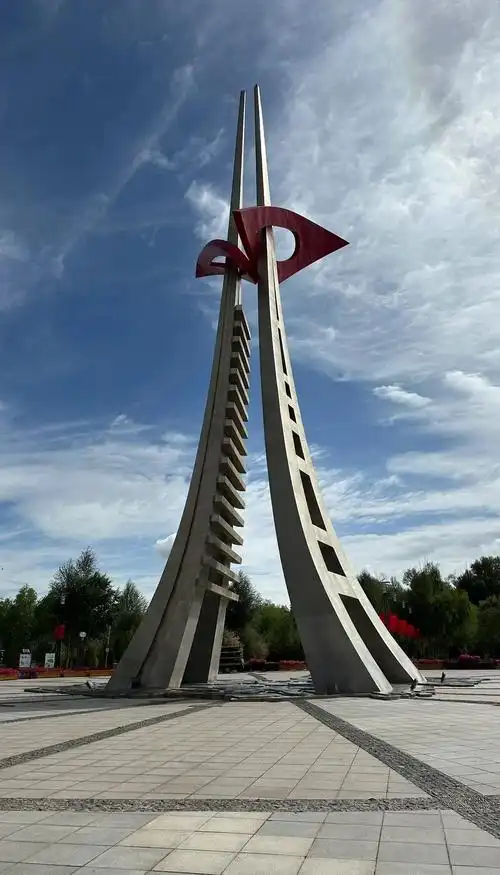 Golmud sits at roughly 2,800 meters above sea level, perched where the ancient Silk Road's southern corridor pushed toward Tibet and where the Kunlun Mountains—the mythological axis of Chinese cosmology—meet the Qaidam Basin. Long a caravanserai crossroads for Tibetan nomads, Mongol traders, and Han settlers, the city today still pulses with that multicultural energy. The Cultural Square embodies this legacy without fanfare: rather than a monument, it functions as an open-air living room where three traditions share the same pavement. For European travelers familiar with the public squares of Siena or Krakow, think less of grand architectural statements and more of a humble, lived-in piazza where the community itself is the attraction.
The layout is deliberately plain—no walls, no ticket booths, no ornamental facades. A modest fitness trail loops through the space, shaded rest corridors line the edges, and the surrounding ring of restaurants keeps the air fragrant with cumin-spiced lamb, butter tea, and Qinghai noodles. This "designless authenticity," as locals might put it, is precisely the point: the square's charm lies in everyday use rather than curated spectacle. Nearby, a roll-up market of Tibetan handicrafts, prayer beads, dried yak meat, and barley-based treats gives visitors a chance to shop and snack much as travelers along old caravan stops once did.
Evenings bring the square's true rhythm. As the fierce plateau sun softens, residents arrive to stroll, perform slow-motion qigong, and link arms in the circular guozhuang dance—steps so simple that even passing tourists are often welcomed in. From time to time, Mongolian long-song singers or Tibetan performers in brocade robes appear, turning the plaza into an open-air stage. Visitors are encouraged to join respectfully: always ask before photographing individuals, and remember that religious and cultural sensitivities run deeper here than in lowland China.
Practical timing matters. The best window runs from May through September, when evenings are mild enough to linger outdoors; outside these months, biting winds and freezing nights make standing around uncomfortable. Because the sun is intense at this altitude, sunscreen, sunglasses, and a windproof layer are essential even in summer. The square pairs well with two nearby attractions: General's Tower Park (Jiangjun Lou), a relic of the 1950s Qinghai-Tibet Highway construction era, and the Kunlun Sacred Realm Night City, a modern entertainment district themed around the region's mountain mythology.
Getting there is straightforward. A taxi from Golmud Railway Station or the long-distance bus terminal takes about 10 to 15 minutes and costs only a few yuan, while city buses 1, 3, 6, and 9 all stop within walking distance of the plaza. Before heading out, check the official "格尔木文旅" (Golmud Culture and Tourism) social-media channels—translatable via any phone app—for listings of that evening's performances or pop-up markets. Come with no grand expectations and an appetite for the unhurried: Golmud Cultural Square rewards travelers who treat it not as a destination but as a doorway into the everyday heartbeat of the high plateau.
Golmud sits at roughly 2,800 meters above sea level, perched where the ancient Silk Road's southern corridor pushed toward Tibet and where the Kunlun Mountains—the mythological axis of Chinese cosmology—meet the Qaidam Basin. Long a caravanserai crossroads for Tibetan nomads, Mongol traders, and Han settlers, the city today still pulses with that multicultural energy. The Cultural Square embodies this legacy without fanfare: rather than a monument, it functions as an open-air living room where three traditions share the same pavement. For European travelers familiar with the public squares of Siena or Krakow, think less of grand architectural statements and more of a humble, lived-in piazza where the community itself is the attraction.
The layout is deliberately plain—no walls, no ticket booths, no ornamental facades. A modest fitness trail loops through the space, shaded rest corridors line the edges, and the surrounding ring of restaurants keeps the air fragrant with cumin-spiced lamb, butter tea, and Qinghai noodles. This "designless authenticity," as locals might put it, is precisely the point: the square's charm lies in everyday use rather than curated spectacle. Nearby, a roll-up market of Tibetan handicrafts, prayer beads, dried yak meat, and barley-based treats gives visitors a chance to shop and snack much as travelers along old caravan stops once did.
Evenings bring the square's true rhythm. As the fierce plateau sun softens, residents arrive to stroll, perform slow-motion qigong, and link arms in the circular guozhuang dance—steps so simple that even passing tourists are often welcomed in. From time to time, Mongolian long-song singers or Tibetan performers in brocade robes appear, turning the plaza into an open-air stage. Visitors are encouraged to join respectfully: always ask before photographing individuals, and remember that religious and cultural sensitivities run deeper here than in lowland China.
Practical timing matters. The best window runs from May through September, when evenings are mild enough to linger outdoors; outside these months, biting winds and freezing nights make standing around uncomfortable. Because the sun is intense at this altitude, sunscreen, sunglasses, and a windproof layer are essential even in summer. The square pairs well with two nearby attractions: General's Tower Park (Jiangjun Lou), a relic of the 1950s Qinghai-Tibet Highway construction era, and the Kunlun Sacred Realm Night City, a modern entertainment district themed around the region's mountain mythology.
Getting there is straightforward. A taxi from Golmud Railway Station or the long-distance bus terminal takes about 10 to 15 minutes and costs only a few yuan, while city buses 1, 3, 6, and 9 all stop within walking distance of the plaza. Before heading out, check the official "格尔木文旅" (Golmud Culture and Tourism) social-media channels—translatable via any phone app—for listings of that evening's performances or pop-up markets. Come with no grand expectations and an appetite for the unhurried: Golmud Cultural Square rewards travelers who treat it not as a destination but as a doorway into the everyday heartbeat of the high plateau.