Tanggula Pass
⭐ 4.00
Tanggula Pass, Golmud, Qinghai Province, China
 Tanggula Pass sits at the heart of the Qinghai-Tibet Plateau, the world's highest and largest plateau, often called the "Roof of the World." At 5,231 meters, it dwarfs Europe's loftiest road passes—the Italian Stelvio and the French Col de l'Iseran barely top 2,700 meters. The route traverses the ancient Tang-Tibet Road, a trade corridor linking imperial China with Tibet for over a millennium. Since 1954, when the Qinghai-Tibet Highway opened, this saddle has served as the vital link to Lhasa, earning the poetic name "Crown of the Heavenly Road." Today, National Route 109 still funnels travelers across this legendary gateway, a modern Silk Road artery into the Tibetan highlands.
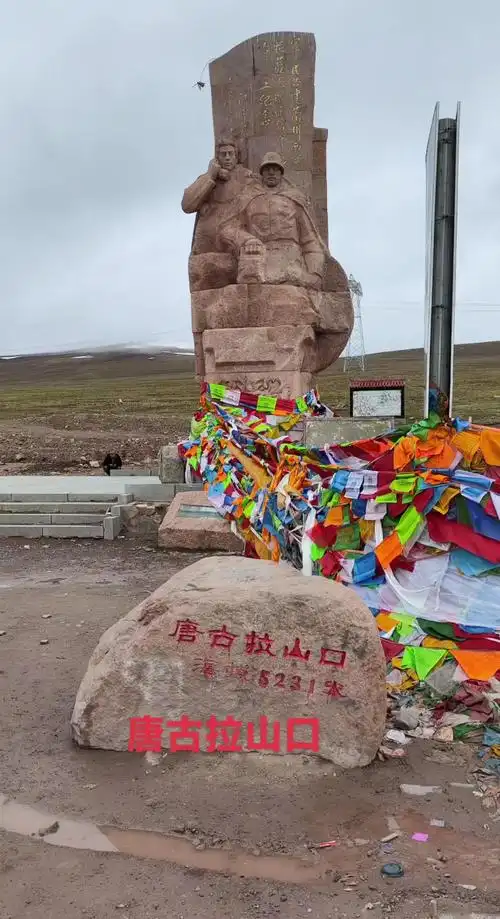
The pass offers no grand monuments, but rather a stark triptych of natural and cultural elements. Fluttering prayer flags, inscribed with sacred Buddhist mantras, whip in the perpetual wind as offerings for safe passage and family wellbeing. Beside the road stands a modest stone marker engraved "5,231 meters," where virtually every traveler pauses for a photograph. Beyond, the snow-laden peaks of the Tanggula Range gleam year-round, forming a solemn backdrop against the cobalt sky. Together these elements compose a tableau of austere majesty, comparable in spirit to the windswept Andean passes or the prayer-flag-strewn summits of Nepal.
For Tibetan Buddhists, Tanggula ranks among the guardian mountain deities, presiding over wind, snow, and the northern directions. The prayer flags are far more than decoration: each colored banner represents one of the five elements—earth, water, fire, wind, and sky—and carries blessings on the wind. Standing astride the boundary, travelers experience the symbolic sensation of "one foot in each province," a moment echoing pilgrimage traditions from Spain's Camino de Santiago to the high-altitude circuits of Mustang in Nepal. The pass is revered as a spiritual threshold where human vulnerability meets the sublime, granting visitors an awe that transcends sightseeing.
Located in Amdo County, Nagqu Prefecture, on National Highway 109, the pass is not a developed scenic area: no entrance fee, viewing platform, toilet, or shelter. The best window is July and August, though afternoon winds can whip up sand and hail. Aim to arrive between 9 and 11 a.m. and plan a 30 to 45-minute stop. Oxygen here is roughly 45 percent of sea level, so avoid running or strenuous posing. Mobile signal is weak; bring windproof layers, altitude medication, water, and high-calorie snacks. Never overnight here, and if blood oxygen drops below 80 percent or headache persists, retreat immediately to the lower town of Tuotuohe at about 4,500 meters.
Tanggula Pass is best understood not as a destination but as a transformative waypoint on the Qinghai-Tibet Highway adventure. Far more compelling than its scenery is the psychological resonance of standing where few travelers on Earth have stood—at an altitude higher than any point in the Alps, Andes, or Rockies outside Alaska. Travelers seeking polished landscapes should instead prioritize Namtso Lake, Siling Lake, or Mount Sapu. But for those willing to embrace discomfort and humility, Tanggula delivers something rare: a visceral encounter with the Tibetan Plateau's grandeur and a personal benchmark of endurance. Arrive with realistic expectations, prepare for the altitude, and you may leave with one of the most memorable half-hours of your journey through high Asia.
Tanggula Pass sits at the heart of the Qinghai-Tibet Plateau, the world's highest and largest plateau, often called the "Roof of the World." At 5,231 meters, it dwarfs Europe's loftiest road passes—the Italian Stelvio and the French Col de l'Iseran barely top 2,700 meters. The route traverses the ancient Tang-Tibet Road, a trade corridor linking imperial China with Tibet for over a millennium. Since 1954, when the Qinghai-Tibet Highway opened, this saddle has served as the vital link to Lhasa, earning the poetic name "Crown of the Heavenly Road." Today, National Route 109 still funnels travelers across this legendary gateway, a modern Silk Road artery into the Tibetan highlands.
The pass offers no grand monuments, but rather a stark triptych of natural and cultural elements. Fluttering prayer flags, inscribed with sacred Buddhist mantras, whip in the perpetual wind as offerings for safe passage and family wellbeing. Beside the road stands a modest stone marker engraved "5,231 meters," where virtually every traveler pauses for a photograph. Beyond, the snow-laden peaks of the Tanggula Range gleam year-round, forming a solemn backdrop against the cobalt sky. Together these elements compose a tableau of austere majesty, comparable in spirit to the windswept Andean passes or the prayer-flag-strewn summits of Nepal.
For Tibetan Buddhists, Tanggula ranks among the guardian mountain deities, presiding over wind, snow, and the northern directions. The prayer flags are far more than decoration: each colored banner represents one of the five elements—earth, water, fire, wind, and sky—and carries blessings on the wind. Standing astride the boundary, travelers experience the symbolic sensation of "one foot in each province," a moment echoing pilgrimage traditions from Spain's Camino de Santiago to the high-altitude circuits of Mustang in Nepal. The pass is revered as a spiritual threshold where human vulnerability meets the sublime, granting visitors an awe that transcends sightseeing.
Located in Amdo County, Nagqu Prefecture, on National Highway 109, the pass is not a developed scenic area: no entrance fee, viewing platform, toilet, or shelter. The best window is July and August, though afternoon winds can whip up sand and hail. Aim to arrive between 9 and 11 a.m. and plan a 30 to 45-minute stop. Oxygen here is roughly 45 percent of sea level, so avoid running or strenuous posing. Mobile signal is weak; bring windproof layers, altitude medication, water, and high-calorie snacks. Never overnight here, and if blood oxygen drops below 80 percent or headache persists, retreat immediately to the lower town of Tuotuohe at about 4,500 meters.
Tanggula Pass is best understood not as a destination but as a transformative waypoint on the Qinghai-Tibet Highway adventure. Far more compelling than its scenery is the psychological resonance of standing where few travelers on Earth have stood—at an altitude higher than any point in the Alps, Andes, or Rockies outside Alaska. Travelers seeking polished landscapes should instead prioritize Namtso Lake, Siling Lake, or Mount Sapu. But for those willing to embrace discomfort and humility, Tanggula delivers something rare: a visceral encounter with the Tibetan Plateau's grandeur and a personal benchmark of endurance. Arrive with realistic expectations, prepare for the altitude, and you may leave with one of the most memorable half-hours of your journey through high Asia.