Golmud River
⭐ 3.20
Golmud River Scenic Area, Golmud City, Haixi Prefecture, Qinghai Province, China
 The Golmud River gave its name to the city it sustains—"Golmud" meaning "a place of many rivers" in Mongolian—much as the Rhône gave rise to Lyon or the Tigris to Baghdad. For millennia it has watered the pastures of Tibetan herders and the caravan stops along the high-altitude branches of the southern Silk Road. In the 1950s, the river's corridor was chosen for the Qinghai-Tibet Highway, an engineering feat on par with the Karakoram Highway through the Pakistani Karakoram, opening the plateau to modern settlement and cementing Golmud's status as the gateway to Lhasa.
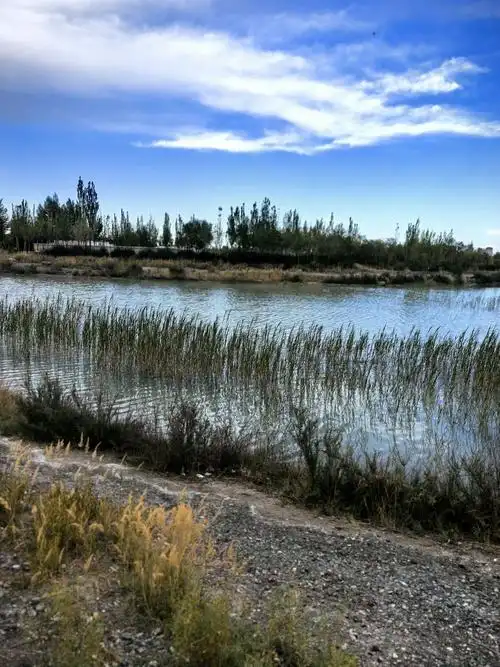
Upstream, the river slices a knife-edge gorge through the Kunlun foothills that recalls the defiles of the Swiss Alps, but at roughly twice their elevation. In its middle reaches it transforms into a broad, braided floodplain—a thread of green threading through a Gobi-style desert, much like the oases that once sustained travelers between Kashgar and Dunhuang. The downstream finale is the surreal Chaerhan Salt Lake, China's answer to Bolivia's Salar de Uyuni, crossed by the famed 32-kilometer "Salt Bridge," a causeway paved directly from crystallized brine.
The river flows in the shadow of the Kunlun range, revered in Chinese mythology as the home of the Queen Mother of the West, much as Mount Olympus housed the Greek gods. Along its banks sits Nachitai Spring, venerated as a sacred fountain by both Tibetan Buddhists and Mongolian shamanists—comparable in syncretic importance to pilgrimage sites such as Lake Manasarovar. The corridor is therefore less a tourist attraction than a living cultural landscape, where nomadic herding, salt harvesting, and Buddhist devotion continue alongside modern infrastructure.
There is no entrance fee, no visitor center, and no organized tours; travelers must self-drive or hire a private vehicle. Recommended waypoints include Kunlun Bridge, Nachitai Spring, and Chaerhan Salt Lake, with random pull-offs along the G315 for spontaneous photography. Altitude hovers around 2,800 meters (9,200 ft), so acclimatization, strong sun protection, and high-altitude medication are essential, and the nearest major hospital is several hours away. Bathing is strictly prohibited, as much of the riverbank is protected watershed or flood-control zone.
For travelers drawn to the road less traveled, the Golmud River offers a quintessential Qinghai-Tibet experience: the chance to drive from 6,000-meter snow peaks through a desert oasis to a blinding salt sea in a single day. It pairs naturally with broader itineraries linking Qinghai's ethnic Tibetan regions, the Qilian Mountains, or the eastern Silk Road sites of Dunhuang. Visit between June and September for lush riverbanks and migrating birds, or in autumn for cooler air, golden tundra, and solitude.
The Golmud River gave its name to the city it sustains—"Golmud" meaning "a place of many rivers" in Mongolian—much as the Rhône gave rise to Lyon or the Tigris to Baghdad. For millennia it has watered the pastures of Tibetan herders and the caravan stops along the high-altitude branches of the southern Silk Road. In the 1950s, the river's corridor was chosen for the Qinghai-Tibet Highway, an engineering feat on par with the Karakoram Highway through the Pakistani Karakoram, opening the plateau to modern settlement and cementing Golmud's status as the gateway to Lhasa.
Upstream, the river slices a knife-edge gorge through the Kunlun foothills that recalls the defiles of the Swiss Alps, but at roughly twice their elevation. In its middle reaches it transforms into a broad, braided floodplain—a thread of green threading through a Gobi-style desert, much like the oases that once sustained travelers between Kashgar and Dunhuang. The downstream finale is the surreal Chaerhan Salt Lake, China's answer to Bolivia's Salar de Uyuni, crossed by the famed 32-kilometer "Salt Bridge," a causeway paved directly from crystallized brine.
The river flows in the shadow of the Kunlun range, revered in Chinese mythology as the home of the Queen Mother of the West, much as Mount Olympus housed the Greek gods. Along its banks sits Nachitai Spring, venerated as a sacred fountain by both Tibetan Buddhists and Mongolian shamanists—comparable in syncretic importance to pilgrimage sites such as Lake Manasarovar. The corridor is therefore less a tourist attraction than a living cultural landscape, where nomadic herding, salt harvesting, and Buddhist devotion continue alongside modern infrastructure.
There is no entrance fee, no visitor center, and no organized tours; travelers must self-drive or hire a private vehicle. Recommended waypoints include Kunlun Bridge, Nachitai Spring, and Chaerhan Salt Lake, with random pull-offs along the G315 for spontaneous photography. Altitude hovers around 2,800 meters (9,200 ft), so acclimatization, strong sun protection, and high-altitude medication are essential, and the nearest major hospital is several hours away. Bathing is strictly prohibited, as much of the riverbank is protected watershed or flood-control zone.
For travelers drawn to the road less traveled, the Golmud River offers a quintessential Qinghai-Tibet experience: the chance to drive from 6,000-meter snow peaks through a desert oasis to a blinding salt sea in a single day. It pairs naturally with broader itineraries linking Qinghai's ethnic Tibetan regions, the Qilian Mountains, or the eastern Silk Road sites of Dunhuang. Visit between June and September for lush riverbanks and migrating birds, or in autumn for cooler air, golden tundra, and solitude.