Kunlun Pass
⭐ 3.20
Kunlun Pass, Golmud City, Haixi Mongol and Tibetan Autonomous Prefecture, Qinghai Province, China
 The Kunlun Range, often called the "Ancestor of Ten Thousand Mountains," occupies a place in Chinese cosmology rivaling Olympus in the Greek imagination or the Hindu Kush in Vedic tradition. For over two millennia, this formidable barrier separated the agrarian heartland of the Yellow River from the high plateaus of Tibet. Travelers in antiquity crossed these passes along the ancient Tsaidam corridors, much as merchants navigated the St. Gotthard or Brenner Passes through the Alps. The Taoist tradition reveres Kunlun as the primordial "dragon-vein" of the earth, a cosmic axis linking heaven and the mortal realm — a belief that still echoes in nearby sanctuaries like the Wuji Dragon and Phoenix Temple and the sacred springs of Nachitai.
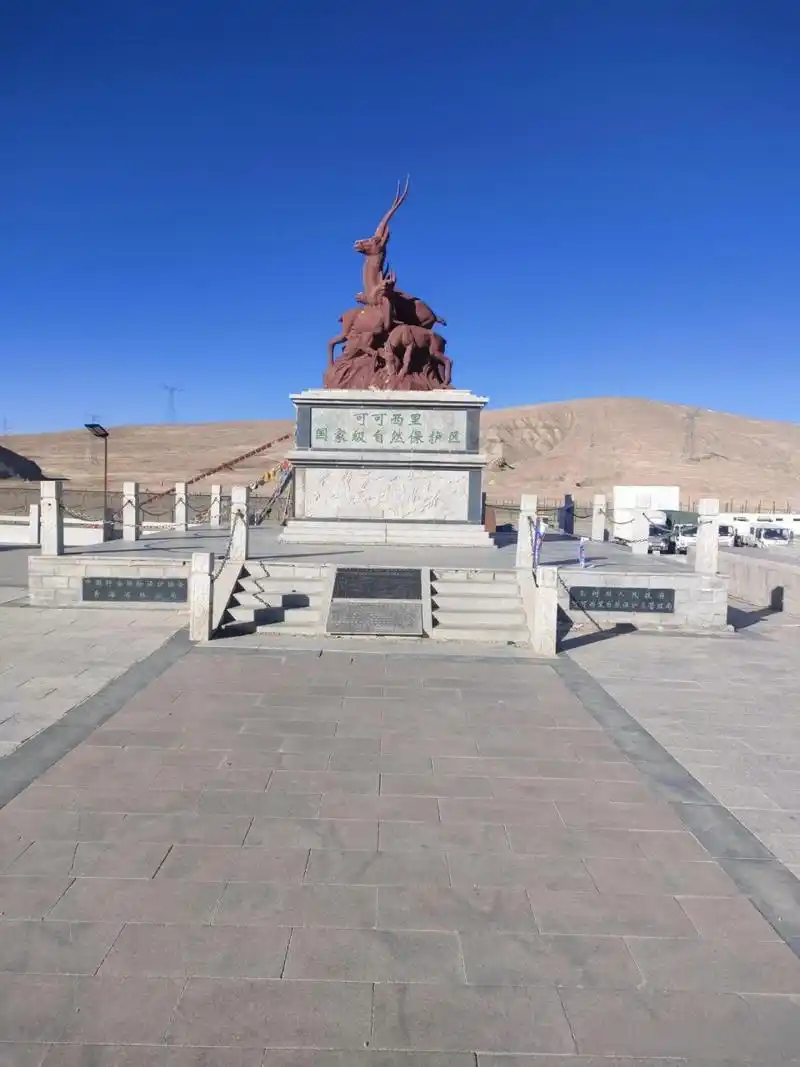
A lone, unadorned granite stele rises 4.767 meters at the summit, its height an elegant numerical echo of the altitude itself. There is nothing else like it on the highway: no ticket booths, no viewing platforms, no interpretive signs — just stone, sky, and the roaring silence of the high desert. Behind it, the twin peaks of Yuxu (6,038 m) and Yuzhu (6,178 m) thrust skyward, their snowfields glowing against a cobalt sky in a tableau that rivals the glaciated amphitheaters of Patagonia or the Karakoram. The surrounding terrain features remarkable cryogenic landforms — ice hummocks and frost-heaved polygons sculpted by the eternal battle between permafrost and thin summer thaw.
The pass lies roughly 160 kilometers south of Golmud, reached via the G109 National Highway, the same modern asphalt artery that has carried trucks, pilgrims, and adventure travelers since 1954. Travelers commonly pause here for twenty to thirty minutes — long enough to record a photograph at the marker, to scan the horizon for herds of Tibetan antelope or wild ass, and to absorb the rarefied hush of air that contains only about 57% of the oxygen found at sea level.
Practical planning is essential. The site is free and accessible year-round, though winter storms and summer roadwork can cause sudden closures. There are no facilities — no restrooms, no shelter, no vendors — so travelers should bring their own water, snacks, and warm clothing. UV radiation is ferocious even under cloud cover, and temperatures can plummet twenty degrees between noon and dusk. Visitors are asked to remain on designated gravel pull-offs; the fragile alpine ecosystem recovers almost imperceptibly from even a single footprint.
Those with a seasoned constitution, already acclimatized to altitude, will find Kunlun Pass an unforgettable threshold — the precise point where the modern road, ancient mythology, and primeval geology converge. First-time travelers to the Tibetan Plateau, however, are wisely advised to acclimatize for two or three days in Golmud (2,800 m) or to combine this stop with the lower-elevation spring at Nachitai before attempting the ascent.
[BRIEF]
Kunlun Pass, soaring at 4,767 meters on the legendary Kunlun Mountains, marks the dramatic gateway where the Qinghai-Tibet Highway crests from the lowlands into the roof of the world. Travelers crossing this storied saddle are rewarded with sweeping views of twin snow-clad sentinels — Mount Yuxu and Mount Yuzhu — whose glacial flanks rival the alpine grandeur of Mont Blanc. A modest 4.767-meter marker stone stands as the ritual photo stop for those chasing the romance of the high plateau, with chances of spotting the fleet-footed Tibetan antelope grazing the tundra below.
[DETAILED]
The Kunlun Range, often called the "Ancestor of Ten Thousand Mountains," occupies a place in Chinese cosmology rivaling Olympus in the Greek imagination or the Hindu Kush in Vedic tradition. For over two millennia, this formidable barrier separated the agrarian heartland of the Yellow River from the high plateaus of Tibet. Travelers in antiquity crossed these passes along the ancient Tsaidam corridors, much as merchants navigated the St. Gotthard or Brenner Passes through the Alps. The Taoist tradition reveres Kunlun as the primordial "dragon-vein" of the earth, a cosmic axis linking heaven and the mortal realm — a belief that still echoes in nearby sanctuaries like the Wuji Dragon and Phoenix Temple and the sacred springs of Nachitai.
A lone, unadorned granite stele rises 4.767 meters at the summit, its height an elegant numerical echo of the altitude itself. There is nothing else like it on the highway: no ticket booths, no viewing platforms, no interpretive signs — just stone, sky, and the roaring silence of the high desert. Behind it, the twin peaks of Yuxu (6,038 m) and Yuzhu (6,178 m) thrust skyward, their snowfields glowing against a cobalt sky in a tableau that rivals the glaciated amphitheaters of Patagonia or the Karakoram. The surrounding terrain features remarkable cryogenic landforms — ice hummocks and frost-heaved polygons sculpted by the eternal battle between permafrost and thin summer thaw.
The pass lies roughly 160 kilometers south of Golmud, reached via the G109 National Highway, the same modern asphalt artery that has carried trucks, pilgrims, and adventure travelers since 1954. Travelers commonly pause here for twenty to thirty minutes — long enough to record a photograph at the marker, to scan the horizon for herds of Tibetan antelope or wild ass, and to absorb the rarefied hush of air that contains only about 57% of the oxygen found at sea level.
Practical planning is essential. The site is free and accessible year-round, though winter storms and summer roadwork can cause sudden closures. There are no facilities — no restrooms, no shelter, no vendors — so travelers should bring their own water, snacks, and warm clothing. UV radiation is ferocious even under cloud cover, and temperatures can plummet twenty degrees between noon and dusk. Visitors are asked to remain on designated gravel pull-offs; the fragile alpine ecosystem recovers almost imperceptibly from even a single footprint.
Those with a seasoned constitution, already acclimatized to altitude, will find Kunlun Pass an unforgettable threshold — the precise point where the modern road, ancient mythology, and primeval geology converge. First-time travelers to the Tibetan Plateau, however, are wisely advised to acclimatize for two or three days in Golmud (2,800 m) or to combine this stop with the lower-elevation spring at Nachitai before attempting the ascent.
The Kunlun Range, often called the "Ancestor of Ten Thousand Mountains," occupies a place in Chinese cosmology rivaling Olympus in the Greek imagination or the Hindu Kush in Vedic tradition. For over two millennia, this formidable barrier separated the agrarian heartland of the Yellow River from the high plateaus of Tibet. Travelers in antiquity crossed these passes along the ancient Tsaidam corridors, much as merchants navigated the St. Gotthard or Brenner Passes through the Alps. The Taoist tradition reveres Kunlun as the primordial "dragon-vein" of the earth, a cosmic axis linking heaven and the mortal realm — a belief that still echoes in nearby sanctuaries like the Wuji Dragon and Phoenix Temple and the sacred springs of Nachitai.
A lone, unadorned granite stele rises 4.767 meters at the summit, its height an elegant numerical echo of the altitude itself. There is nothing else like it on the highway: no ticket booths, no viewing platforms, no interpretive signs — just stone, sky, and the roaring silence of the high desert. Behind it, the twin peaks of Yuxu (6,038 m) and Yuzhu (6,178 m) thrust skyward, their snowfields glowing against a cobalt sky in a tableau that rivals the glaciated amphitheaters of Patagonia or the Karakoram. The surrounding terrain features remarkable cryogenic landforms — ice hummocks and frost-heaved polygons sculpted by the eternal battle between permafrost and thin summer thaw.
The pass lies roughly 160 kilometers south of Golmud, reached via the G109 National Highway, the same modern asphalt artery that has carried trucks, pilgrims, and adventure travelers since 1954. Travelers commonly pause here for twenty to thirty minutes — long enough to record a photograph at the marker, to scan the horizon for herds of Tibetan antelope or wild ass, and to absorb the rarefied hush of air that contains only about 57% of the oxygen found at sea level.
Practical planning is essential. The site is free and accessible year-round, though winter storms and summer roadwork can cause sudden closures. There are no facilities — no restrooms, no shelter, no vendors — so travelers should bring their own water, snacks, and warm clothing. UV radiation is ferocious even under cloud cover, and temperatures can plummet twenty degrees between noon and dusk. Visitors are asked to remain on designated gravel pull-offs; the fragile alpine ecosystem recovers almost imperceptibly from even a single footprint.
Those with a seasoned constitution, already acclimatized to altitude, will find Kunlun Pass an unforgettable threshold — the precise point where the modern road, ancient mythology, and primeval geology converge. First-time travelers to the Tibetan Plateau, however, are wisely advised to acclimatize for two or three days in Golmud (2,800 m) or to combine this stop with the lower-elevation spring at Nachitai before attempting the ascent.
[BRIEF]
Kunlun Pass, soaring at 4,767 meters on the legendary Kunlun Mountains, marks the dramatic gateway where the Qinghai-Tibet Highway crests from the lowlands into the roof of the world. Travelers crossing this storied saddle are rewarded with sweeping views of twin snow-clad sentinels — Mount Yuxu and Mount Yuzhu — whose glacial flanks rival the alpine grandeur of Mont Blanc. A modest 4.767-meter marker stone stands as the ritual photo stop for those chasing the romance of the high plateau, with chances of spotting the fleet-footed Tibetan antelope grazing the tundra below.
[DETAILED]
The Kunlun Range, often called the "Ancestor of Ten Thousand Mountains," occupies a place in Chinese cosmology rivaling Olympus in the Greek imagination or the Hindu Kush in Vedic tradition. For over two millennia, this formidable barrier separated the agrarian heartland of the Yellow River from the high plateaus of Tibet. Travelers in antiquity crossed these passes along the ancient Tsaidam corridors, much as merchants navigated the St. Gotthard or Brenner Passes through the Alps. The Taoist tradition reveres Kunlun as the primordial "dragon-vein" of the earth, a cosmic axis linking heaven and the mortal realm — a belief that still echoes in nearby sanctuaries like the Wuji Dragon and Phoenix Temple and the sacred springs of Nachitai.
A lone, unadorned granite stele rises 4.767 meters at the summit, its height an elegant numerical echo of the altitude itself. There is nothing else like it on the highway: no ticket booths, no viewing platforms, no interpretive signs — just stone, sky, and the roaring silence of the high desert. Behind it, the twin peaks of Yuxu (6,038 m) and Yuzhu (6,178 m) thrust skyward, their snowfields glowing against a cobalt sky in a tableau that rivals the glaciated amphitheaters of Patagonia or the Karakoram. The surrounding terrain features remarkable cryogenic landforms — ice hummocks and frost-heaved polygons sculpted by the eternal battle between permafrost and thin summer thaw.
The pass lies roughly 160 kilometers south of Golmud, reached via the G109 National Highway, the same modern asphalt artery that has carried trucks, pilgrims, and adventure travelers since 1954. Travelers commonly pause here for twenty to thirty minutes — long enough to record a photograph at the marker, to scan the horizon for herds of Tibetan antelope or wild ass, and to absorb the rarefied hush of air that contains only about 57% of the oxygen found at sea level.
Practical planning is essential. The site is free and accessible year-round, though winter storms and summer roadwork can cause sudden closures. There are no facilities — no restrooms, no shelter, no vendors — so travelers should bring their own water, snacks, and warm clothing. UV radiation is ferocious even under cloud cover, and temperatures can plummet twenty degrees between noon and dusk. Visitors are asked to remain on designated gravel pull-offs; the fragile alpine ecosystem recovers almost imperceptibly from even a single footprint.
Those with a seasoned constitution, already acclimatized to altitude, will find Kunlun Pass an unforgettable threshold — the precise point where the modern road, ancient mythology, and primeval geology converge. First-time travelers to the Tibetan Plateau, however, are wisely advised to acclimatize for two or three days in Golmud (2,800 m) or to combine this stop with the lower-elevation spring at Nachitai before attempting the ascent.