Zhayeba Temple
⭐ 2.50
Zhayeba Temple, Bayi District, Nyingchi, Tibet Autonomous Region, China
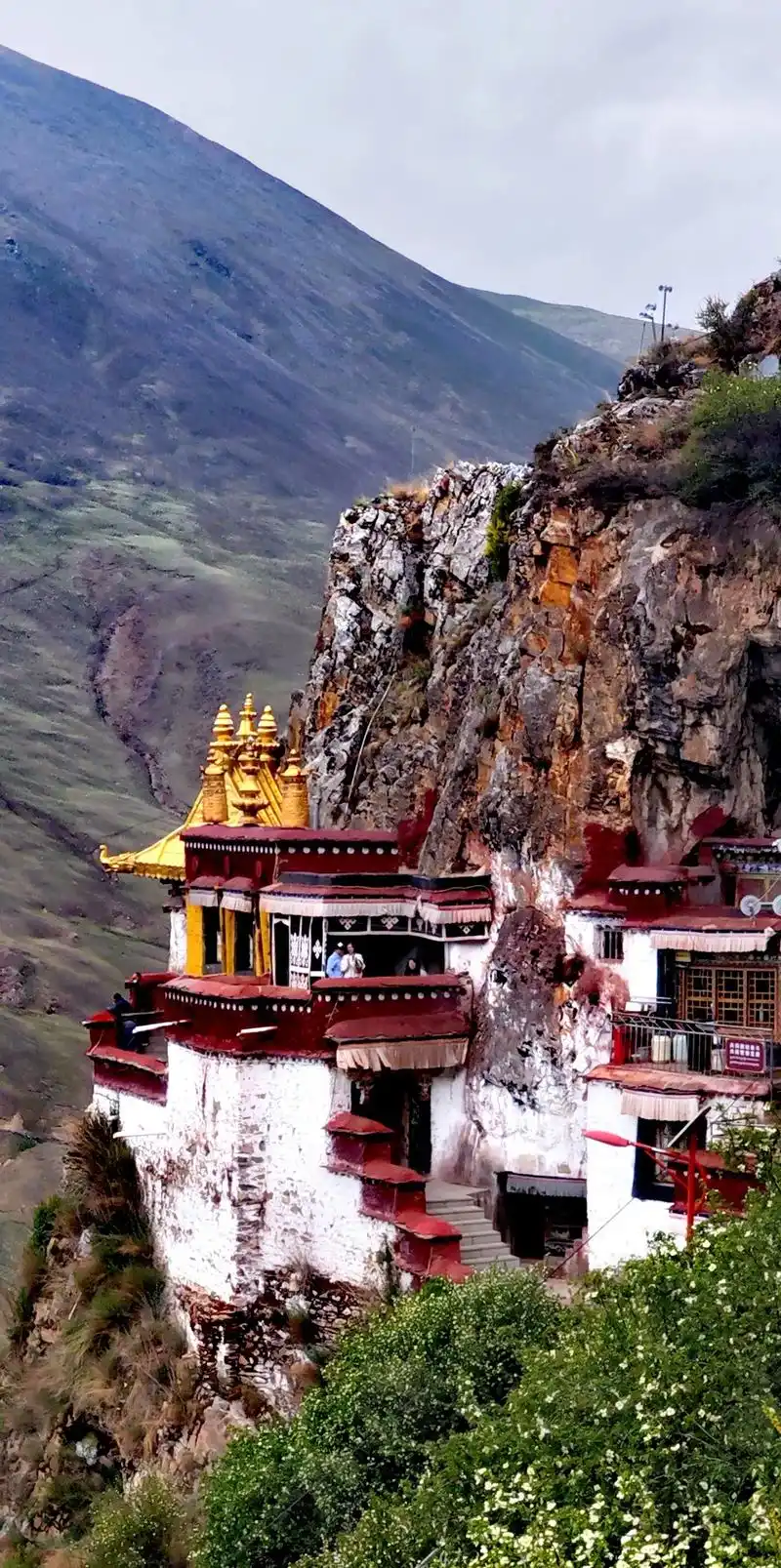 Yerpa was founded in the 7th century by Songtsen Gampo (c. 605–650 CE), the Tibetan king often credited with unifying the plateau and opening Buddhism's paths from Tang China and India. This was the same era that saw Muhammad's prophetic mission in Arabia, the consolidation of the Tang under Emperor Taizong, and the spread of Christianity through the Anglo-Saxon kingdoms of Britain. In later centuries the hermitage became associated with some of Tibetan Buddhism's most revered figures, including the 8th-century tantric master Padmasambhava and the Bengali scholar Atisha, who arrived in 1042 to revitalize Tibetan Buddhism after a period of royal persecution.
The site's most arresting feature is its seamless blending of hand-carved meditation caves and built structures—an arrangement that recalls the rock-hewn monastic complexes of Cappadocia in Turkey and the cliff-top monasteries of Meteora, though on a far more intimate scale. More than a dozen caves puncture the sheer ochre cliffs, including chambers attributed to Songtsen Gampo, Padmasambhava, and Atisha. Whitewashed walls and red-trimmed roofs cascade up the rock face, while narrow stone staircases climb to the most spiritually charged grottoes, where ancient Buddha images and weathered meditation seats remain preserved.
Yerpa is venerated as the foremost of Tibet's "four great meditation sites," a distinction earned through its continuous association with contemplative masters across more than a thousand years. Padmasambhava is said to have concealed treasure texts—terma, meant to surface in future centuries—within the cliffs, and pilgrims have circumambulated the caves since the early medieval period. During major festivals, drawn by prayer flags snapping in the wind, devotees arrive in great numbers to continue a tradition whose rhythms remain essentially unchanged since the reign of Songtsen Gampo.
Yerpa sits roughly 36–40 kilometers east of central Lhasa in Dagzê District, about an hour's drive through the scenic Kyichu River valley. A shuttle covers the steep lower stretch for around 30 yuan; admission is roughly 40 yuan; opening hours are typically 9:00 to 17:30. There are no food vendors on site, so bring water, snacks, and portable oxygen. The altitude and steep stairs demand caution: acclimatize in Lhasa for at least two days first, and dress in layers for sudden wind and cold, even in summer.
The hermitage offers a far quieter, more contemplative experience than Lhasa's grander monasteries. Visitors should dress modestly—shoulders and knees covered—remove hats upon entering chapels, and never photograph interior statues or altars. Always walk clockwise around caves, shrines, and the main hall. Mornings are calmest and best for photography, before afternoon gusts and haze roll up the valley. Few Tibetan sites combine such dramatic natural scenery with such deep historical resonance—a place where, for thirteen centuries, seekers have climbed the same windswept stairs toward silence.
Yerpa was founded in the 7th century by Songtsen Gampo (c. 605–650 CE), the Tibetan king often credited with unifying the plateau and opening Buddhism's paths from Tang China and India. This was the same era that saw Muhammad's prophetic mission in Arabia, the consolidation of the Tang under Emperor Taizong, and the spread of Christianity through the Anglo-Saxon kingdoms of Britain. In later centuries the hermitage became associated with some of Tibetan Buddhism's most revered figures, including the 8th-century tantric master Padmasambhava and the Bengali scholar Atisha, who arrived in 1042 to revitalize Tibetan Buddhism after a period of royal persecution.
The site's most arresting feature is its seamless blending of hand-carved meditation caves and built structures—an arrangement that recalls the rock-hewn monastic complexes of Cappadocia in Turkey and the cliff-top monasteries of Meteora, though on a far more intimate scale. More than a dozen caves puncture the sheer ochre cliffs, including chambers attributed to Songtsen Gampo, Padmasambhava, and Atisha. Whitewashed walls and red-trimmed roofs cascade up the rock face, while narrow stone staircases climb to the most spiritually charged grottoes, where ancient Buddha images and weathered meditation seats remain preserved.
Yerpa is venerated as the foremost of Tibet's "four great meditation sites," a distinction earned through its continuous association with contemplative masters across more than a thousand years. Padmasambhava is said to have concealed treasure texts—terma, meant to surface in future centuries—within the cliffs, and pilgrims have circumambulated the caves since the early medieval period. During major festivals, drawn by prayer flags snapping in the wind, devotees arrive in great numbers to continue a tradition whose rhythms remain essentially unchanged since the reign of Songtsen Gampo.
Yerpa sits roughly 36–40 kilometers east of central Lhasa in Dagzê District, about an hour's drive through the scenic Kyichu River valley. A shuttle covers the steep lower stretch for around 30 yuan; admission is roughly 40 yuan; opening hours are typically 9:00 to 17:30. There are no food vendors on site, so bring water, snacks, and portable oxygen. The altitude and steep stairs demand caution: acclimatize in Lhasa for at least two days first, and dress in layers for sudden wind and cold, even in summer.
The hermitage offers a far quieter, more contemplative experience than Lhasa's grander monasteries. Visitors should dress modestly—shoulders and knees covered—remove hats upon entering chapels, and never photograph interior statues or altars. Always walk clockwise around caves, shrines, and the main hall. Mornings are calmest and best for photography, before afternoon gusts and haze roll up the valley. Few Tibetan sites combine such dramatic natural scenery with such deep historical resonance—a place where, for thirteen centuries, seekers have climbed the same windswept stairs toward silence.