Midui Glacier
⭐ 3.80
Midui Glacier Scenic Area, Midui Village, Yupu Township, Bomi County, Nyingchi City, Tibet Autonomous Region, China
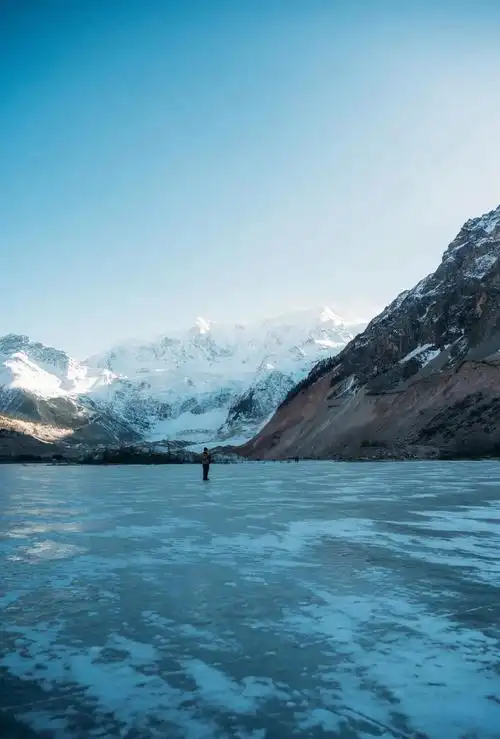 Midui Glacier forms part of the eastern Nyainqêntanglha Range, a sub-system of the greater Himalayan orogeny that began uplifting some fifty million years ago when the Indian subcontinent collided with Eurasia. Unlike the continental ice sheets of Greenland or Antarctica, Midui is a maritime glacier—fed by monsoon moisture from the Indian Ocean, much like Norway's Jostedalsbreen or New Zealand's Franz Josef. Its extraordinary 2,400-meter terminus elevation places it well below the snowline of the European Alps, making it accessible where most Himalayan glaciers have retreated into thin, high cirques.
Two immense ice cascades spill down the glacier's flanks like frozen rivers, terminating in a turquoise moraine lake. On clear days, the lake mirrors the cobalt ice and snow-capped ridgeline with mirror-like fidelity; sharp-eyed visitors may even spot a natural "panda face" ice sculpture embedded in the icefall—an oddity that delights photographers. The vertical ecological zonation is dramatic: primeval mixed conifer-broadleaf forest climbs the lower slopes, transitioning through fir and rhododendron into bare ice—a compressed version of what trekkers experience over weeks in Nepal's Annapurna region.
At the glacier's foot sits Midui Village, where traditional Tibetan timber-and-stone farmhouses huddle beneath barley-drying racks, their chimneys sending up curls of juniper-scented smoke. The juxtaposition of glacial wilderness and pastoral Tibetan life echoes the Alpine villages of the Valais or Engadin, where farming communities have long coexisted with colossal ice. Mani stone cairns line the trail, hinting at centuries of Buddhist reverence for the mountains as sacred abodes of protective deities—a worldview shared with Himalayan peoples from Ladakh to Bhutan.
The glacier lies in Yupu Township, Bomi County, about eight kilometers off National Highway 318, the legendary Sichuan-Tibet overland route. From the ticket gate, visitors transfer to a sightseeing shuttle (¥36) to reach the trailhead. The 2–3 kilometer path crosses three terminal moraine ridges over 1.5–2 hours each way, with gentle gradient suitable for families; horses are available for the round trip (¥100). Sturdy non-slip footwear is essential, and warm layers are recommended even in summer.
Late August brings verdant vegetation but occasional rain and slippery paths; the optimal window runs from late October through March, when dry-season skies deliver the most luminous blue-ice vistas. Travelers should pair Midui with neighboring Ranwu Lake and the wilder Laigu Glacier to complete the eastern Sichuan-Tibet glacier circuit. For those tracing the overland route from Chengdu to Lhasa—comparable in ambition to the Karakoram Highway or the historic Silk Road corridors—Midui offers the rare privilege of walking among living ice without technical mountaineering, a vivid encounter with Tibet's lesser-seen eastern frontier.
Midui Glacier forms part of the eastern Nyainqêntanglha Range, a sub-system of the greater Himalayan orogeny that began uplifting some fifty million years ago when the Indian subcontinent collided with Eurasia. Unlike the continental ice sheets of Greenland or Antarctica, Midui is a maritime glacier—fed by monsoon moisture from the Indian Ocean, much like Norway's Jostedalsbreen or New Zealand's Franz Josef. Its extraordinary 2,400-meter terminus elevation places it well below the snowline of the European Alps, making it accessible where most Himalayan glaciers have retreated into thin, high cirques.
Two immense ice cascades spill down the glacier's flanks like frozen rivers, terminating in a turquoise moraine lake. On clear days, the lake mirrors the cobalt ice and snow-capped ridgeline with mirror-like fidelity; sharp-eyed visitors may even spot a natural "panda face" ice sculpture embedded in the icefall—an oddity that delights photographers. The vertical ecological zonation is dramatic: primeval mixed conifer-broadleaf forest climbs the lower slopes, transitioning through fir and rhododendron into bare ice—a compressed version of what trekkers experience over weeks in Nepal's Annapurna region.
At the glacier's foot sits Midui Village, where traditional Tibetan timber-and-stone farmhouses huddle beneath barley-drying racks, their chimneys sending up curls of juniper-scented smoke. The juxtaposition of glacial wilderness and pastoral Tibetan life echoes the Alpine villages of the Valais or Engadin, where farming communities have long coexisted with colossal ice. Mani stone cairns line the trail, hinting at centuries of Buddhist reverence for the mountains as sacred abodes of protective deities—a worldview shared with Himalayan peoples from Ladakh to Bhutan.
The glacier lies in Yupu Township, Bomi County, about eight kilometers off National Highway 318, the legendary Sichuan-Tibet overland route. From the ticket gate, visitors transfer to a sightseeing shuttle (¥36) to reach the trailhead. The 2–3 kilometer path crosses three terminal moraine ridges over 1.5–2 hours each way, with gentle gradient suitable for families; horses are available for the round trip (¥100). Sturdy non-slip footwear is essential, and warm layers are recommended even in summer.
Late August brings verdant vegetation but occasional rain and slippery paths; the optimal window runs from late October through March, when dry-season skies deliver the most luminous blue-ice vistas. Travelers should pair Midui with neighboring Ranwu Lake and the wilder Laigu Glacier to complete the eastern Sichuan-Tibet glacier circuit. For those tracing the overland route from Chengdu to Lhasa—comparable in ambition to the Karakoram Highway or the historic Silk Road corridors—Midui offers the rare privilege of walking among living ice without technical mountaineering, a vivid encounter with Tibet's lesser-seen eastern frontier.