Qufu Ancient City Wall
⭐ 3.80
Qufu Ancient City Wall, Qufu, Shandong Province, China
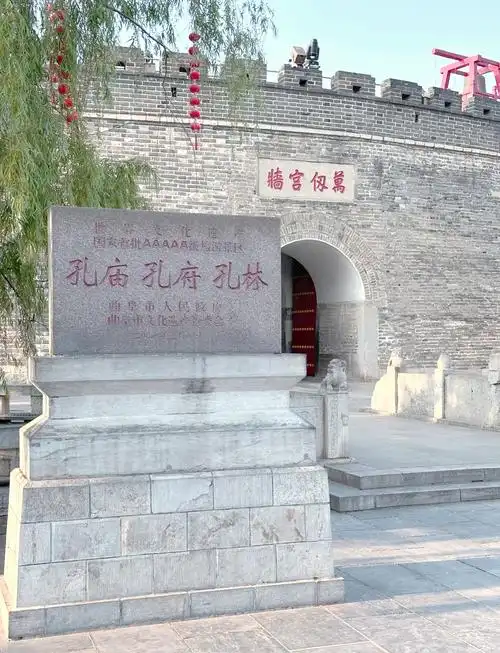 Qufu's city wall ranks among Asia's most culturally significant fortifications, erected during the Ming Dynasty to safeguard the Temple of Confucius—a complex venerated for over 2,500 years since the philosopher's death in 479 BCE. Like medieval walls protecting European pilgrimage sites such as Santiago de Compostela, this enclosure transformed a sacred precinct into a defined ceremonial space. Confucius's influence on East Asian civilization parallels Aristotle's impact on Western thought, placing Qufu in philosophical company with Athens or Jerusalem. The wall spans approximately 5.3 kilometers, with original Ming-era brickwork surviving only at the south and north gates and two corner sections following centuries of urban expansion.
The architecture embodies Ming-dynasty imperial aesthetics, featuring vermillion walls crowned with golden-yellow glazed tiles—a palette traditionally reserved for sacred structures, echoing the visual language of Beijing's Forbidden City. The south gate's "Wanren Palace Wall" inscription, brushed by Qing Emperor Qianlong in the 18th century, derives from the Analects: "Our Master's wall is several rên high," using an elaborate metaphor for the boundless depth of Confucian learning. Double-eaved gate towers with upturned flying eaves create a ceremonial axis visually connecting with the Temple beyond. A flagstone walkway runs along the rampart top, offering elevated vantage points over the temple's golden roofs and surrounding moat.
"Wanren Palace Wall" functions as Confucianism's spiritual gateway—a metaphor so powerful it survived imperial dynasties, foreign invasions, and modernization itself. The daily 8 AM opening ceremony recreates ancient rituals through the Eight-Row Yi Dance and ceremonial music, comparable in solemnity to witnessing the Changing of the Guard at the Vatican or attending Orthodox Easter services in Jerusalem. Performers in classical costume ceremonially swing open the massive vermillion gates, offering travelers a glimpse into imperial China's living traditions. The ceremony's blend of music, choreography, and architectural drama illuminates how ritual shaped one of history's longest-enduring civilizations.
Since 2002-2004 restoration efforts returned the wall to its current grandeur, an innovative evening spectacle has joined traditional ceremonies. After 7 PM, the ramparts host a 3D light projection show—imagine Renaissance-mapped imagery cast onto Carcassonne's medieval fortifications—where bamboo-slip motifs, Yi dance silhouettes, and Analects passages transform ancient brickwork into a luminous canvas. This fusion of classical philosophy with contemporary digital art appeals strongly to younger travelers and photography enthusiasts. The thirty-minute projection delivers Confucian concepts through universally accessible visual storytelling, bridging ancient wisdom with modern entertainment sensibilities.
The site occupies Qufu's historic heart, adjacent to the Temple of Confucius and Kong Family Mansion, reachable on foot. Rampart walking costs nothing, but entering through the Wanren Palace Wall gate requires the Three Confucian Sites combined ticket (140 yuan, roughly $20 USD). The morning gate-opening ceremony remains complimentary, though arriving 10-15 minutes early secures optimal viewing positions. Multilingual audio guides rent for approximately 20 yuan. Summer temperatures can be punishing, so plan visits for early morning or late afternoon—timing your day around the evening light show is genuinely rewarding.
For an ideal half-day experience, arrive at 8:00 AM to witness the opening ceremony, then stroll the eastern rampart walkway until 10:00 AM for elevated temple views. Return at 5:30 PM to capture sunset over the south gate, and remain for the 7:00-7:30 PM light show. Bring identification for entry verification, wear sturdy footwear for uneven stone paths, and avoid midday summer heat. While visiting the wall alone provides valuable context, pairing your ticket with the Three Confucian Sites unlocks the full Confucian cultural narrative—essential for understanding the philosophical heritage that shaped a quarter of humanity.
Qufu's city wall ranks among Asia's most culturally significant fortifications, erected during the Ming Dynasty to safeguard the Temple of Confucius—a complex venerated for over 2,500 years since the philosopher's death in 479 BCE. Like medieval walls protecting European pilgrimage sites such as Santiago de Compostela, this enclosure transformed a sacred precinct into a defined ceremonial space. Confucius's influence on East Asian civilization parallels Aristotle's impact on Western thought, placing Qufu in philosophical company with Athens or Jerusalem. The wall spans approximately 5.3 kilometers, with original Ming-era brickwork surviving only at the south and north gates and two corner sections following centuries of urban expansion.
The architecture embodies Ming-dynasty imperial aesthetics, featuring vermillion walls crowned with golden-yellow glazed tiles—a palette traditionally reserved for sacred structures, echoing the visual language of Beijing's Forbidden City. The south gate's "Wanren Palace Wall" inscription, brushed by Qing Emperor Qianlong in the 18th century, derives from the Analects: "Our Master's wall is several rên high," using an elaborate metaphor for the boundless depth of Confucian learning. Double-eaved gate towers with upturned flying eaves create a ceremonial axis visually connecting with the Temple beyond. A flagstone walkway runs along the rampart top, offering elevated vantage points over the temple's golden roofs and surrounding moat.
"Wanren Palace Wall" functions as Confucianism's spiritual gateway—a metaphor so powerful it survived imperial dynasties, foreign invasions, and modernization itself. The daily 8 AM opening ceremony recreates ancient rituals through the Eight-Row Yi Dance and ceremonial music, comparable in solemnity to witnessing the Changing of the Guard at the Vatican or attending Orthodox Easter services in Jerusalem. Performers in classical costume ceremonially swing open the massive vermillion gates, offering travelers a glimpse into imperial China's living traditions. The ceremony's blend of music, choreography, and architectural drama illuminates how ritual shaped one of history's longest-enduring civilizations.
Since 2002-2004 restoration efforts returned the wall to its current grandeur, an innovative evening spectacle has joined traditional ceremonies. After 7 PM, the ramparts host a 3D light projection show—imagine Renaissance-mapped imagery cast onto Carcassonne's medieval fortifications—where bamboo-slip motifs, Yi dance silhouettes, and Analects passages transform ancient brickwork into a luminous canvas. This fusion of classical philosophy with contemporary digital art appeals strongly to younger travelers and photography enthusiasts. The thirty-minute projection delivers Confucian concepts through universally accessible visual storytelling, bridging ancient wisdom with modern entertainment sensibilities.
The site occupies Qufu's historic heart, adjacent to the Temple of Confucius and Kong Family Mansion, reachable on foot. Rampart walking costs nothing, but entering through the Wanren Palace Wall gate requires the Three Confucian Sites combined ticket (140 yuan, roughly $20 USD). The morning gate-opening ceremony remains complimentary, though arriving 10-15 minutes early secures optimal viewing positions. Multilingual audio guides rent for approximately 20 yuan. Summer temperatures can be punishing, so plan visits for early morning or late afternoon—timing your day around the evening light show is genuinely rewarding.
For an ideal half-day experience, arrive at 8:00 AM to witness the opening ceremony, then stroll the eastern rampart walkway until 10:00 AM for elevated temple views. Return at 5:30 PM to capture sunset over the south gate, and remain for the 7:00-7:30 PM light show. Bring identification for entry verification, wear sturdy footwear for uneven stone paths, and avoid midday summer heat. While visiting the wall alone provides valuable context, pairing your ticket with the Three Confucian Sites unlocks the full Confucian cultural narrative—essential for understanding the philosophical heritage that shaped a quarter of humanity.