Cemetery of Confucius
⭐ 4.20
Cemetery of Confucius, Qufu City, Shandong Province, China
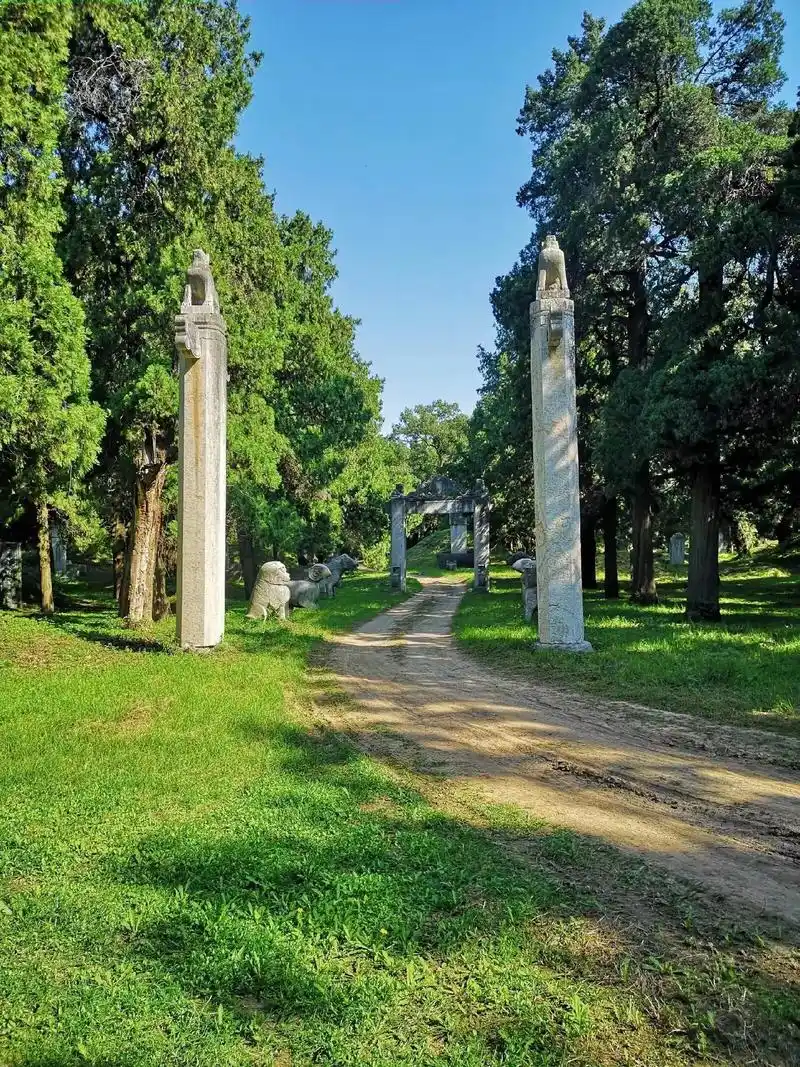 When Confucius died in 479 BCE, his followers planted a simple mound beside the Si River. That single grave has since grown into a 300-acre walled necropolis—the world's only family cemetery in uninterrupted use for 24 centuries. To put that in perspective, the site's oldest sections predate the founding of Rome, while descendants continue to be interred here today. This astonishing continuity makes Kong Lin a living archive of Chinese ancestral rites, a phenomenon with no real parallel in Western Europe, where even royal dynasties rarely retain burial sites for more than a millennium.
The cemetery doubles as a vast open-air calligraphy museum. Some 4,000 stone steles span the Han dynasty through the Republican era, featuring authentic brushwork by celebrated scholars and officials including Li Dongyang, Yan Song, and He Shaoji. Eighty-five pairs of stone statues—mythical beasts, officials, and guardian figures—line the avenues, while more than 60 Ming and Qing dynasty archways, pavilions, and ceremonial buildings punctuate the landscape. Walking its lanes feels like leafing through a three-dimensional history book, each monument a frozen chapter of political power, artistic taste, and Confucian ritual.
One of the cemetery's most photographed features is the symbolic layout near Confucius's own tomb. His grave takes the rare shape of an inverted axe, flanked by the tombs of his son Kong Li and grandson Kong Ji in a configuration known as "carrying the son and embracing the grandson." This deliberate arrangement reflects deep Confucian values of filial piety and the honoring of ancestors—a tangible expression of the moral principles Confucius himself taught, offering visitors a rare glimpse into how those ideas shaped even the architecture of death.
Nature and history merge seamlessly across the grounds. More than 100,000 ancient trees—cypresses, maples, junipers, and scholar trees—form a lush arboretum where twisted trunks and tangled branches shadow quiet footpaths. The atmosphere recalls the solemnity of Père Lachaise in Paris or Highgate in London, but on a far grander scale and steeped in continuous tradition. Songbirds fill the canopy, moss softens the stones, and the dappled light lends an almost cathedral-like hush to this remarkable meeting of ecology, art, and memory.
Practicalities are straightforward. Kong Lin sits about 1.5 kilometers north of Qufu's old town, an easy 10–15 minute walk from the rear gate of the Confucius Mansion—best visited second or third on a "Temple–Mansion–Cemetery" circuit. Gates are open 8:00 to 18:30; admission is 10 yuan individually or 150 yuan for the combined Three Sites ticket. A licensed guide or audio device is strongly recommended, as much of the meaning lies in inscriptions and symbolism easily missed without context. Visitors should speak softly, refrain from touching steles, and avoid bringing incense or candles to help preserve this irreplaceable World Heritage treasure.
[DETAILED]
Plan at least two to three hours to wander Kong Lin at a relaxed pace. Electric carts circle the main loop for those who prefer not to walk, though the quieter back paths reward the curious on foot. The visit pairs naturally with the Confucius Temple and Mansion, which together explain the philosophy behind the stones—without them, the cemetery reads as scenery; with them, it reads as scripture. For travelers tracing the roots of East Asian civilization, or anyone drawn to places where time itself seems to accumulate, Kong Lin is an essential stop—an experience as singular in China as Westminster Abbey is in England or St. Peter's necropolis is in Rome.
When Confucius died in 479 BCE, his followers planted a simple mound beside the Si River. That single grave has since grown into a 300-acre walled necropolis—the world's only family cemetery in uninterrupted use for 24 centuries. To put that in perspective, the site's oldest sections predate the founding of Rome, while descendants continue to be interred here today. This astonishing continuity makes Kong Lin a living archive of Chinese ancestral rites, a phenomenon with no real parallel in Western Europe, where even royal dynasties rarely retain burial sites for more than a millennium.
The cemetery doubles as a vast open-air calligraphy museum. Some 4,000 stone steles span the Han dynasty through the Republican era, featuring authentic brushwork by celebrated scholars and officials including Li Dongyang, Yan Song, and He Shaoji. Eighty-five pairs of stone statues—mythical beasts, officials, and guardian figures—line the avenues, while more than 60 Ming and Qing dynasty archways, pavilions, and ceremonial buildings punctuate the landscape. Walking its lanes feels like leafing through a three-dimensional history book, each monument a frozen chapter of political power, artistic taste, and Confucian ritual.
One of the cemetery's most photographed features is the symbolic layout near Confucius's own tomb. His grave takes the rare shape of an inverted axe, flanked by the tombs of his son Kong Li and grandson Kong Ji in a configuration known as "carrying the son and embracing the grandson." This deliberate arrangement reflects deep Confucian values of filial piety and the honoring of ancestors—a tangible expression of the moral principles Confucius himself taught, offering visitors a rare glimpse into how those ideas shaped even the architecture of death.
Nature and history merge seamlessly across the grounds. More than 100,000 ancient trees—cypresses, maples, junipers, and scholar trees—form a lush arboretum where twisted trunks and tangled branches shadow quiet footpaths. The atmosphere recalls the solemnity of Père Lachaise in Paris or Highgate in London, but on a far grander scale and steeped in continuous tradition. Songbirds fill the canopy, moss softens the stones, and the dappled light lends an almost cathedral-like hush to this remarkable meeting of ecology, art, and memory.
Practicalities are straightforward. Kong Lin sits about 1.5 kilometers north of Qufu's old town, an easy 10–15 minute walk from the rear gate of the Confucius Mansion—best visited second or third on a "Temple–Mansion–Cemetery" circuit. Gates are open 8:00 to 18:30; admission is 10 yuan individually or 150 yuan for the combined Three Sites ticket. A licensed guide or audio device is strongly recommended, as much of the meaning lies in inscriptions and symbolism easily missed without context. Visitors should speak softly, refrain from touching steles, and avoid bringing incense or candles to help preserve this irreplaceable World Heritage treasure.
[DETAILED]
Plan at least two to three hours to wander Kong Lin at a relaxed pace. Electric carts circle the main loop for those who prefer not to walk, though the quieter back paths reward the curious on foot. The visit pairs naturally with the Confucius Temple and Mansion, which together explain the philosophy behind the stones—without them, the cemetery reads as scenery; with them, it reads as scripture. For travelers tracing the roots of East Asian civilization, or anyone drawn to places where time itself seems to accumulate, Kong Lin is an essential stop—an experience as singular in China as Westminster Abbey is in England or St. Peter's necropolis is in Rome.