Kong Family Mansion
⭐ 4.50
Dongmenli, Qufu City, Shandong Province, China
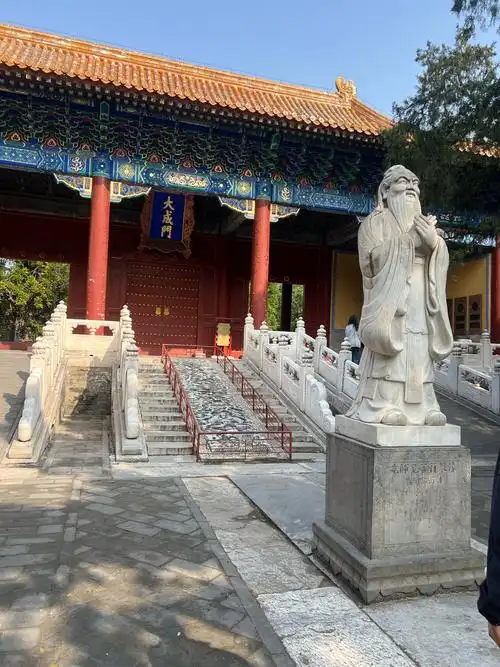 The mansion's history stretches back to the Northern Song dynasty, when successive emperors began bestowing titles and estates upon Confucius's lineal heirs. By the Ming and Qing dynasties, the family had risen to the rank of "Yanshen Gong," a hereditary dukedom unique in imperial China. Spanning almost a millennium of continuous occupation, the Kongfu predates most European aristocratic estates still standing today—comparable in dynastic endurance to the Habsburgs' Hofburg in Vienna or the Medici palaces in Florence, yet rooted in scholarly rather than secular power.
Architecturally, the complex occupies roughly 120,000 to 160,000 square metres and unfolds across nine sequential courtyards arranged in three parallel axes: an eastern wing for clan ancestral rites, a western wing devoted to study and receiving guests, and a central axis combining ceremonial offices with private living quarters. This "front office, rear residence" plan is exceptionally rare in China, where official and domestic spaces were usually kept apart. Grey brick walls, restrained rooflines, and dignified proportions convey a noble austerity quite different from the gilded splendour of Versailles—closer in spirit to a Tudor great house such than to a royal palace.
Inside, the mansion safeguards more than ten thousand artefacts, including nearly one hundred thousand volumes of the celebrated Kongfu Archives—Ming and Qing administrative documents unmatched anywhere in China. Highlights include ten bronze ritual vessels from the Shang and Zhou dynasties and a rare Yuan-era heptagonal crown. Scholars regard this archive as a treasure trove comparable to the Vatican Secret Archives or the English Pipe Rolls, illuminating nine centuries of clan governance, ritual practice, and daily life under imperial Confucian rule.
Visitors are strongly advised to rent an audio guide or hire a knowledgeable interpreter. The plaques, couplets, and meticulously arranged furnishings follow strict Confucian protocols whose meaning is invisible without expert commentary; without explanation the architecture may seem plain, but with a guide the mansion reveals itself as a living fossil of ritual hierarchy and family history.
Admission is around 60 RMB, with combination tickets covering all three Confucius sites (Temple, Mansion, and Cemetery) widely available. Allow one to two hours for a thorough visit, ideally in the morning before the courtyards heat up. The classic itinerary traces the full arc of Confucian culture: morning at the Temple, midday at the Mansion, and sunset among the ancient pines of the Cemetery—a sequence that brings a thousand years of tradition vividly to life.
The mansion's history stretches back to the Northern Song dynasty, when successive emperors began bestowing titles and estates upon Confucius's lineal heirs. By the Ming and Qing dynasties, the family had risen to the rank of "Yanshen Gong," a hereditary dukedom unique in imperial China. Spanning almost a millennium of continuous occupation, the Kongfu predates most European aristocratic estates still standing today—comparable in dynastic endurance to the Habsburgs' Hofburg in Vienna or the Medici palaces in Florence, yet rooted in scholarly rather than secular power.
Architecturally, the complex occupies roughly 120,000 to 160,000 square metres and unfolds across nine sequential courtyards arranged in three parallel axes: an eastern wing for clan ancestral rites, a western wing devoted to study and receiving guests, and a central axis combining ceremonial offices with private living quarters. This "front office, rear residence" plan is exceptionally rare in China, where official and domestic spaces were usually kept apart. Grey brick walls, restrained rooflines, and dignified proportions convey a noble austerity quite different from the gilded splendour of Versailles—closer in spirit to a Tudor great house such than to a royal palace.
Inside, the mansion safeguards more than ten thousand artefacts, including nearly one hundred thousand volumes of the celebrated Kongfu Archives—Ming and Qing administrative documents unmatched anywhere in China. Highlights include ten bronze ritual vessels from the Shang and Zhou dynasties and a rare Yuan-era heptagonal crown. Scholars regard this archive as a treasure trove comparable to the Vatican Secret Archives or the English Pipe Rolls, illuminating nine centuries of clan governance, ritual practice, and daily life under imperial Confucian rule.
Visitors are strongly advised to rent an audio guide or hire a knowledgeable interpreter. The plaques, couplets, and meticulously arranged furnishings follow strict Confucian protocols whose meaning is invisible without expert commentary; without explanation the architecture may seem plain, but with a guide the mansion reveals itself as a living fossil of ritual hierarchy and family history.
Admission is around 60 RMB, with combination tickets covering all three Confucius sites (Temple, Mansion, and Cemetery) widely available. Allow one to two hours for a thorough visit, ideally in the morning before the courtyards heat up. The classic itinerary traces the full arc of Confucian culture: morning at the Temple, midday at the Mansion, and sunset among the ancient pines of the Cemetery—a sequence that brings a thousand years of tradition vividly to life.