Temple of Confucius
⭐ 4.80
No. 1, Kongmiao Road, Dongguanwai, Qufu City, Shandong Province, China
 **Ancient Origins and Imperial Patronage**
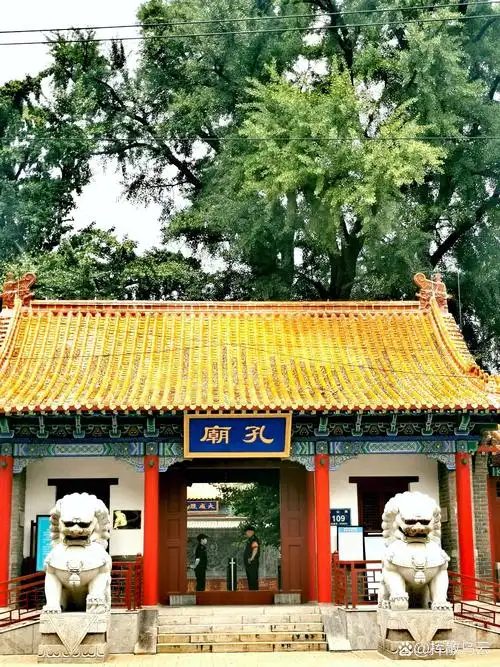
Established in 478 BC when Duke Ai of Lu transformed Confucius's former residence into a memorial hall, the temple predates the Roman Colosseum by nearly five centuries and the Hagia Sophia by more than nine hundred years. Over the following 2,500 years, emperors of the Han, Tang, Song, Yuan, Ming, and Qing dynasties expanded the modest original three-room structure through more than seventy renovations into the present-day complex. The site absorbed imperial inscriptions, calligraphy, and ceremonial refinements from each era, transforming it into the single most important physical record of China's unbroken ritual and scholarly traditions—much as Westminster Abbey chronicles English monarchy or the Vatican preserves Catholic heritage.
**Architectural Splendor and Design**
Spanning roughly 140,000 square meters with 460 halls and pavilions behind 54 ornamental gates, the temple follows a meticulously planned central axis reminiscent of classical European pilgrimage routes like the Way of St. James. Visitors progress through a sequence of progressively sacred spaces—from the Wanyen Palace Wall, through the Lingxing Gate and the Thirteen Stele Pavilions, to the climactic Dacheng Hall. This fourteen-meter-tall, double-eaved masterpiece rests upon twenty-eight stone columns carved with dragons and phoenixes rising through clouds, a feat of craftsmanship considered unique in Eastern architecture and ranked alongside Beijing's Hall of Supreme Harmony and Tai Mountain's Tiankuang Hall as one of the "Three Great Halls of the East."
**Cultural and Spiritual Significance**
Confucianism shaped East Asian governance, education, and ethics for over two millennia in much the same way Aristotelian thought shaped medieval Europe, and this temple stands as its supreme physical embodiment. The legendary Apricot Grove marks where Confucius reportedly taught his disciples, drawing students and scholars who still arrive seeking intellectual inspiration. The site's elevation from family shrine to state ritual venue mirrors how local saints' cults evolved into official canonizations in medieval Christianity. Today, the grand September 28th commemoration of Confucius's birthday is recognized as a national intangible cultural heritage, drawing dignitaries and devotees in robes echoing ceremonies first performed more than two thousand years ago.
**Planning Your Visit**
The temple sits inside Qufu's south gate in Shandong Province, part of the celebrated "Three Confucius Sites" that also include the adjacent Kong Family Mansion and the Cemetery of Confucius just outside town. Hours run from 7:30 AM to 6:00 PM in peak season and 8:00 AM to 5:00 PM in quieter months. Individual admission runs approximately 80 RMB, while a combined 140 RMB ticket covers all three sites and remains valid for two days. Hiring an official guide or renting an electronic audio device is strongly recommended—without context, the dense symbolism and historical layering can easily overwhelm even seasoned travelers. Allow two to three hours for a comfortable visit along the central axis from south to north.
**Why It Belongs on Your Itinerary**
Few locations on earth offer such a direct encounter with the foundational ideas of an entire civilization. Where the Parthenon embodies Greek democratic ideals and Canterbury Cathedral anchors Anglican tradition, the Qufu Temple crystallizes the Confucian worldview that governed more people for longer than any other philosophical system in history. The pairing of overwhelming architectural scale—comparable to encountering St. Peter's Basilica for the first time—with intimate relics like the philosopher's supposed teaching grove creates an experience that is simultaneously awe-inspiring and personally moving. For travelers seeking to understand not merely China's past but the moral architecture underlying much of East Asia today, this temple is nothing short of essential.
**Ancient Origins and Imperial Patronage**
Established in 478 BC when Duke Ai of Lu transformed Confucius's former residence into a memorial hall, the temple predates the Roman Colosseum by nearly five centuries and the Hagia Sophia by more than nine hundred years. Over the following 2,500 years, emperors of the Han, Tang, Song, Yuan, Ming, and Qing dynasties expanded the modest original three-room structure through more than seventy renovations into the present-day complex. The site absorbed imperial inscriptions, calligraphy, and ceremonial refinements from each era, transforming it into the single most important physical record of China's unbroken ritual and scholarly traditions—much as Westminster Abbey chronicles English monarchy or the Vatican preserves Catholic heritage.
**Architectural Splendor and Design**
Spanning roughly 140,000 square meters with 460 halls and pavilions behind 54 ornamental gates, the temple follows a meticulously planned central axis reminiscent of classical European pilgrimage routes like the Way of St. James. Visitors progress through a sequence of progressively sacred spaces—from the Wanyen Palace Wall, through the Lingxing Gate and the Thirteen Stele Pavilions, to the climactic Dacheng Hall. This fourteen-meter-tall, double-eaved masterpiece rests upon twenty-eight stone columns carved with dragons and phoenixes rising through clouds, a feat of craftsmanship considered unique in Eastern architecture and ranked alongside Beijing's Hall of Supreme Harmony and Tai Mountain's Tiankuang Hall as one of the "Three Great Halls of the East."
**Cultural and Spiritual Significance**
Confucianism shaped East Asian governance, education, and ethics for over two millennia in much the same way Aristotelian thought shaped medieval Europe, and this temple stands as its supreme physical embodiment. The legendary Apricot Grove marks where Confucius reportedly taught his disciples, drawing students and scholars who still arrive seeking intellectual inspiration. The site's elevation from family shrine to state ritual venue mirrors how local saints' cults evolved into official canonizations in medieval Christianity. Today, the grand September 28th commemoration of Confucius's birthday is recognized as a national intangible cultural heritage, drawing dignitaries and devotees in robes echoing ceremonies first performed more than two thousand years ago.
**Planning Your Visit**
The temple sits inside Qufu's south gate in Shandong Province, part of the celebrated "Three Confucius Sites" that also include the adjacent Kong Family Mansion and the Cemetery of Confucius just outside town. Hours run from 7:30 AM to 6:00 PM in peak season and 8:00 AM to 5:00 PM in quieter months. Individual admission runs approximately 80 RMB, while a combined 140 RMB ticket covers all three sites and remains valid for two days. Hiring an official guide or renting an electronic audio device is strongly recommended—without context, the dense symbolism and historical layering can easily overwhelm even seasoned travelers. Allow two to three hours for a comfortable visit along the central axis from south to north.
**Why It Belongs on Your Itinerary**
Few locations on earth offer such a direct encounter with the foundational ideas of an entire civilization. Where the Parthenon embodies Greek democratic ideals and Canterbury Cathedral anchors Anglican tradition, the Qufu Temple crystallizes the Confucian worldview that governed more people for longer than any other philosophical system in history. The pairing of overwhelming architectural scale—comparable to encountering St. Peter's Basilica for the first time—with intimate relics like the philosopher's supposed teaching grove creates an experience that is simultaneously awe-inspiring and personally moving. For travelers seeking to understand not merely China's past but the moral architecture underlying much of East Asia today, this temple is nothing short of essential.