Sanbao Village
⭐ 4.20
Sanbao Village, Fuliang County, Jingdezhen City, Jiangxi Province, China
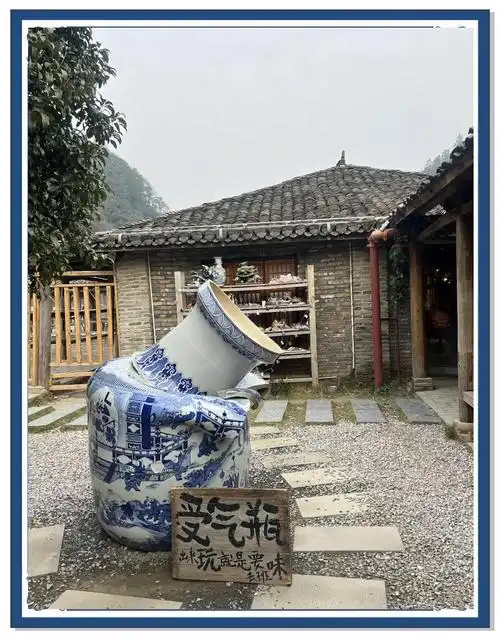 Sanbao Village, named for the "three treasures" of Song dynasty porcelain production—china clay, glaze stone, and pine firewood—has been central to Jingdezhen's ceramic heritage for nearly a millennium. Its Hutian kiln site is celebrated as the birthplace of "yingqing" shadow-blue porcelain, prized by courts from the Song to the Qing, and exported across Eurasia on Silk Road caravans. While Italian Renaissance potters were experimenting with maiolica in Faenza, artisans in this same valley were perfecting translucent glazes that would later influence ceramics from Delft to Meissen. The kilns here never stopped burning—making this the world's longest continuously operating ceramic production center.
The village reads as a sprawling architectural experiment in dialogue with landscape and craft. Along the stream, rammed-earth walls of old cottages are studded with fragments of broken porcelain spanning dynasties—creating distinctive "porcelain shard walls" with a graphic intensity reminiscent of Portuguese azulejo tilework or Byzantine mosaics. The award-winning Sanbao Peng Art Center rises in raw board-marked concrete, while teahouses such as Bukongshan incorporate Zen-inspired dry-landscape gardens echoing Kyoto's Ryōan-ji. Traditional village houses alternate with sleek modern galleries, creating an unusual but harmonious conversation between centuries of craft and contemporary design.
Far from a museum piece, Sanbao is a working creative community housing over 3,000 "Jing drifters"—artists drawn from across China and abroad to live, create, and collaborate. More than 200 studios, galleries, and design workshops line the valley,
Sanbao Village, named for the "three treasures" of Song dynasty porcelain production—china clay, glaze stone, and pine firewood—has been central to Jingdezhen's ceramic heritage for nearly a millennium. Its Hutian kiln site is celebrated as the birthplace of "yingqing" shadow-blue porcelain, prized by courts from the Song to the Qing, and exported across Eurasia on Silk Road caravans. While Italian Renaissance potters were experimenting with maiolica in Faenza, artisans in this same valley were perfecting translucent glazes that would later influence ceramics from Delft to Meissen. The kilns here never stopped burning—making this the world's longest continuously operating ceramic production center.
The village reads as a sprawling architectural experiment in dialogue with landscape and craft. Along the stream, rammed-earth walls of old cottages are studded with fragments of broken porcelain spanning dynasties—creating distinctive "porcelain shard walls" with a graphic intensity reminiscent of Portuguese azulejo tilework or Byzantine mosaics. The award-winning Sanbao Peng Art Center rises in raw board-marked concrete, while teahouses such as Bukongshan incorporate Zen-inspired dry-landscape gardens echoing Kyoto's Ryōan-ji. Traditional village houses alternate with sleek modern galleries, creating an unusual but harmonious conversation between centuries of craft and contemporary design.
Far from a museum piece, Sanbao is a working creative community housing over 3,000 "Jing drifters"—artists drawn from across China and abroad to live, create, and collaborate. More than 200 studios, galleries, and design workshops line the valley,