Fuliang Ancient County Office
⭐ 3.80
Fuliang Ancient County Office, Fuliang County, Jingdezhen City, Jiangxi Province, China
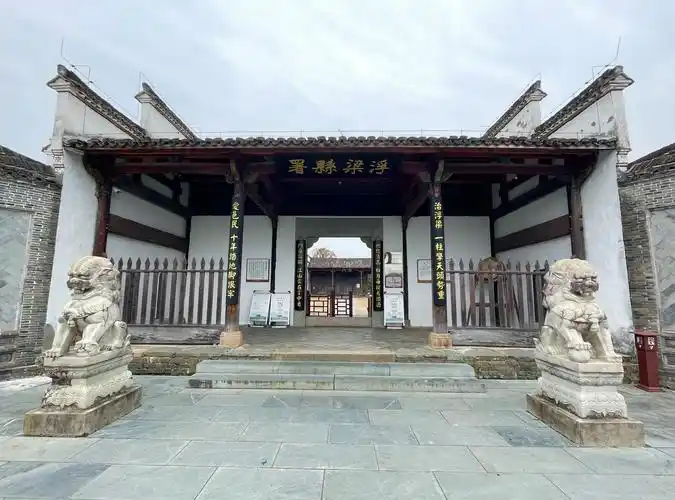 The story of Fuliang County Office begins in the Tang Dynasty, in 816 AD, when this region sat astride the legendary Jingdezhen porcelain and tea trade routes—much as medieval Italian merchant republics like Florence or Venice owed their prosperity to strategic crossroads. So vital was Fuliang to imperial tax revenue that emperors bestowed it the rank of fifth-grade, two full ranks above an ordinary county. This exceptional status, virtually unheard of anywhere else in China, is why the complex feels more like a prefectural palace than a modest rural courthouse. In 2019, it was designated a National Key Cultural Relics Protection Site.
Architecturally, the 95-acre compound unfolds along a strict north-south axis reminiscent of Beijing's Forbidden City, though on a more human scale—think of it as a Chinese counterpart to a stately European chateau, with successive gate halls, ceremonial courtyards, and audience chambers replacing the Great Hall and state rooms. Walls of dark blue-grey brick rise beneath sweeping tiled eaves, while the central Great Hall, where magistrates pronounced judgment, conveys the same solemn gravitas as a Tudor great hall or a Viennese courtroom. More than fifty inscribed couplets line the corridors, expounding on justice, integrity, and governance—ancient equivalents of courtroom mottos etched in stone.
The site's cultural riches extend well beyond the yamen itself. The neighboring Red Pagoda, begun in the Northern Song dynasty around the 11th century and often called "Jiangxi's Number One Tower," rises like a brick echo of Tuscany's Romanesque campanili. Nearby, a long painted corridor traces the intertwined histories of Jingdezhen's imperial kilns and Fuliang's tea trade—precisely the route the Tang poet Bai Juyi immortalized when he wrote "Last month I went to Fuliang to buy tea." Together, these elements paint a vivid portrait of a county whose fortunes were literally shaped by clay and leaves.
What truly sets the visit apart is the living history. Throughout the day, costumed performers stage dramatic "Magistrate Holding Court" reenactments, complete with gavel strikes on the惊堂木 (warning block) and theatrical sentencing scenes that rival a Renaissance pageant for sheer spectacle. Visitors can take the magistrate's seat themselves, bang the wooden block, and pose for photos. Additional experiences include warrior patrols, gate-opening ceremonies, Hanfu costume rentals, and puzzle-solving scavenger hunts, making the site especially popular with families and school groups eager to turn dusty history into hands-on adventure.
Practical details are refreshingly straightforward. Admission is roughly 45 RMB, with discounts for seniors, students, and military personnel. During peak season (May through September) the site is open 8:10 AM to 6:00 PM; in the off-season it closes at 5:30 PM. From central Jingdezhen, Bus 39 or 601 stops at "Jiucheng Village," about a ten-minute walk from the entrance, while a taxi costs around 20–30 RMB. Plan on two to three hours, ideally arriving in the morning to catch the 10:00 or 11:00 court performance.
A suggested route: begin in the porcelain-history corridor for context, then progress along the central axis from the first gate through the ceremonial hall and the Six Ministries offices to the Great Hall. After lunch, explore the inner chambers and rear garden, climb the gate tower for a panoramic view, and finish at the Red Pagoda for a photograph at golden hour. Wear comfortable shoes, bring sun protection in summer, and—if you have time—read up on the unusual fifth-grade status and Bai Juyi's tea poem beforehand. The deeper your background knowledge, the richer the experience of stepping into one of imperial China's most surprisingly grand little corners.
The story of Fuliang County Office begins in the Tang Dynasty, in 816 AD, when this region sat astride the legendary Jingdezhen porcelain and tea trade routes—much as medieval Italian merchant republics like Florence or Venice owed their prosperity to strategic crossroads. So vital was Fuliang to imperial tax revenue that emperors bestowed it the rank of fifth-grade, two full ranks above an ordinary county. This exceptional status, virtually unheard of anywhere else in China, is why the complex feels more like a prefectural palace than a modest rural courthouse. In 2019, it was designated a National Key Cultural Relics Protection Site.
Architecturally, the 95-acre compound unfolds along a strict north-south axis reminiscent of Beijing's Forbidden City, though on a more human scale—think of it as a Chinese counterpart to a stately European chateau, with successive gate halls, ceremonial courtyards, and audience chambers replacing the Great Hall and state rooms. Walls of dark blue-grey brick rise beneath sweeping tiled eaves, while the central Great Hall, where magistrates pronounced judgment, conveys the same solemn gravitas as a Tudor great hall or a Viennese courtroom. More than fifty inscribed couplets line the corridors, expounding on justice, integrity, and governance—ancient equivalents of courtroom mottos etched in stone.
The site's cultural riches extend well beyond the yamen itself. The neighboring Red Pagoda, begun in the Northern Song dynasty around the 11th century and often called "Jiangxi's Number One Tower," rises like a brick echo of Tuscany's Romanesque campanili. Nearby, a long painted corridor traces the intertwined histories of Jingdezhen's imperial kilns and Fuliang's tea trade—precisely the route the Tang poet Bai Juyi immortalized when he wrote "Last month I went to Fuliang to buy tea." Together, these elements paint a vivid portrait of a county whose fortunes were literally shaped by clay and leaves.
What truly sets the visit apart is the living history. Throughout the day, costumed performers stage dramatic "Magistrate Holding Court" reenactments, complete with gavel strikes on the惊堂木 (warning block) and theatrical sentencing scenes that rival a Renaissance pageant for sheer spectacle. Visitors can take the magistrate's seat themselves, bang the wooden block, and pose for photos. Additional experiences include warrior patrols, gate-opening ceremonies, Hanfu costume rentals, and puzzle-solving scavenger hunts, making the site especially popular with families and school groups eager to turn dusty history into hands-on adventure.
Practical details are refreshingly straightforward. Admission is roughly 45 RMB, with discounts for seniors, students, and military personnel. During peak season (May through September) the site is open 8:10 AM to 6:00 PM; in the off-season it closes at 5:30 PM. From central Jingdezhen, Bus 39 or 601 stops at "Jiucheng Village," about a ten-minute walk from the entrance, while a taxi costs around 20–30 RMB. Plan on two to three hours, ideally arriving in the morning to catch the 10:00 or 11:00 court performance.
A suggested route: begin in the porcelain-history corridor for context, then progress along the central axis from the first gate through the ceremonial hall and the Six Ministries offices to the Great Hall. After lunch, explore the inner chambers and rear garden, climb the gate tower for a panoramic view, and finish at the Red Pagoda for a photograph at golden hour. Wear comfortable shoes, bring sun protection in summer, and—if you have time—read up on the unusual fifth-grade status and Bai Juyi's tea poem beforehand. The deeper your background knowledge, the richer the experience of stepping into one of imperial China's most surprisingly grand little corners.