Dai Ethnic Village
⭐ 4.20
Nuofu Township, Lancang Lahu Autonomous County, Pu'er City, Yunnan Province, China
 The Dai people belong to the broader Tai family whose descendants shaped civilizations from Assam to Vietnam, and their arrival along the Mekong's upper tributaries roughly parallels the spread of Theravada Buddhism from Sri Lanka across mainland Southeast Asia between the 13th and 16th centuries. Zhengdong's relative isolation near the Chinese-Lao frontier preserved customs that have faded elsewhere, making it a remarkable field site for understanding pre-modern cross-border ethnic networks along what was once the southern Silk Road of mainland Southeast Asia.
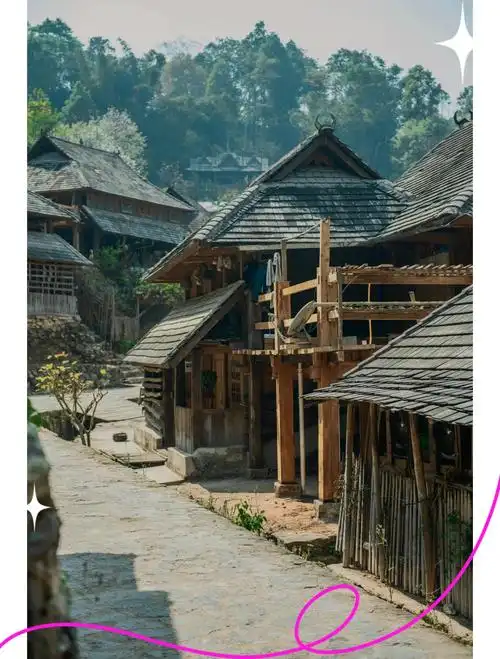
The architecture is the visual heart of the village. Stilted wooden houses, known locally as ganlan, recall the raised granaries of Alpine Switzerland or the pile dwellings reconstructed at Alpine lake sites in Europe—though these are built from tropical hardwoods and designed to breathe through humid monsoon air. Their pitched roofs and elegant upturned eaves echo temple architecture found from Bagan to Chiang Mai, creating a skyline that feels closer to northern Thailand than to anything most visitors associate with China.
Culture here is not performed but practiced. Manhe is recognized as a national-level preservation site for Dai brocade, a textile tradition using backstrap looms and indigo dyes whose patterns share DNA with Lao sinh cloth and Thai mudmee silk. Visitors can watch women weaving geometric motifs that encode village history, then join a hands-on session of *baoshao*—banana-leaf grilling over open flame—before walking to a working Buddhist temple where monks still conduct morning alms rounds.
Practical logistics require planning. The village lies roughly 150 kilometers from Pu'er's Simao district, a three-hour drive through winding mountain roads best negotiated by private car or chartered minivan, as no direct public buses serve the area. The dry season from November through April brings comfortable temperatures, festivals, and passable roads, while the May-to-October rains turn the landscape emerald but muddy trails demand sturdy footwear and strong insect repellent. Carry your passport at all times in this border zone.
Overnight stays in family homestays cost between 100 and 200 yuan per person, with home-cooked meals around 40 to 60 yuan, offering immersion that no hotel chain could replicate. Mobile signals are weak, so download offline maps in advance, and pair the visit with a stop at Mengyejing Hot Springs or a border viewpoint overlooking Laos. Come for the silence, the ancient trees, and the chance to witness a culture that has survived centuries precisely by remaining off the beaten path.
The Dai people belong to the broader Tai family whose descendants shaped civilizations from Assam to Vietnam, and their arrival along the Mekong's upper tributaries roughly parallels the spread of Theravada Buddhism from Sri Lanka across mainland Southeast Asia between the 13th and 16th centuries. Zhengdong's relative isolation near the Chinese-Lao frontier preserved customs that have faded elsewhere, making it a remarkable field site for understanding pre-modern cross-border ethnic networks along what was once the southern Silk Road of mainland Southeast Asia.
The architecture is the visual heart of the village. Stilted wooden houses, known locally as ganlan, recall the raised granaries of Alpine Switzerland or the pile dwellings reconstructed at Alpine lake sites in Europe—though these are built from tropical hardwoods and designed to breathe through humid monsoon air. Their pitched roofs and elegant upturned eaves echo temple architecture found from Bagan to Chiang Mai, creating a skyline that feels closer to northern Thailand than to anything most visitors associate with China.
Culture here is not performed but practiced. Manhe is recognized as a national-level preservation site for Dai brocade, a textile tradition using backstrap looms and indigo dyes whose patterns share DNA with Lao sinh cloth and Thai mudmee silk. Visitors can watch women weaving geometric motifs that encode village history, then join a hands-on session of *baoshao*—banana-leaf grilling over open flame—before walking to a working Buddhist temple where monks still conduct morning alms rounds.
Practical logistics require planning. The village lies roughly 150 kilometers from Pu'er's Simao district, a three-hour drive through winding mountain roads best negotiated by private car or chartered minivan, as no direct public buses serve the area. The dry season from November through April brings comfortable temperatures, festivals, and passable roads, while the May-to-October rains turn the landscape emerald but muddy trails demand sturdy footwear and strong insect repellent. Carry your passport at all times in this border zone.
Overnight stays in family homestays cost between 100 and 200 yuan per person, with home-cooked meals around 40 to 60 yuan, offering immersion that no hotel chain could replicate. Mobile signals are weak, so download offline maps in advance, and pair the visit with a stop at Mengyejing Hot Springs or a border viewpoint overlooking Laos. Come for the silence, the ancient trees, and the chance to witness a culture that has survived centuries precisely by remaining off the beaten path.