Menghai Tropical Rainforest
⭐ 4.00
Menghai Tropical Rainforest, Menghai County, Pu'er City, Yunnan Province, China
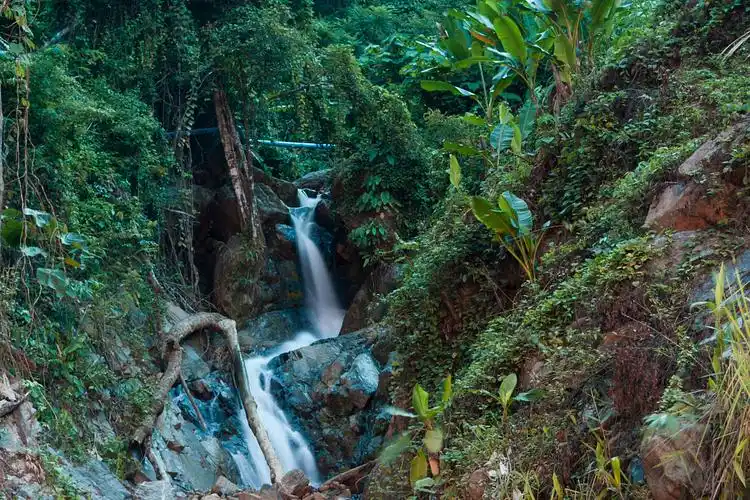 Menghai sits on the southern edge of Yunnan, a region that has trafficked in tea since the Tang Dynasty. While European merchants were navigating the Silk Road with spices, local growers were perfecting pu'er tea here, and by the Qing era, "Menghai tea" was already prized in Beijing's imperial court and exported throughout Southeast Asia. The Bulang people, often called the original cultivators of the tea tree, still hand-press leaves using techniques passed down for generations. Walking these forest paths is, in a sense, tracing the same caravan routes that once carried Chinese tea overland toward Tibet and beyond.
The crown jewel of Menghai's cultural landscape is the Jingzhen Octagonal Pavilion, built in 1703 during the reign of the Kangxi Emperor. Standing 21 meters tall, this elegant wooden structure features eight sides inlaid with mirrored glass, vibrant painted panels, and a layered, ten-tiered roof that would feel at home beside a Vietnamese stupa or a Burmese pagoda. Inside, a Buddha relic is venerated by followers of Theravada Buddhism, the southern school practiced across mainland Southeast Asia, linking Menghai to a vast Buddhist world stretching from Sri Lanka to Thailand.
Cultural life here is layered like the forest itself. Menghai is home to four distinct peoples — Dai, Bulang, Hani, and Lahu — each bringing their own festivals to the calendar: the Bulang Tea Ancestor ceremony, the famous Dai Water Splashing Festival in April, and the Hani's festive Gatongpa harvest celebrations. Centuries before ecology became a science, locals practiced what they call "forest-tea symbiosis," allowing ancient tea trees to grow alongside wild vines and hardwoods. The forest is home, livelihood, and sacred space all at once — a philosophy increasingly studied by modern permaculture enthusiasts.
The site welcomes visitors year-round, though the dry season from October to April offers the most reliable hiking weather; summer afternoons often bring sudden showers. Menghai lies about 50 kilometers from Jinghong, roughly an hour by car, with shuttle services available from Gasa International Airport. Sturdy hiking shoes, mosquito repellent, rain gear, and a light jacket are essential, as mornings and evenings can be 5°C cooler than midday. Local Dai kitchens serve fragrant dishes like pineapple rice, lemongrass grilled fish, and sour bamboo-shoot chicken, rewarding tired hikers with rich regional flavors.
What truly sets Menghai apart is the seamless blending of three experiences rarely found together: primeval rainforest, living tea heritage, and authentic minority cultures. Travelers can follow themed routes — a tea mountain hike to ancient gardens of Lao Banzhang and Hekai, a gentle rainforest stroll on Jingzhen Mountain to see buttress roots and strangler figs, or a village visit to old Bulang communities like Man'e and Zhanglang, where guests can try their hand at picking and pressing tea. Two to three days is ideal, and the journey can be extended northward to the spectacular sky-walk rainforests of Mengla for a deeper tropical adventure.
Menghai sits on the southern edge of Yunnan, a region that has trafficked in tea since the Tang Dynasty. While European merchants were navigating the Silk Road with spices, local growers were perfecting pu'er tea here, and by the Qing era, "Menghai tea" was already prized in Beijing's imperial court and exported throughout Southeast Asia. The Bulang people, often called the original cultivators of the tea tree, still hand-press leaves using techniques passed down for generations. Walking these forest paths is, in a sense, tracing the same caravan routes that once carried Chinese tea overland toward Tibet and beyond.
The crown jewel of Menghai's cultural landscape is the Jingzhen Octagonal Pavilion, built in 1703 during the reign of the Kangxi Emperor. Standing 21 meters tall, this elegant wooden structure features eight sides inlaid with mirrored glass, vibrant painted panels, and a layered, ten-tiered roof that would feel at home beside a Vietnamese stupa or a Burmese pagoda. Inside, a Buddha relic is venerated by followers of Theravada Buddhism, the southern school practiced across mainland Southeast Asia, linking Menghai to a vast Buddhist world stretching from Sri Lanka to Thailand.
Cultural life here is layered like the forest itself. Menghai is home to four distinct peoples — Dai, Bulang, Hani, and Lahu — each bringing their own festivals to the calendar: the Bulang Tea Ancestor ceremony, the famous Dai Water Splashing Festival in April, and the Hani's festive Gatongpa harvest celebrations. Centuries before ecology became a science, locals practiced what they call "forest-tea symbiosis," allowing ancient tea trees to grow alongside wild vines and hardwoods. The forest is home, livelihood, and sacred space all at once — a philosophy increasingly studied by modern permaculture enthusiasts.
The site welcomes visitors year-round, though the dry season from October to April offers the most reliable hiking weather; summer afternoons often bring sudden showers. Menghai lies about 50 kilometers from Jinghong, roughly an hour by car, with shuttle services available from Gasa International Airport. Sturdy hiking shoes, mosquito repellent, rain gear, and a light jacket are essential, as mornings and evenings can be 5°C cooler than midday. Local Dai kitchens serve fragrant dishes like pineapple rice, lemongrass grilled fish, and sour bamboo-shoot chicken, rewarding tired hikers with rich regional flavors.
What truly sets Menghai apart is the seamless blending of three experiences rarely found together: primeval rainforest, living tea heritage, and authentic minority cultures. Travelers can follow themed routes — a tea mountain hike to ancient gardens of Lao Banzhang and Hekai, a gentle rainforest stroll on Jingzhen Mountain to see buttress roots and strangler figs, or a village visit to old Bulang communities like Man'e and Zhanglang, where guests can try their hand at picking and pressing tea. Two to three days is ideal, and the journey can be extended northward to the spectacular sky-walk rainforests of Mengla for a deeper tropical adventure.