Mengsuo Dragon Pool
⭐ 3.80
Pu'er City, Yunnan Province, China
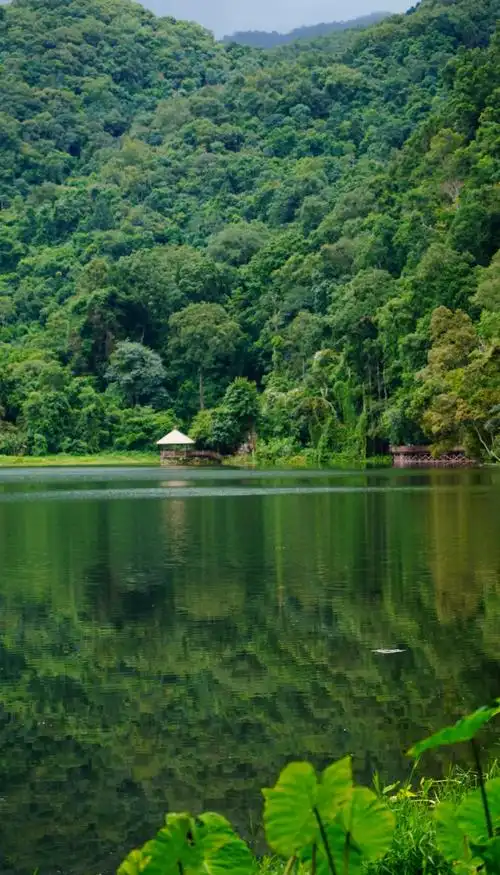 The Wa people have inhabited the rugged highlands along the China-Myanmar border for more than 2,000 years, making them one of Southeast Asia's oldest surviving ethnic groups. Their animist faith—centred on ancestor spirits, sacred groves, and ritual sacrifice—predates the Buddhist and Hindu traditions that swept through mainland Asia much as Celtic paganism once dominated pre-Christian Europe. Mengsuo Longtan functions as the spiritual epicentre of this living tradition, with the lake itself venerated as a dwelling place of benevolent spirits. Visitors familiar with Highland Scottish lochs or Alpine lakes like Bled will recognize a kindred mystique, though here the surrounding forest is subtropical rainforest rather than pine and larch.
The lake itself is the jewel of the reserve, fed by underground springs that keep its waters clear year-round. Early mornings bring a fine mist that hovers over the surface, transforming the shoreline into something reminiscent of a Constable painting come to life. The forest canopy shelters upwards of 180 species of fauna, including silver pheasants and the striking Yunnan giant squirrel. Walkers occasionally witness the charming spectacle of small birds snatching fallen leaves from the water's mirror surface—a detail that captures the site's delicate ecological balance and makes it feel far removed from China's better-trodden tourist circuits.
No visit is complete without a stop at Longmo Ye, the most arresting landmark in the area and reputedly the inspiration for eerie rituals in the popular Chinese drama "Yunnan Worm Valley." Here, more than 3,000 weathered cattle skulls are suspended from wooden frames in what locals describe as a "council chamber of the gods." Western travellers might compare the macabre tableau to the bone-chandeliers of Prague's Sedlec Ossuary or Rome's Capuchin Crypt, though the Wa ritual context is one of reverence rather than memento mori. Guides explain the cosmology encoded in each skull and recount passages from the Wa creation epic "Sigangri," offering rare insight into a worldview largely unknown outside the region.
Equally significant is the Sacred Spring just outside the main lake basin, where ritual water-drawing ceremonies continue much as they have for centuries. This practice links Ximeng not only to Wa communities across Yunnan but also to ethnic Wa populations in Myanmar, Thailand, and Laos—making it a tangible thread in a transnational cultural tapestry akin to the shared Marian pilgrimages connecting Lourdes, Fátima, and Knock in Catholic Europe. Nearby attractions include the Datang Buddha Mountain, a working Theravada Buddhist temple, and a pair of legendary相思树 (Acacia) trees tied to local love myths, offering visitors a layered cultural experience spanning animism, Buddhism, and folk legend.
The site is open daily from 08:00 to 18:00, with a recommended visit of three to four hours. The address is 40 Longtan Road, Ximeng Wa Autonomous County, Pu'er Prefecture, Yunnan Province. Public transport is limited, so renting a car or arranging a private driver from Pu'er city (roughly a four-hour journey) is strongly advised. Note that on-site resort amenities are still being developed, and certain sections of the lakeside trail can be slippery and challenging for inexperienced hikers—sturdy, grip-soled footwear and a walking companion are essential. The nearest airport is Pu'er Simao, after which onward transport must be pre-arranged.
What sets Mengsuo Longtan apart from Yunnan's marquee destinations like Lijiang or Shangri-La is precisely its rawness: there are no cable cars, no commercialized old towns, no souvenir alleys. Instead, you find an intact sacred landscape where a minority culture still practices rituals described in oral epics older than most European cathedrals, surrounded by rainforest that predates the Roman Empire. For travellers who have already "done" China's headline sites and crave something genuinely uncommon—something that feels closer to discovering a hidden valley in Papua New Guinea than revisiting a postcard from Guilin—this is the kind of place that rewards the detour many times over.
The Wa people have inhabited the rugged highlands along the China-Myanmar border for more than 2,000 years, making them one of Southeast Asia's oldest surviving ethnic groups. Their animist faith—centred on ancestor spirits, sacred groves, and ritual sacrifice—predates the Buddhist and Hindu traditions that swept through mainland Asia much as Celtic paganism once dominated pre-Christian Europe. Mengsuo Longtan functions as the spiritual epicentre of this living tradition, with the lake itself venerated as a dwelling place of benevolent spirits. Visitors familiar with Highland Scottish lochs or Alpine lakes like Bled will recognize a kindred mystique, though here the surrounding forest is subtropical rainforest rather than pine and larch.
The lake itself is the jewel of the reserve, fed by underground springs that keep its waters clear year-round. Early mornings bring a fine mist that hovers over the surface, transforming the shoreline into something reminiscent of a Constable painting come to life. The forest canopy shelters upwards of 180 species of fauna, including silver pheasants and the striking Yunnan giant squirrel. Walkers occasionally witness the charming spectacle of small birds snatching fallen leaves from the water's mirror surface—a detail that captures the site's delicate ecological balance and makes it feel far removed from China's better-trodden tourist circuits.
No visit is complete without a stop at Longmo Ye, the most arresting landmark in the area and reputedly the inspiration for eerie rituals in the popular Chinese drama "Yunnan Worm Valley." Here, more than 3,000 weathered cattle skulls are suspended from wooden frames in what locals describe as a "council chamber of the gods." Western travellers might compare the macabre tableau to the bone-chandeliers of Prague's Sedlec Ossuary or Rome's Capuchin Crypt, though the Wa ritual context is one of reverence rather than memento mori. Guides explain the cosmology encoded in each skull and recount passages from the Wa creation epic "Sigangri," offering rare insight into a worldview largely unknown outside the region.
Equally significant is the Sacred Spring just outside the main lake basin, where ritual water-drawing ceremonies continue much as they have for centuries. This practice links Ximeng not only to Wa communities across Yunnan but also to ethnic Wa populations in Myanmar, Thailand, and Laos—making it a tangible thread in a transnational cultural tapestry akin to the shared Marian pilgrimages connecting Lourdes, Fátima, and Knock in Catholic Europe. Nearby attractions include the Datang Buddha Mountain, a working Theravada Buddhist temple, and a pair of legendary相思树 (Acacia) trees tied to local love myths, offering visitors a layered cultural experience spanning animism, Buddhism, and folk legend.
The site is open daily from 08:00 to 18:00, with a recommended visit of three to four hours. The address is 40 Longtan Road, Ximeng Wa Autonomous County, Pu'er Prefecture, Yunnan Province. Public transport is limited, so renting a car or arranging a private driver from Pu'er city (roughly a four-hour journey) is strongly advised. Note that on-site resort amenities are still being developed, and certain sections of the lakeside trail can be slippery and challenging for inexperienced hikers—sturdy, grip-soled footwear and a walking companion are essential. The nearest airport is Pu'er Simao, after which onward transport must be pre-arranged.
What sets Mengsuo Longtan apart from Yunnan's marquee destinations like Lijiang or Shangri-La is precisely its rawness: there are no cable cars, no commercialized old towns, no souvenir alleys. Instead, you find an intact sacred landscape where a minority culture still practices rituals described in oral epics older than most European cathedrals, surrounded by rainforest that predates the Roman Empire. For travellers who have already "done" China's headline sites and crave something genuinely uncommon—something that feels closer to discovering a hidden valley in Papua New Guinea than revisiting a postcard from Guilin—this is the kind of place that rewards the detour many times over.