Shijiu Lake
⭐ 4.20
Shijiu Lake Scenic Area, Lanshan District, Rizhao City, Shandong Province, China
 **A Working Waterway Since the Sui Dynasty**
Shijiu Lake—historically "Shijiu Shui"—owes its name to its basin-shaped hollow, resembling the stone mortars Chinese households once used to pound grain. Since the Sui and Tang dynasties (roughly contemporary with the rise of Anglo-Saxon England), the lake served as a vital grain-shipping corridor along the lower Yangtze, linking inland rice harvests to coastal trade routes. Villages along its banks still earn the old epithet "earning a tael of gold each sunrise" from silver fish, whitebait, and crucian carp harvests. Today the wooden fishing boats and reed-thatched homes recall a Mediterranean or Dalmatian lakeside timelessness, preserved surprisingly close to major highways and high-speed rail lines.
**The "Sky Mirror" and a Solitary Tree**
The lake's signature spectacle appears after summer rains when still air transforms the surface into a flawless mirror—comparable in effect to Bolivia's Salar de Uyuni or Scotland's Loch Leven at dawn. Skies, distant mountains, and the village lighthouse invert so perfectly that visitors feel suspended between two heavens. The "lonely tree" rising from the shallows has become a pilgrimage subject for photographers, evoking the same haunting solitude as California's lone cypress at Monterey or the lone trees painted by Caspar David Friedrich. Reflections typically emerge from June through August on windless, post-rain afternoons.
**Wetland Sanctuary and Cross-Provincial Conservation**
Designated a provincial wetland reserve, the reed-fringed shoreline shelters more than 90 migratory species, including endangered Oriental storks and thousands of overwintering tundra swans—an Asian parallel to France's Camargue or Spain's Ebro Delta. Spanning four administrative districts across two provinces, Shijiu Lake has become a flagship site for the Yangtze Delta's ecological integration initiative, similar in ambition to cross-border European reserves around the Alps. Local fishermen continue hereditary practices unchanged for generations, supplying kitchens with the ingredients for famed fish-head soup, lake-fish balls, and fish-head flatbread—dishes that anchor a distinct borderland cuisine between Anhui and Jiangsu.
**Getting There and Getting Around**
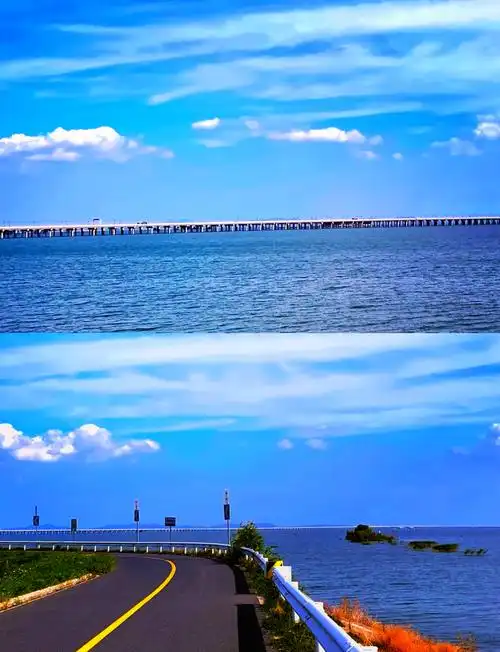
The lake lies about 60 km southeast of Nanjing and is reached via high-speed rail to Nanjing South Station, then Metro Line S9 toward the suburbs—alight at Mingjue or Tuanjiexu station, both under an hour from central Nanjing. Drivers should navigate to "Shijiu Lake Zhangxu Village Parking"; arriving before 9 a.m. on weekends avoids congestion. The most celebrated vantage points are the Zhangxu Village lighthouse (a reconstructed 1930s beacon), the elevated boardwalk at Section One Works, and the mid-lake section of Metro S9, which crosses the water on a causeway—frequently compared to the dreamy floating-train scene in Spirited Away.
**When to Visit and What to Bring**
The golden hour for photography runs from late afternoon through dusk (roughly 18:30–19:30), when the water glows and the lighthouse begins to glitter; the sky-mirror phenomenon requires the June–August high-water season combined with calm, sunny weather. Spring through early summer delivers yellow rapeseed fields stretching to the waterfront, while November through February brings mass bird arrivals. Rural guesthouses and the small lakeside coffee shop need booking three days ahead. Pack mosquito repellent, sunscreen, a wide-brimmed hat, and a light windbreaker—lake breezes can be sharp. Swimming, trampling reeds, and fishing without permission are prohibited to protect this fragile wetland.
**Why It's Worth the Detour**
Within an hour of Shanghai and Nanjing, Shijiu Lake offers something increasingly rare in eastern China: unobstructed horizons, genuine quiet, and a sense of elemental weather—clouds, wind, light, and water—at work. Few other places allow travelers to step off a metro and, within minutes, feel transported to the 19th-century Yangtze floodplain. For nature photographers, birdwatchers, and anyone seeking a contemplative counterpoint to China's megacity pace, it is the region's hidden gem, where a red lighthouse, a lone tree, and an endless inland sea become a very personal mirror.
**A Working Waterway Since the Sui Dynasty**
Shijiu Lake—historically "Shijiu Shui"—owes its name to its basin-shaped hollow, resembling the stone mortars Chinese households once used to pound grain. Since the Sui and Tang dynasties (roughly contemporary with the rise of Anglo-Saxon England), the lake served as a vital grain-shipping corridor along the lower Yangtze, linking inland rice harvests to coastal trade routes. Villages along its banks still earn the old epithet "earning a tael of gold each sunrise" from silver fish, whitebait, and crucian carp harvests. Today the wooden fishing boats and reed-thatched homes recall a Mediterranean or Dalmatian lakeside timelessness, preserved surprisingly close to major highways and high-speed rail lines.
**The "Sky Mirror" and a Solitary Tree**
The lake's signature spectacle appears after summer rains when still air transforms the surface into a flawless mirror—comparable in effect to Bolivia's Salar de Uyuni or Scotland's Loch Leven at dawn. Skies, distant mountains, and the village lighthouse invert so perfectly that visitors feel suspended between two heavens. The "lonely tree" rising from the shallows has become a pilgrimage subject for photographers, evoking the same haunting solitude as California's lone cypress at Monterey or the lone trees painted by Caspar David Friedrich. Reflections typically emerge from June through August on windless, post-rain afternoons.
**Wetland Sanctuary and Cross-Provincial Conservation**
Designated a provincial wetland reserve, the reed-fringed shoreline shelters more than 90 migratory species, including endangered Oriental storks and thousands of overwintering tundra swans—an Asian parallel to France's Camargue or Spain's Ebro Delta. Spanning four administrative districts across two provinces, Shijiu Lake has become a flagship site for the Yangtze Delta's ecological integration initiative, similar in ambition to cross-border European reserves around the Alps. Local fishermen continue hereditary practices unchanged for generations, supplying kitchens with the ingredients for famed fish-head soup, lake-fish balls, and fish-head flatbread—dishes that anchor a distinct borderland cuisine between Anhui and Jiangsu.
**Getting There and Getting Around**
The lake lies about 60 km southeast of Nanjing and is reached via high-speed rail to Nanjing South Station, then Metro Line S9 toward the suburbs—alight at Mingjue or Tuanjiexu station, both under an hour from central Nanjing. Drivers should navigate to "Shijiu Lake Zhangxu Village Parking"; arriving before 9 a.m. on weekends avoids congestion. The most celebrated vantage points are the Zhangxu Village lighthouse (a reconstructed 1930s beacon), the elevated boardwalk at Section One Works, and the mid-lake section of Metro S9, which crosses the water on a causeway—frequently compared to the dreamy floating-train scene in Spirited Away.
**When to Visit and What to Bring**
The golden hour for photography runs from late afternoon through dusk (roughly 18:30–19:30), when the water glows and the lighthouse begins to glitter; the sky-mirror phenomenon requires the June–August high-water season combined with calm, sunny weather. Spring through early summer delivers yellow rapeseed fields stretching to the waterfront, while November through February brings mass bird arrivals. Rural guesthouses and the small lakeside coffee shop need booking three days ahead. Pack mosquito repellent, sunscreen, a wide-brimmed hat, and a light windbreaker—lake breezes can be sharp. Swimming, trampling reeds, and fishing without permission are prohibited to protect this fragile wetland.
**Why It's Worth the Detour**
Within an hour of Shanghai and Nanjing, Shijiu Lake offers something increasingly rare in eastern China: unobstructed horizons, genuine quiet, and a sense of elemental weather—clouds, wind, light, and water—at work. Few other places allow travelers to step off a metro and, within minutes, feel transported to the 19th-century Yangtze floodplain. For nature photographers, birdwatchers, and anyone seeking a contemplative counterpoint to China's megacity pace, it is the region's hidden gem, where a red lighthouse, a lone tree, and an endless inland sea become a very personal mirror.