Mount Yuhuang
⭐ 4.20
Dongchang District, Tonghua, Jilin, China
 Jade Emperor Mountain's cultural heart is the pavilion crowning its summit, built in the thirteenth year of the Guangxu reign (1887)—the same era that saw the Eiffel Tower rise in Paris and the Statue of Liberty take shape in New York Harbor. As one of the earliest Qing Dynasty religious structures still standing in Jilin Province, it has been designated a provincial heritage site. The temple venerates the Jade Emperor, the supreme Taoist deity, alongside a pantheon of attendant gods whose clay statues have survived more than 130 winters of northeast China's punishing climate. For travelers interested in folk religion, it offers an authentic glimpse into devotional practices that predate modern China by centuries.
The pavilion itself embodies classic late-Qing sacred architecture, with swooping upturned eaves, intricately carved beams, and painted brackets that recall the temple traditions seen at Beijing's Lama Temple or Shanxi's ancient monasteries. Beyond the temple, the mountain holds a martyrs' memorial cemetery and a stone inscription garden, where revolutionary history and traditional faith coexist. From the summit pavilions such as Wangjiang and Jiulong, visitors enjoy sweeping panoramas of the Hunjiang River snaking through the Tonghua valley—a perspective that has drawn pilgrims and poets alike since the late nineteenth century.
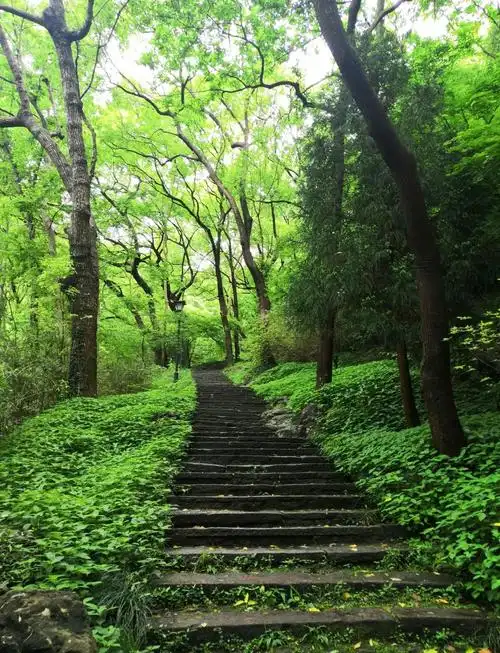
The mountain is also a model of urban ecology, with more than 95% forest coverage and an average elevation that keeps the air rich in negative ions, hence its nickname as the "city's green lung." Approximately five to six kilometers of paved and stepped trails wind through the trees, offering cool shade in summer, fiery maple color in autumn, and crystalline rime frost in winter. The trail gradient is gentle enough for casual walkers, and the main summit sits at a modest 476.5 meters—roughly the height of a hundred-story building climbed gradually rather than by elevator.
Practical access is refreshingly simple: the park sits within Tonghua's Dongchang District along Liuquan Road and is served by multiple city buses. Entry is free year-round, though amusement rides in the front-hill area charge separately. The recommended route is to enter via the East Gate, pass through the family-friendly amusement zone (complete with pirate-ship rides, a small animal park featuring alpacas and bears, and a children's playground), then climb the boardwalk to the Jade Emperor Pavilion before looping back through the quieter back-hill trails to the North Gate—a circuit of roughly 1.5 to 2 hours.
Timing matters: arrive between 6 and 8 a.m. for misty sunrise views over the river, or stay until 17:00 to 19:00 when the setting sun gilds the rooftops of the old town below. Bring comfortable walking shoes and water, and avoid national holidays—especially the autumn chrysanthemum festival in October, when crowds can swell beyond 100,000 and the paths feel more like a subway platform than a forest trail. Some amusement equipment is aging, even after a 2025 refurbishment, so manage expectations accordingly.
In sum, Jade Emperor Mountain is best understood as Tonghua's beloved backyard rather than a marquee tourist attraction. Travelers seeking wilderness solitude or polished sightseeing infrastructure may be underwhelmed, but those curious about everyday Chinese urban life, willing Qing religious art, and an easy half-day hike with a city panorama will find it a warm, rewarding detour off the standard northeast China circuit.
Jade Emperor Mountain's cultural heart is the pavilion crowning its summit, built in the thirteenth year of the Guangxu reign (1887)—the same era that saw the Eiffel Tower rise in Paris and the Statue of Liberty take shape in New York Harbor. As one of the earliest Qing Dynasty religious structures still standing in Jilin Province, it has been designated a provincial heritage site. The temple venerates the Jade Emperor, the supreme Taoist deity, alongside a pantheon of attendant gods whose clay statues have survived more than 130 winters of northeast China's punishing climate. For travelers interested in folk religion, it offers an authentic glimpse into devotional practices that predate modern China by centuries.
The pavilion itself embodies classic late-Qing sacred architecture, with swooping upturned eaves, intricately carved beams, and painted brackets that recall the temple traditions seen at Beijing's Lama Temple or Shanxi's ancient monasteries. Beyond the temple, the mountain holds a martyrs' memorial cemetery and a stone inscription garden, where revolutionary history and traditional faith coexist. From the summit pavilions such as Wangjiang and Jiulong, visitors enjoy sweeping panoramas of the Hunjiang River snaking through the Tonghua valley—a perspective that has drawn pilgrims and poets alike since the late nineteenth century.
The mountain is also a model of urban ecology, with more than 95% forest coverage and an average elevation that keeps the air rich in negative ions, hence its nickname as the "city's green lung." Approximately five to six kilometers of paved and stepped trails wind through the trees, offering cool shade in summer, fiery maple color in autumn, and crystalline rime frost in winter. The trail gradient is gentle enough for casual walkers, and the main summit sits at a modest 476.5 meters—roughly the height of a hundred-story building climbed gradually rather than by elevator.
Practical access is refreshingly simple: the park sits within Tonghua's Dongchang District along Liuquan Road and is served by multiple city buses. Entry is free year-round, though amusement rides in the front-hill area charge separately. The recommended route is to enter via the East Gate, pass through the family-friendly amusement zone (complete with pirate-ship rides, a small animal park featuring alpacas and bears, and a children's playground), then climb the boardwalk to the Jade Emperor Pavilion before looping back through the quieter back-hill trails to the North Gate—a circuit of roughly 1.5 to 2 hours.
Timing matters: arrive between 6 and 8 a.m. for misty sunrise views over the river, or stay until 17:00 to 19:00 when the setting sun gilds the rooftops of the old town below. Bring comfortable walking shoes and water, and avoid national holidays—especially the autumn chrysanthemum festival in October, when crowds can swell beyond 100,000 and the paths feel more like a subway platform than a forest trail. Some amusement equipment is aging, even after a 2025 refurbishment, so manage expectations accordingly.
In sum, Jade Emperor Mountain is best understood as Tonghua's beloved backyard rather than a marquee tourist attraction. Travelers seeking wilderness solitude or polished sightseeing infrastructure may be underwhelmed, but those curious about everyday Chinese urban life, willing Qing religious art, and an easy half-day hike with a city panorama will find it a warm, rewarding detour off the standard northeast China circuit.