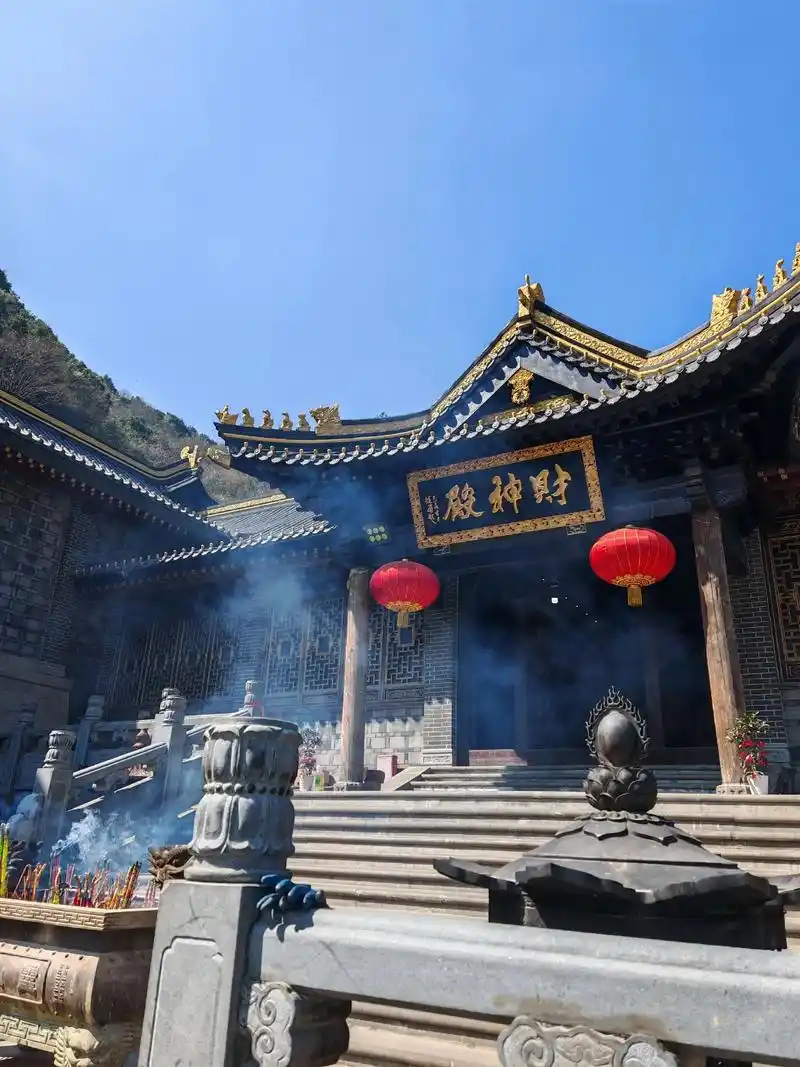
Dating back to the Ming Dynasty (1368–1644) and reconstructed during the Qing era (1644–1911), Lingshan Temple's origins place it within the same historical sweep as Europe's Renaissance and Reformation. The Liao-style pagodas predate even the Ming foundations, suggesting Buddhist activity on this hill stretching back nearly a millennium—contemporary with the Norman Conquest of England. As a preserved example of Han Buddhist temple planning along a traditional central axis, the complex offers a tangible link to the religious currents that shaped northeastern China over centuries.
The temple embodies an intimate, ground-hugging layout reminiscent of provincial European monasteries such as San Miniato al Monte above Florence. Red-walled halls crowned by green-glazed tiles nestle among towering cypresses and ginkgos, some over a thousand years old—rivals in age to England's famous Ankerwycke Yew. The standout Liao-style pagoda cluster stands as the temple's most distinctive feature, an ensemble comparable in rarity to the surviving Romanesque bell towers of the Rhineland. Soft morning or late-afternoon light gilding the weathered masonry produces strikingly photogenic scenes.
Unlike Anshan's more developed attractions, Lingshan remains a living religious site where resident monks continue their daily practice. The temple promotes a "slow travel" philosophy, occasionally inviting visitors to copy sutras by hand or sample meditative tea ceremonies—offering a depth of engagement similar to a retreat at a Benedictine abbey. This immersive cultural dimension, rare among Anshan's sightseeing options, makes it especially rewarding for those interested in Buddhism, contemplative traditions, or authentic local heritage.
Reaching the temple is easiest by car or ride-hailing, as public buses are infrequent and indirect. The stone-paved paths are gentle, suitable for older travelers and young children. A hilltop platform offers sweeping views over Anshan, especially atmospheric when mist gathers after rain. Admission is roughly 30 RMB. On-site amenities are minimal—bring water, snacks, and mosquito repellent; long sleeves are wise in summer. Allow 1 to 1.5 hours, ideally between 9:00 and 11:00 AM, and telephone ahead to confirm opening status.
For travelers weary of crowded temples and hawker-lined courtyards, Lingshan offers what is increasingly rare in modern China: genuine stillness. The absence of commercial pressure, combined with thousand-year-old trees, working monastic life, and distant views over Anshan, makes this humble site a memorable detour. Should the temple prove unexpectedly closed, the celebrated Qianshan Mountain scenic area—Anshan's signature natural attraction—lies nearby as a worthy alternative for the day.