Sakya Monastery
⭐ 4.20
Sakya Monastery Scenic Area, Sakya County, Shigatse, Tibet Autonomous Region, China
 **A Monastery That Shaped a Nation**
Founded in 1073 by the Khön family of the Sakya school, Sakya Monastery rose to political prominence in the 13th century when, in 1247, the great Sakya Pandita convened the historic凉州 (Liangzhou) Alliance with the Mongol prince Köden. This pivotal meeting, much like the Treaty of Troyes in reshaping medieval Europe, established the administrative framework by which Tibet formally became part of the Yuan Empire. The monastery still safeguards relics of this epoch-making diplomacy, making it less a chapel than a living archive of Eurasian history.
**A Fortress Carved in Color**
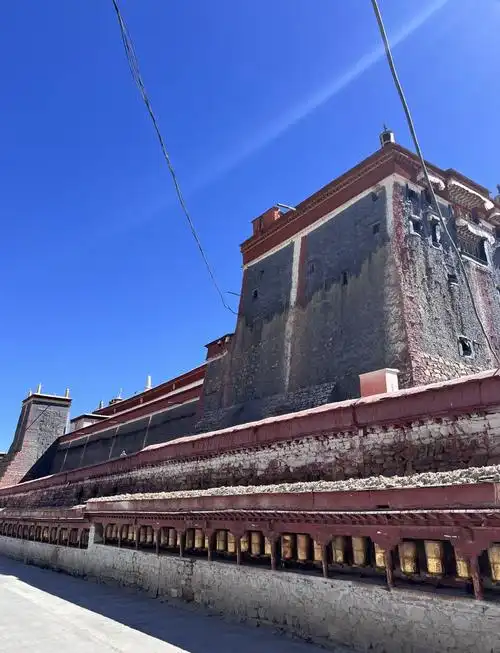
The complex splits into northern and southern monasteries, with the South Monastery as the showpiece. Its thick walls are painted in bold bands of oxblood red, chalk white, and ink black, representing Vajrapani, Avalokiteshvara, and Manjushri respectively. Built along Yuan-dynasty military-fortress lines, with battlements, watchtowers, and a defensive moat, it fuses Han Chinese, Tibetan, and Nepalese craftsmanship in a manner reminiscent of a Carpathian citadel transplanted onto the Himalayan plateau.
**The "Second Dunhuang"**
Inside the great assembly hall stands the legendary Scripture Wall, a 30-meter-long, 10-meter-high wooden bookcase crammed with more than 84,000 volumes. Among these are gold-ink copies of the *Prajnaparamita in 8,000 Verses* and rare palm-leaf sutras imported from India, rivaling the manuscript treasures of the Vatican Apostolic Library. The 3,000-plus murals covering every chamber depict Buddhist parables, Mongol-era court life, and daily Tibetan customs, with a vividness and chromatic range that invites direct comparison with the Raphael Rooms.
**Planning Your Visit**
Foreign travelers must obtain a Tibet Entry Permit through a registered travel agency at least 30 days in advance and travel with a licensed guide. Admission is approximately 45 RMB, free for Tibetan worshippers; opening hours run roughly 09:00 to 18:00. At 4,300 meters above sea level, the air is thin and arid—allocate two to three hours, bring layers for dramatic temperature swings, and acclimatize in Shigatse beforehand.
**When to Go and How to Behave**
The prime visiting window runs May through October, with the summer grand dharma assembly and Cham masked dances held in the seventh lunar month offering an unforgettable cultural spectacle. Inside the chapels, hats and sunglasses must be removed and photography is strictly forbidden. When circumambulating, always move clockwise, the same direction pilgrims follow at sites like St. Peter's Basilica.
**Why It Matters**
Sakya offers something few monasteries anywhere can match: an unbroken thread from the Mongol conquests to living Vajrayana practice, all enclosed within fortress walls older than most European cathedrals. For travelers drawn to Silk Road history, Buddhist art, or simply the romance of high-altitude adventure, this remote citadel rewards the journey with one of Asia's most extraordinary cultural treasures.
**A Monastery That Shaped a Nation**
Founded in 1073 by the Khön family of the Sakya school, Sakya Monastery rose to political prominence in the 13th century when, in 1247, the great Sakya Pandita convened the historic凉州 (Liangzhou) Alliance with the Mongol prince Köden. This pivotal meeting, much like the Treaty of Troyes in reshaping medieval Europe, established the administrative framework by which Tibet formally became part of the Yuan Empire. The monastery still safeguards relics of this epoch-making diplomacy, making it less a chapel than a living archive of Eurasian history.
**A Fortress Carved in Color**
The complex splits into northern and southern monasteries, with the South Monastery as the showpiece. Its thick walls are painted in bold bands of oxblood red, chalk white, and ink black, representing Vajrapani, Avalokiteshvara, and Manjushri respectively. Built along Yuan-dynasty military-fortress lines, with battlements, watchtowers, and a defensive moat, it fuses Han Chinese, Tibetan, and Nepalese craftsmanship in a manner reminiscent of a Carpathian citadel transplanted onto the Himalayan plateau.
**The "Second Dunhuang"**
Inside the great assembly hall stands the legendary Scripture Wall, a 30-meter-long, 10-meter-high wooden bookcase crammed with more than 84,000 volumes. Among these are gold-ink copies of the *Prajnaparamita in 8,000 Verses* and rare palm-leaf sutras imported from India, rivaling the manuscript treasures of the Vatican Apostolic Library. The 3,000-plus murals covering every chamber depict Buddhist parables, Mongol-era court life, and daily Tibetan customs, with a vividness and chromatic range that invites direct comparison with the Raphael Rooms.
**Planning Your Visit**
Foreign travelers must obtain a Tibet Entry Permit through a registered travel agency at least 30 days in advance and travel with a licensed guide. Admission is approximately 45 RMB, free for Tibetan worshippers; opening hours run roughly 09:00 to 18:00. At 4,300 meters above sea level, the air is thin and arid—allocate two to three hours, bring layers for dramatic temperature swings, and acclimatize in Shigatse beforehand.
**When to Go and How to Behave**
The prime visiting window runs May through October, with the summer grand dharma assembly and Cham masked dances held in the seventh lunar month offering an unforgettable cultural spectacle. Inside the chapels, hats and sunglasses must be removed and photography is strictly forbidden. When circumambulating, always move clockwise, the same direction pilgrims follow at sites like St. Peter's Basilica.
**Why It Matters**
Sakya offers something few monasteries anywhere can match: an unbroken thread from the Mongol conquests to living Vajrayana practice, all enclosed within fortress walls older than most European cathedrals. For travelers drawn to Silk Road history, Buddhist art, or simply the romance of high-altitude adventure, this remote citadel rewards the journey with one of Asia's most extraordinary cultural treasures.