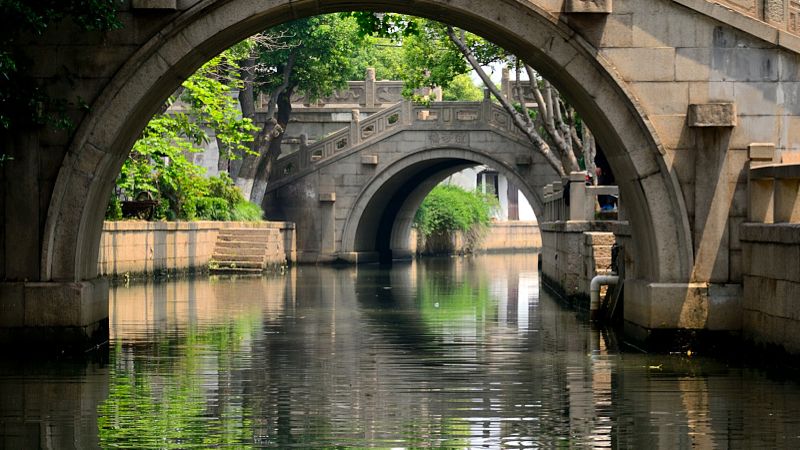
The Qingming Bridge was first constructed during the Wanli reign of the Ming Dynasty (1573–1620), making it nearly four centuries old. It stands at the confluence where the ancient Grand Canal meets the Bodu River, forming a distinctive Y-shaped waterway that links two historic streets: Nanchang Street and Nanxiatang Lane. The Grand Canal itself, stretching 1,700 kilometers from Beijing south to Hangzhou, predates nearly all of Europe's major navigable waterways and sustained imperial grain transport for centuries. When UNESCO inscribed the canal in 2014, Qingming Bridge was recognized as one of its most representative cultural nodes, embodying a millennium of southern China's commercial economy and folk traditions.
The bridge itself is Wuxi's largest surviving single-arch stone bridge, its weathered grey blocks rising in an elegant silhouette mirrored in still waters. The eastern approach climbs 46 stone steps while the western side ascends 43, each worn smooth by generations of travelers. Flanking the canal, traditional homes with whitewashed walls and dark-tiled roofs huddle shoulder-to-shoulder along narrow lanes, stone steps, and tiny dockside landings—a layout that echoes the canal districts of historic Bruges or Amsterdam's Jordaan neighborhood, though unmistakably southern Chinese in mood. The bridge itself serves as the ideal viewing platform for this picturesque "one river, two streets" composition.
Unlike a sealed museum, this remains a functioning neighborhood where residents continue centuries-old daily routines in their ancestral homes. Visitors can explore several small museums housed in restored buildings, including the China Silk Industry Museum and the Wuxi Kiln Site Museum, which trace the region's pivotal role in late-Qing industrialization and ceramics production. Evenings bring the immersive multimedia production "Liang Xiao Tonight," combining augmented reality projections with live performers to recount canal legends. Like a working folk village in Scandinavia or a living medina in Fez, the site offers cultural texture no static exhibit can replicate.
The district is free to enter around the clock, though museum interiors typically operate 09:00–17:00 with some closing on Mondays. Reach the area via Wuxi Metro Line 1, alighting at either Nanchan Temple or Qingming Bridge station. Traditional oar-powered boat rides cost approximately 80 yuan (about 11 USD) per person. Plan for at least two to three hours. Summer visitors should bring sun protection and insect repellent, as the climate is hot and humid. Stone pavement can be slippery after rain, so wear flat, non-slip shoes.
Time your visit for late afternoon and evening to witness the area's magical transformation. From around 17:30, hundreds of red lanterns flicker to life along both streets, their reflections shimmering in the canal until well past 21:30. Begin with a culinary wander along Nanxiatang Lane, sampling dumplings at the historic Xishengyuan teahouse and crisp Yulan cakes sold from street stalls. Then board a leisurely oar boat at Kuatang Bridge dock for a canal-side journey before climbing Qingming Bridge for the iconic overhead view of this timeless Jiangnan tableau.