Lingshan Grand Buddha
⭐ 4.70
Lingshan Grand Buddha Scenic Area, Huishan District, Wuxi City, Jiangsu Province, China
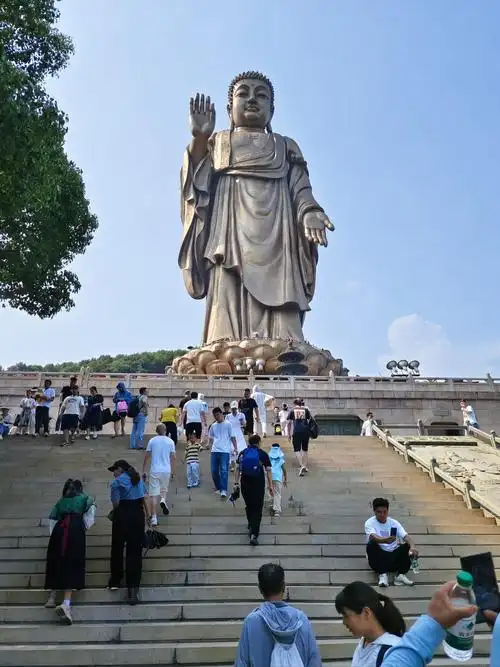 The Grand Buddha stands as one of the most ambitious religious monuments of the late 20th century, conceived by the revered Buddhist leader Zhao Puchu, whose vision echoes a tradition of colossal sacred sculpture stretching back to the Bamiyan Buddhas of Afghanistan and the great bronze Buddhas of Japan's Kamakura era. At 88 meters, it surpasses the height of London's Marble Arch and rivals ancient colossi like Rhodes in ambition, though here rendered not in stone but in shimmering bronze. The figure's serene gaze is said to follow visitors from every angle, evoking the same psychological intimacy pilgrims have sought at sacred sites for millennia.
The surrounding architecture is a masterclass in cross-cultural design. The Brahma Palace dazzles with its soaring domes, intricate Dongyang woodcarvings, and Dunhuang-inspired murals—surfaces as ornate as those of the Vatican's Sistine Chapel or St. Petersburg's Hermitage, yet unmistakably Chinese in soul. A multimedia performance, "Auspicious Hymns," plays within its halls. Nearby, the Tibetan-style Five Seal Mandala City, nicknamed Wuxi's "Little Potala Palace," rises with golden roofs and whitewashed walls that seem transported from Lhasa, offering a striking contrast to the misty Jiangnan landscape.
Culturally, the site functions as a living dialogue between Buddhism's three major schools, a rarity in China. The Nine Dragons Bath spectacle brings to life the legend of the Buddha's birth, with bronze dragons spraying water over a lotus while fountains dance to symphonic music. Visitors are invited to drink the "Eight Virtues Water" as a blessing, and to engage with playful monuments such as the "World's Largest Buddha Hand" and the "Laughing Buddha with 100 Children."
Practical planning is essential. Admission runs 195–210 RMB, and the park closes at 17:30 in summer months. Book tickets and show reservations through the official WeChat mini-program, entering via the South Gate. The recommended route flows from the Nine Dragons Bath, through the Buddha Hand Plaza, ancient Xiangfu Temple, the Grand Buddha itself, the Brahma Palace, and finally the Mandala City—a journey requiring four to six hours.
Wear flat, comfortable shoes: climbing the 216 steps to the Buddha's platform is memorable but demanding, and shuttle carts or an elevator to the Buddha's feet are available. Modest dress is expected inside the halls, where flash photography is prohibited. In summer, sun protection and water are essential, and travelers should check the day's performance schedule in advance to catch the Nine Dragons Bath show at its scheduled time.
More than a tourist attraction, Lingshan offers Western visitors a rare chance to experience contemporary Chinese Buddhism at its most spectacular—a place where ancient devotion meets modern engineering on a scale that competes with Europe's grandest cathedrals.
The Grand Buddha stands as one of the most ambitious religious monuments of the late 20th century, conceived by the revered Buddhist leader Zhao Puchu, whose vision echoes a tradition of colossal sacred sculpture stretching back to the Bamiyan Buddhas of Afghanistan and the great bronze Buddhas of Japan's Kamakura era. At 88 meters, it surpasses the height of London's Marble Arch and rivals ancient colossi like Rhodes in ambition, though here rendered not in stone but in shimmering bronze. The figure's serene gaze is said to follow visitors from every angle, evoking the same psychological intimacy pilgrims have sought at sacred sites for millennia.
The surrounding architecture is a masterclass in cross-cultural design. The Brahma Palace dazzles with its soaring domes, intricate Dongyang woodcarvings, and Dunhuang-inspired murals—surfaces as ornate as those of the Vatican's Sistine Chapel or St. Petersburg's Hermitage, yet unmistakably Chinese in soul. A multimedia performance, "Auspicious Hymns," plays within its halls. Nearby, the Tibetan-style Five Seal Mandala City, nicknamed Wuxi's "Little Potala Palace," rises with golden roofs and whitewashed walls that seem transported from Lhasa, offering a striking contrast to the misty Jiangnan landscape.
Culturally, the site functions as a living dialogue between Buddhism's three major schools, a rarity in China. The Nine Dragons Bath spectacle brings to life the legend of the Buddha's birth, with bronze dragons spraying water over a lotus while fountains dance to symphonic music. Visitors are invited to drink the "Eight Virtues Water" as a blessing, and to engage with playful monuments such as the "World's Largest Buddha Hand" and the "Laughing Buddha with 100 Children."
Practical planning is essential. Admission runs 195–210 RMB, and the park closes at 17:30 in summer months. Book tickets and show reservations through the official WeChat mini-program, entering via the South Gate. The recommended route flows from the Nine Dragons Bath, through the Buddha Hand Plaza, ancient Xiangfu Temple, the Grand Buddha itself, the Brahma Palace, and finally the Mandala City—a journey requiring four to six hours.
Wear flat, comfortable shoes: climbing the 216 steps to the Buddha's platform is memorable but demanding, and shuttle carts or an elevator to the Buddha's feet are available. Modest dress is expected inside the halls, where flash photography is prohibited. In summer, sun protection and water are essential, and travelers should check the day's performance schedule in advance to catch the Nine Dragons Bath show at its scheduled time.
More than a tourist attraction, Lingshan offers Western visitors a rare chance to experience contemporary Chinese Buddhism at its most spectacular—a place where ancient devotion meets modern engineering on a scale that competes with Europe's grandest cathedrals.