Dunhuang Mural Art Museum
⭐ 4.20
Dunhuang City, Gansu Province, China
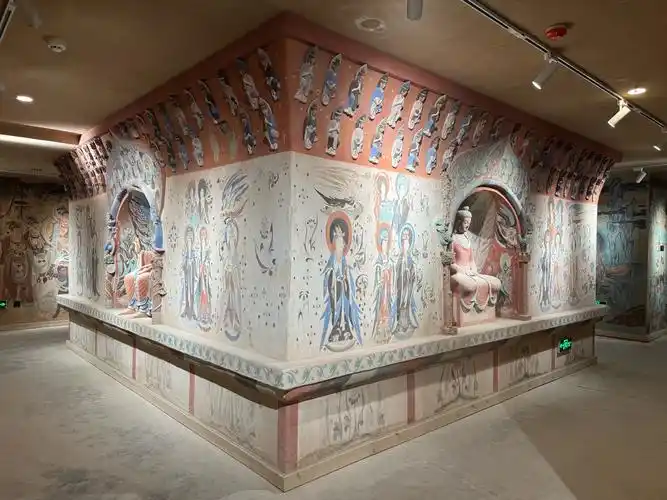 The Mogao Grottoes, carved into desert cliffs near Dunhuang between the 4th and 14th centuries, are often called the "Eastern Louvre" and rank alongside the Sistine Chapel ceilings as one of the world's great monuments of religious art. A UNESCO World Heritage Site since 1987, the complex flourished along the ancient Silk Road, where Buddhist merchants, monks, and pilgrims converged. Like the medieval cathedrals of Europe, the caves serve as both sacred space and painted encyclopedia, their vibrant Tang Dynasty murals—executed between the 7th and 10th centuries—depicting Buddhist sutra tales and grand donor processions. This Lanzhou gallery offers a compelling scholarly introduction.
The gallery's signature feature is its faithful reproduction of four celebrated cave-temples at exact 1:1 scale, paired with 46 high-resolution murals and 3D-printed polychrome statues. Visitors enter a layered, softly illuminated environment where subtle techniques like "powdered-lacquer gilding"—comparable to the gold-leaf detailing seen in Byzantine mosaics at Hagia Sophia or Ravenna—become legible to the naked eye. Because the digital scans capture colors that have oxidized at the original site, the replicas reveal the murals closer to their original brilliance, much as modern reproductions at France's Lascaux aim to preserve Cro-Magnon pigments. The approach makes brushwork unusually accessible.
More than a tourist attraction, the gallery functions as a cultural ambassador, extending the Dunhuang Research Academy's mission to protect and interpret this fragile heritage. Where the actual grottoes limit visitors to brief glimpses behind glass, this venue encourages slow, unmediated looking, an experience closer to studying the carved tympana of Chartres Cathedral at leisure. The thoughtfully curated selection transforms the dispersed treasures of dozens of caves into a coherent narrative, helping visitors grasp how Buddhist iconography traveled the Silk Road much as Christianity's visual language spread through medieval Europe.
Admission is free, and the gallery opens Tuesday through Sunday from 9:00 to 17:00, closing Mondays for maintenance. Complimentary guided tours in Mandarin run daily at 11:00 and 15:00, lasting roughly 45 minutes with no reservation required; some English-language materials are also available. Non-flash photography is permitted, but tripods are not, and free luggage storage is provided on site. Allow 1 to 1.5 hours for a comfortable visit. The facility is barrier-free, air-conditioned, and offers seating in several galleries for those wishing to linger.
The gallery occupies Lanzhou's Chengguan District on the southern Yellow River bank, a scenic promenade often compared to the embankments of Paris or Budapest. It sits within easy walking distance of the Readers Museum and the Waterwheel Expo Garden, allowing visitors to assemble a rewarding half-day cultural itinerary. Travelers without time to reach Dunhuang—a flight or long train ride westward into the Gobi—will find this Lanzhou outpost an invaluable substitute. Those who do continue to the real Mogao will arrive better prepared to appreciate the originals in all their fragile, weathered glory.
The Mogao Grottoes, carved into desert cliffs near Dunhuang between the 4th and 14th centuries, are often called the "Eastern Louvre" and rank alongside the Sistine Chapel ceilings as one of the world's great monuments of religious art. A UNESCO World Heritage Site since 1987, the complex flourished along the ancient Silk Road, where Buddhist merchants, monks, and pilgrims converged. Like the medieval cathedrals of Europe, the caves serve as both sacred space and painted encyclopedia, their vibrant Tang Dynasty murals—executed between the 7th and 10th centuries—depicting Buddhist sutra tales and grand donor processions. This Lanzhou gallery offers a compelling scholarly introduction.
The gallery's signature feature is its faithful reproduction of four celebrated cave-temples at exact 1:1 scale, paired with 46 high-resolution murals and 3D-printed polychrome statues. Visitors enter a layered, softly illuminated environment where subtle techniques like "powdered-lacquer gilding"—comparable to the gold-leaf detailing seen in Byzantine mosaics at Hagia Sophia or Ravenna—become legible to the naked eye. Because the digital scans capture colors that have oxidized at the original site, the replicas reveal the murals closer to their original brilliance, much as modern reproductions at France's Lascaux aim to preserve Cro-Magnon pigments. The approach makes brushwork unusually accessible.
More than a tourist attraction, the gallery functions as a cultural ambassador, extending the Dunhuang Research Academy's mission to protect and interpret this fragile heritage. Where the actual grottoes limit visitors to brief glimpses behind glass, this venue encourages slow, unmediated looking, an experience closer to studying the carved tympana of Chartres Cathedral at leisure. The thoughtfully curated selection transforms the dispersed treasures of dozens of caves into a coherent narrative, helping visitors grasp how Buddhist iconography traveled the Silk Road much as Christianity's visual language spread through medieval Europe.
Admission is free, and the gallery opens Tuesday through Sunday from 9:00 to 17:00, closing Mondays for maintenance. Complimentary guided tours in Mandarin run daily at 11:00 and 15:00, lasting roughly 45 minutes with no reservation required; some English-language materials are also available. Non-flash photography is permitted, but tripods are not, and free luggage storage is provided on site. Allow 1 to 1.5 hours for a comfortable visit. The facility is barrier-free, air-conditioned, and offers seating in several galleries for those wishing to linger.
The gallery occupies Lanzhou's Chengguan District on the southern Yellow River bank, a scenic promenade often compared to the embankments of Paris or Budapest. It sits within easy walking distance of the Readers Museum and the Waterwheel Expo Garden, allowing visitors to assemble a rewarding half-day cultural itinerary. Travelers without time to reach Dunhuang—a flight or long train ride westward into the Gobi—will find this Lanzhou outpost an invaluable substitute. Those who do continue to the real Mogao will arrive better prepared to appreciate the originals in all their fragile, weathered glory.