Dunhuang Museum
⭐ 4.70
Dunhuang Museum, Dunhuang City, Gansu Province, China
 The Silk Road is often compared to the ancient Roman trade networks that linked the Mediterranean to distant Asia, and Dunhuang stood as its vital western gateway just as Antioch once did for Rome. This museum systematically unravels that legacy, organizing its narrative around the theme "A Cosmopolitan Metropolis at the Crossroads of Civilizations." Scale models of the ancient granary fortress and other archaeological finds transport visitors back to the Han and Tang dynasties, when Dunhuang rivaled Constantinople as a meeting point of merchants, monks, and missionaries carrying goods and ideas across continents. The collections illuminate how Buddhist art, Persian motifs, and Chinese traditions fused here, much as Latin, Greek, and Near Eastern influences mingled in early Christian art.
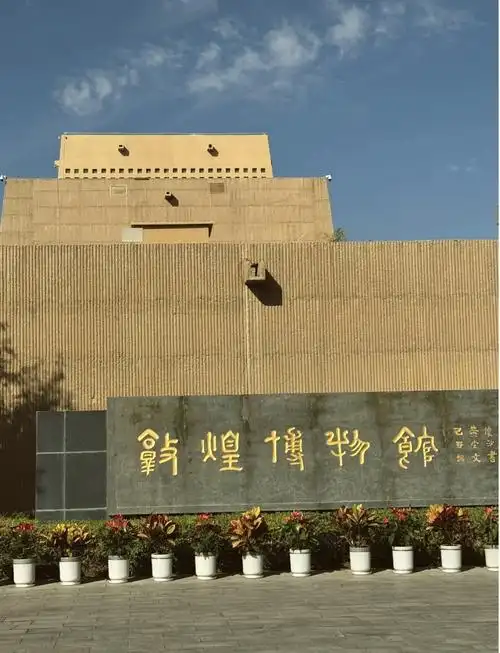
The building itself is worth architectural study, designed by Chinese Academy of Engineering member Cui Kai. Its earthen-yellow palette echoes the surrounding Gobi Desert, while the silhouette evokes the imposing watchtowers of the Great Wall, which stretched hundreds of kilometers to Dunhuang's east. Most striking are the ceiling caisson patterns, directly inspired by the painted dome motifs of the Mogao Caves themselves. Sunlight filters through skylit atria, casting a contemplative glow that prepares visitors for the sacred art within, making the structure a worthy companion to the spiritual treasures it protects, much as the Bauhaus building in Dessau elevates functional architecture to artistic statement.
The crown jewel is undoubtedly the one-to-one reproduction of Mogao Cave 45, widely considered the pinnacle of Tang Dynasty Buddhist sculpture. Where the original cave restricts visitors with dim lighting and strict no-photography rules, this replica invites close examination of the flowing drapery folds, serene facial expressions, and surviving mineral pigments on figures like the bodhisattva beside the Buddha. Photography is permitted, allowing travelers to capture details that even pre-Camera-era European pilgrims to holy sites could not. Complementing this masterpiece are treasures such as a Han Dynasty bronze ox-cart, Wei-Jin period pictorial tomb bricks, and a Northern Liang stone pagoda, recognized as one of the earliest surviving Buddhist reliquaries in China.
Practical logistics are refreshingly straightforward for a site of this caliber. Located at 1390 Mingshan North Road in central Dunhuang, the museum enjoys easy access from most hotels. From May through September, doors open Tuesday through Sunday from 8:30 to 18:30, while winter hours shift to 9:00 to 18:00. The museum closes on Mondays, except for International Museum Day on May 18. Admission is free, though advance real-name reservation via the official WeChat account or Meituan app is mandatory. Plan for two to three hours, and strongly consider renting an audio guide or booking a human docent to navigate the chronological flow from permanent exhibitions to the Cave 45 replica.
A separate digital immersive experience, priced around 38 yuan per person, offers VR and AR interactions that bring the Silk Road's vanished caravanserais and bustling markets back to vivid life, ideal for families with children or dedicated enthusiasts seeking deeper engagement. Following the recommended route, "Permanent Exhibition → Cave 45 Replica → Multi-Ethnic Heritage Corridor," visitors can then walk directly to the Mogao Caves Digital Exhibition Center, creating a complete cultural loop. In much the same way that visitors to Florence use the Uffizi as preparation for the Duomo and Baptistery, treating the Dunhuang Museum as an essential prelude transforms a simple cave visit into a richly contextualized journey through one of human history's most extraordinary cultural exchanges.
The Silk Road is often compared to the ancient Roman trade networks that linked the Mediterranean to distant Asia, and Dunhuang stood as its vital western gateway just as Antioch once did for Rome. This museum systematically unravels that legacy, organizing its narrative around the theme "A Cosmopolitan Metropolis at the Crossroads of Civilizations." Scale models of the ancient granary fortress and other archaeological finds transport visitors back to the Han and Tang dynasties, when Dunhuang rivaled Constantinople as a meeting point of merchants, monks, and missionaries carrying goods and ideas across continents. The collections illuminate how Buddhist art, Persian motifs, and Chinese traditions fused here, much as Latin, Greek, and Near Eastern influences mingled in early Christian art.
The building itself is worth architectural study, designed by Chinese Academy of Engineering member Cui Kai. Its earthen-yellow palette echoes the surrounding Gobi Desert, while the silhouette evokes the imposing watchtowers of the Great Wall, which stretched hundreds of kilometers to Dunhuang's east. Most striking are the ceiling caisson patterns, directly inspired by the painted dome motifs of the Mogao Caves themselves. Sunlight filters through skylit atria, casting a contemplative glow that prepares visitors for the sacred art within, making the structure a worthy companion to the spiritual treasures it protects, much as the Bauhaus building in Dessau elevates functional architecture to artistic statement.
The crown jewel is undoubtedly the one-to-one reproduction of Mogao Cave 45, widely considered the pinnacle of Tang Dynasty Buddhist sculpture. Where the original cave restricts visitors with dim lighting and strict no-photography rules, this replica invites close examination of the flowing drapery folds, serene facial expressions, and surviving mineral pigments on figures like the bodhisattva beside the Buddha. Photography is permitted, allowing travelers to capture details that even pre-Camera-era European pilgrims to holy sites could not. Complementing this masterpiece are treasures such as a Han Dynasty bronze ox-cart, Wei-Jin period pictorial tomb bricks, and a Northern Liang stone pagoda, recognized as one of the earliest surviving Buddhist reliquaries in China.
Practical logistics are refreshingly straightforward for a site of this caliber. Located at 1390 Mingshan North Road in central Dunhuang, the museum enjoys easy access from most hotels. From May through September, doors open Tuesday through Sunday from 8:30 to 18:30, while winter hours shift to 9:00 to 18:00. The museum closes on Mondays, except for International Museum Day on May 18. Admission is free, though advance real-name reservation via the official WeChat account or Meituan app is mandatory. Plan for two to three hours, and strongly consider renting an audio guide or booking a human docent to navigate the chronological flow from permanent exhibitions to the Cave 45 replica.
A separate digital immersive experience, priced around 38 yuan per person, offers VR and AR interactions that bring the Silk Road's vanished caravanserais and bustling markets back to vivid life, ideal for families with children or dedicated enthusiasts seeking deeper engagement. Following the recommended route, "Permanent Exhibition → Cave 45 Replica → Multi-Ethnic Heritage Corridor," visitors can then walk directly to the Mogao Caves Digital Exhibition Center, creating a complete cultural loop. In much the same way that visitors to Florence use the Uffizi as preparation for the Duomo and Baptistery, treating the Dunhuang Museum as an essential prelude transforms a simple cave visit into a richly contextualized journey through one of human history's most extraordinary cultural exchanges.