Yangguan Pass Site
⭐ 4.20
Yangguan Site, Dunhuang, Gansu Province, China
 PARAGRAPH 1: Historical Context
Founded during the Western Han dynasty (111–116 BC) under Emperor Wu's grand westward expansion, Yangguan was among the earliest land-based customs posts regulating traffic between China and Central Asia. While Rome's legions were consolidating the empire's northern limes, Han generals were pushing deep into the Tarim Basin, securing trade routes that would eventually carry silk to Mediterranean markets as far away as Antioch and Alexandria. Positioned at the southern gateway to the Taklamakan Desert—mirroring how Roman frontier forts like Hadrian's Wall guarded Britannia's edge—Yangguan controlled passage along the southern Silk Road corridor, vetting caravans, collecting duties, and signaling threats via its beacon network. For centuries, every merchant, monk, and diplomat heading west from Chang'an passed beneath its walls.
PARAGRAPH 2: Architecture & Setting
The surviving Dundunshan beacon tower, standing roughly 4.7 meters tall after two millennia of wind erosion, is the only original structure still climbable at the site. Built of layered rammed earth and tamarisk branches—a construction technique also found in the contemporaneous Juyan frontier system—it once flared smoke and fire to relay warnings across a chain stretching toward Dunhuang. Nearby, excavated foundations of the Han Great Wall reveal how frontier garrisons integrated natural desert features into their defensive lines, much like the Romans exploited the fossatum in North Africa. Walking the wooden boardwalk toward the pass, visitors encounter ancient wheel ruts carved deep into compacted earth—silent testimony to countless laden caravans heading toward Khotan and beyond.
PARAGRAPH 3: Cultural Significance
No site in China better embodies the romantic ache of departure than Yangguan, immortalized by Tang dynasty poet Wang Wei in his parting song: "Drink one last cup of wine with me—west past Yangguan, you'll find no old friends." This single verse has shaped Chinese literary imagination for over 1,200 years, transforming a frontier outpost into the universal symbol of farewell and the unknown. The museum, a nationally ranked facility housing nearly 4,000 objects including Han bamboo manuscripts, cold weapons, and Silk Road ceramics, contextualizes this poetic legacy against the gritty realities of border military life and transcontinental commerce.
PARAGRAPH 4: Immersive Experiences
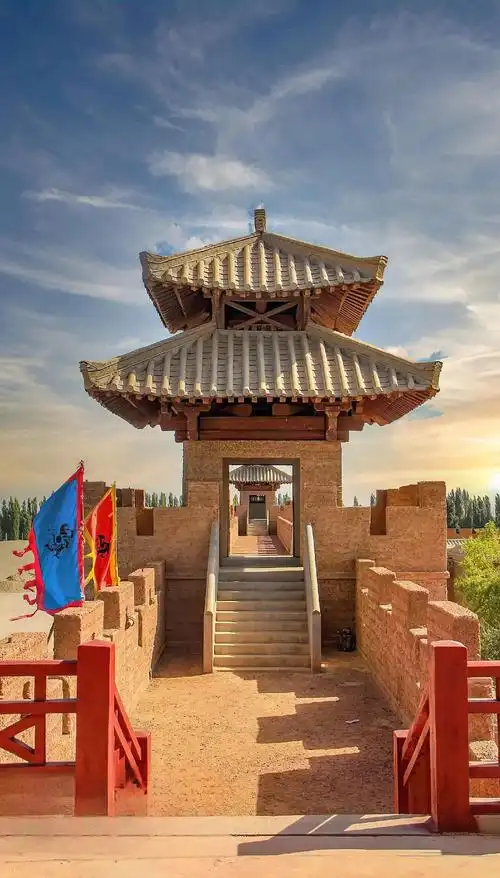
Beyond conventional sightseeing, the park offers hands-on encounters that bring Han-era travel to life. At the replica gatehouse, visitors can stamp their own passport-like通关文牒 (pass document) complete with official seal—a keepsake echoing the wooden tallies carried by Tang pilgrims like Xuanzang. Activities include bamboo-slip calligraphy transcription, pottery-making workshops, and archery ranges where one might imagine facing Xiongnu raiders. Camel treks across the ochre dunes and horse-cart rides along the old road provide atmospheric alternatives, while sunset photography from the beacon hill captures the same "straight smoke over the boundless desert" imagery that inspired Tang frontier painters.
PARAGRAPH 5: Practical Information
Admission is 50 RMB per person, plus a mandatory 10 RMB sightseeing shuttle—essential, as the ruins lie roughly two kilometers from the museum and parking area. Optional extras include camel rides (around 80 RMB) and horse-cart excursions. The site stays open until 8:00 PM from April through October and until 7:30 PM in winter; allow two to three hours for a meaningful visit. Because Yangguan sits deep in the Gobi with no public transit, renting a car or joining a Dunhuang west-line tour is strongly recommended. Arriving in late afternoon rewards visitors with both golden-hour light on the beacon tower and, on clear nights, a spectacular Milky Way overhead.
PARAGRAPH 6: Why Visit
Yangguan offers something increasingly rare in modern tourism: genuine emptiness and silence, where the only sounds are wind and the distant clip of camel bells. Its power lies not in monumental architecture but in atmosphere—the precise landscape where Chinese civilization bid farewell to its travelers for two millennia. Travelers who arrive familiar with Wang Wei's verse, or who join a guided interpretation of beacon systems and caravan logistics, will find the experience deeply resonant. Those rushing through may leave underwhelmed. Budget extra time, bring water and sun protection, and let the vast western horizon do its work: this is the Silk Road as the ancients knew it, still breathing beneath an open sky.
PARAGRAPH 1: Historical Context
Founded during the Western Han dynasty (111–116 BC) under Emperor Wu's grand westward expansion, Yangguan was among the earliest land-based customs posts regulating traffic between China and Central Asia. While Rome's legions were consolidating the empire's northern limes, Han generals were pushing deep into the Tarim Basin, securing trade routes that would eventually carry silk to Mediterranean markets as far away as Antioch and Alexandria. Positioned at the southern gateway to the Taklamakan Desert—mirroring how Roman frontier forts like Hadrian's Wall guarded Britannia's edge—Yangguan controlled passage along the southern Silk Road corridor, vetting caravans, collecting duties, and signaling threats via its beacon network. For centuries, every merchant, monk, and diplomat heading west from Chang'an passed beneath its walls.
PARAGRAPH 2: Architecture & Setting
The surviving Dundunshan beacon tower, standing roughly 4.7 meters tall after two millennia of wind erosion, is the only original structure still climbable at the site. Built of layered rammed earth and tamarisk branches—a construction technique also found in the contemporaneous Juyan frontier system—it once flared smoke and fire to relay warnings across a chain stretching toward Dunhuang. Nearby, excavated foundations of the Han Great Wall reveal how frontier garrisons integrated natural desert features into their defensive lines, much like the Romans exploited the fossatum in North Africa. Walking the wooden boardwalk toward the pass, visitors encounter ancient wheel ruts carved deep into compacted earth—silent testimony to countless laden caravans heading toward Khotan and beyond.
PARAGRAPH 3: Cultural Significance
No site in China better embodies the romantic ache of departure than Yangguan, immortalized by Tang dynasty poet Wang Wei in his parting song: "Drink one last cup of wine with me—west past Yangguan, you'll find no old friends." This single verse has shaped Chinese literary imagination for over 1,200 years, transforming a frontier outpost into the universal symbol of farewell and the unknown. The museum, a nationally ranked facility housing nearly 4,000 objects including Han bamboo manuscripts, cold weapons, and Silk Road ceramics, contextualizes this poetic legacy against the gritty realities of border military life and transcontinental commerce.
PARAGRAPH 4: Immersive Experiences
Beyond conventional sightseeing, the park offers hands-on encounters that bring Han-era travel to life. At the replica gatehouse, visitors can stamp their own passport-like通关文牒 (pass document) complete with official seal—a keepsake echoing the wooden tallies carried by Tang pilgrims like Xuanzang. Activities include bamboo-slip calligraphy transcription, pottery-making workshops, and archery ranges where one might imagine facing Xiongnu raiders. Camel treks across the ochre dunes and horse-cart rides along the old road provide atmospheric alternatives, while sunset photography from the beacon hill captures the same "straight smoke over the boundless desert" imagery that inspired Tang frontier painters.
PARAGRAPH 5: Practical Information
Admission is 50 RMB per person, plus a mandatory 10 RMB sightseeing shuttle—essential, as the ruins lie roughly two kilometers from the museum and parking area. Optional extras include camel rides (around 80 RMB) and horse-cart excursions. The site stays open until 8:00 PM from April through October and until 7:30 PM in winter; allow two to three hours for a meaningful visit. Because Yangguan sits deep in the Gobi with no public transit, renting a car or joining a Dunhuang west-line tour is strongly recommended. Arriving in late afternoon rewards visitors with both golden-hour light on the beacon tower and, on clear nights, a spectacular Milky Way overhead.
PARAGRAPH 6: Why Visit
Yangguan offers something increasingly rare in modern tourism: genuine emptiness and silence, where the only sounds are wind and the distant clip of camel bells. Its power lies not in monumental architecture but in atmosphere—the precise landscape where Chinese civilization bid farewell to its travelers for two millennia. Travelers who arrive familiar with Wang Wei's verse, or who join a guided interpretation of beacon systems and caravan logistics, will find the experience deeply resonant. Those rushing through may leave underwhelmed. Budget extra time, bring water and sun protection, and let the vast western horizon do its work: this is the Silk Road as the ancients knew it, still breathing beneath an open sky.