Luoxi Park
⭐ 3.20
Luoxi Park, Gaoping District, Nanchong City, Sichuan Province, China
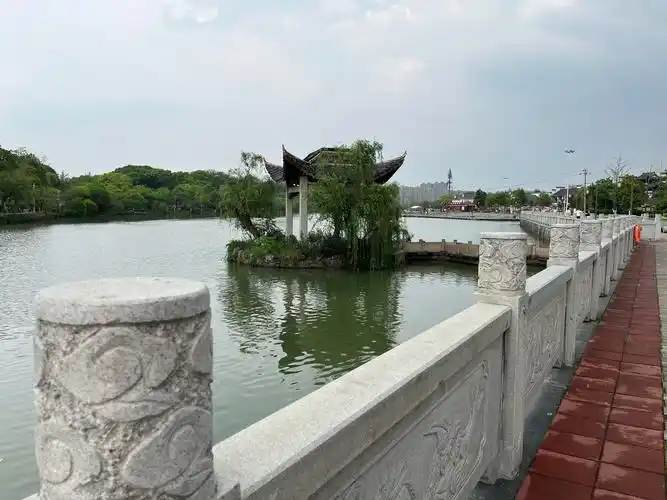 Nanchong has flourished for over 2,200 years along the Jialing River, a Yangtze tributary as central to Sichuan's identity as the Rhine is to Germany or the Danube to Austria. During the Western Han Dynasty, the city served as a silk-producing hub along southern trade routes connecting the imperial capital to the southwest frontier. Luoxi Park transforms a once-neglected river confluence into a contemporary green corridor, echoing Europe's post-industrial waterfront revivals along Paris's Seine or London's Thames, where former working docks and flood-prone edges have been reborn as beloved public promenades.
The park's design marries flood-control engineering with ecological landscape architecture. Reinforced embankments double as terraced viewing platforms, with vegetated slopes cascading toward wetland shallows. Wooden boardwalks thread through reed beds and pebble shorelines, recalling the wetland walkways of Germany's Rhine Delta or the Camargue in southern France, allowing visitors to step directly above the water's surface. Unlike the formal geometric layouts of Baroque European gardens, the design follows organic curves that respect the river's natural flow and seasonal flooding rhythms.
The wetland functions as vital habitat for migratory waterfowl and native aquatic flora, playing a conservation role similar to the Camargue's protected marshes in France. Just steps away, the historic Chuanzhu Temple neighborhood adds cultural texture, embodying Nanchong's signature character of a "city nestled between mountains and water"—a configuration strikingly reminiscent of Lyon, where the Rhône and Saône rivers similarly define urban identity, or Salzburg, where the Salzach threads through the historic core.
Navigate to the Nanchong International Convention and Exhibition Center as your starting point; from here, allow roughly one hour to traverse the full 2.8-kilometer route westward along the water's edge. Entry is entirely free, with no tickets required. Bring your own drinking water and snacks, as on-site dining options are minimal. Wear non-slip footwear—paths grow slippery after rain—and sun protection is essential during Sichuan's humid summers, when temperatures regularly exceed 32°C.
Best photographed at sunrise or sunset, when soft light gilds the river surface and silhouettes the distant city skyline, the park offers a contemplative escape well suited for jogging, tai chi practice, or quiet family walks. Those seeking lively entertainment should note the absence of rides, playgrounds, or major dining pavilions. Travelers with extra time should pair this visit with Beihu Park across town, contrasting modern riverfront minimalism with traditional Chinese garden landscaping—a juxtaposition comparable to experiencing Paris's contemporary Parc de la Villette alongside the historic Tuileries Gardens.
Nanchong has flourished for over 2,200 years along the Jialing River, a Yangtze tributary as central to Sichuan's identity as the Rhine is to Germany or the Danube to Austria. During the Western Han Dynasty, the city served as a silk-producing hub along southern trade routes connecting the imperial capital to the southwest frontier. Luoxi Park transforms a once-neglected river confluence into a contemporary green corridor, echoing Europe's post-industrial waterfront revivals along Paris's Seine or London's Thames, where former working docks and flood-prone edges have been reborn as beloved public promenades.
The park's design marries flood-control engineering with ecological landscape architecture. Reinforced embankments double as terraced viewing platforms, with vegetated slopes cascading toward wetland shallows. Wooden boardwalks thread through reed beds and pebble shorelines, recalling the wetland walkways of Germany's Rhine Delta or the Camargue in southern France, allowing visitors to step directly above the water's surface. Unlike the formal geometric layouts of Baroque European gardens, the design follows organic curves that respect the river's natural flow and seasonal flooding rhythms.
The wetland functions as vital habitat for migratory waterfowl and native aquatic flora, playing a conservation role similar to the Camargue's protected marshes in France. Just steps away, the historic Chuanzhu Temple neighborhood adds cultural texture, embodying Nanchong's signature character of a "city nestled between mountains and water"—a configuration strikingly reminiscent of Lyon, where the Rhône and Saône rivers similarly define urban identity, or Salzburg, where the Salzach threads through the historic core.
Navigate to the Nanchong International Convention and Exhibition Center as your starting point; from here, allow roughly one hour to traverse the full 2.8-kilometer route westward along the water's edge. Entry is entirely free, with no tickets required. Bring your own drinking water and snacks, as on-site dining options are minimal. Wear non-slip footwear—paths grow slippery after rain—and sun protection is essential during Sichuan's humid summers, when temperatures regularly exceed 32°C.
Best photographed at sunrise or sunset, when soft light gilds the river surface and silhouettes the distant city skyline, the park offers a contemplative escape well suited for jogging, tai chi practice, or quiet family walks. Those seeking lively entertainment should note the absence of rides, playgrounds, or major dining pavilions. Travelers with extra time should pair this visit with Beihu Park across town, contrasting modern riverfront minimalism with traditional Chinese garden landscaping—a juxtaposition comparable to experiencing Paris's contemporary Parc de la Villette alongside the historic Tuileries Gardens.