Mogao Caves
⭐ 4.80
Mogao Town, Dunhuang, Gansu Province, China
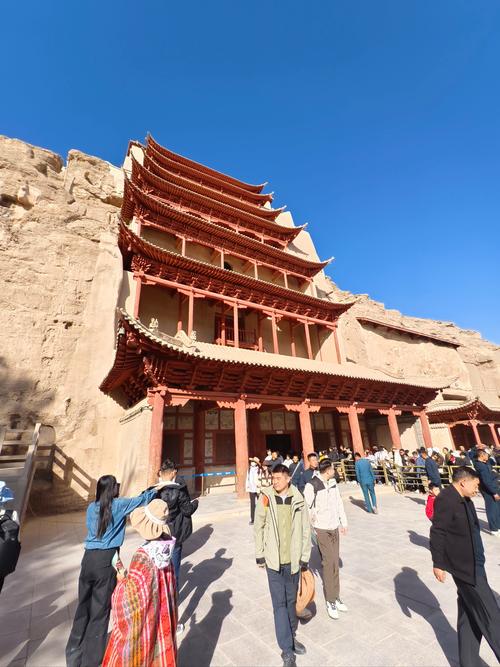 Nicknamed the "Caves of the Thousand Buddhas," the Mogao Caves were first hewn from the desert sandstone in 366 CE, while Europe was still in Late Antiquity and the Western Roman Empire had recently collapsed. Over the following ten centuries, artisans of the Sixteen Kingdoms, Northern Wei, Sui, Tang, Song, Western Xia, and Yuan dynasties continued to carve, paint, and embellish the cliff. This unbroken campaign parallels the construction of Europe's great medieval cathedrals—though here the work was sponsored by Buddhist monks and Silk Road merchants passing through Dunhuang, the strategic oasis where China met the trade routes stretching to Central Asia and beyond.
Stretching 1,600 meters along the cliff, the 735 caves appear in diverse architectural forms: meditation chambers, central-pillar worship halls, and vaulted sanctuaries. Within them, sculptors shaped over 2,400 painted clay figures—serene Buddhas, bodhisattvas, and guardian deities—while anonymous painters covered the walls with roughly 45,000 square meters of murals, more than eight football fields of painted surface. The visual narrative blends Indian Gupta aesthetics, Central Asian influences, and Tang-era Chinese elegance, forming a gallery of evolving religious art with few rivals in scale or preservation.
Unlike the frescoes of Italian Renaissance churches or the ceiling of the Sistine Chapel, Mogao's treasures were sealed behind painted clay walls for centuries, only rediscovered in 1900 when a Daoist monk named Wang Yuanlu uncovered a hidden library cave. The manuscripts and relics found there transformed modern understanding of Silk Road exchange, revealing how Buddhist sutras, trade contracts, and folk songs traveled across Eurasia. The caves themselves stand as a living archive of cross-cultural contact, capturing a moment when Dunhuang rivaled cosmopolitan Venice or Baghdad as a meeting point of East and West.
The Mogao Caves lie about 25 kilometers southeast of Dunhuang city, reachable in roughly 30 minutes by taxi, shuttle bus, or joined tour. Visitors must purchase timed-entry tickets in advance, often weeks ahead during peak season (May through October), and only a limited number of caves are open at any time to protect the fragile murals. Access to the modern digital exhibition center is included with admission, offering high-resolution recreations of the closed grottoes. Temperatures swing dramatically between scorching summer days and freezing winter nights, and photography is strictly prohibited inside the caves.
To stand before a ninth-century Tang bodhisattva painted in lapis lazuli and gold is to glimpse the artistic ambition of an era when China was the most technologically advanced civilization on Earth. The Mogao Caves reward travelers who arrive curious about Buddhism, the Silk Road, or simply the universal human urge to decorate sacred space. Few sites on the planet offer such a tangible, layered encounter with the religious imagination of a vanished world, making this a true pilgrimage for any journey through western China.
Nicknamed the "Caves of the Thousand Buddhas," the Mogao Caves were first hewn from the desert sandstone in 366 CE, while Europe was still in Late Antiquity and the Western Roman Empire had recently collapsed. Over the following ten centuries, artisans of the Sixteen Kingdoms, Northern Wei, Sui, Tang, Song, Western Xia, and Yuan dynasties continued to carve, paint, and embellish the cliff. This unbroken campaign parallels the construction of Europe's great medieval cathedrals—though here the work was sponsored by Buddhist monks and Silk Road merchants passing through Dunhuang, the strategic oasis where China met the trade routes stretching to Central Asia and beyond.
Stretching 1,600 meters along the cliff, the 735 caves appear in diverse architectural forms: meditation chambers, central-pillar worship halls, and vaulted sanctuaries. Within them, sculptors shaped over 2,400 painted clay figures—serene Buddhas, bodhisattvas, and guardian deities—while anonymous painters covered the walls with roughly 45,000 square meters of murals, more than eight football fields of painted surface. The visual narrative blends Indian Gupta aesthetics, Central Asian influences, and Tang-era Chinese elegance, forming a gallery of evolving religious art with few rivals in scale or preservation.
Unlike the frescoes of Italian Renaissance churches or the ceiling of the Sistine Chapel, Mogao's treasures were sealed behind painted clay walls for centuries, only rediscovered in 1900 when a Daoist monk named Wang Yuanlu uncovered a hidden library cave. The manuscripts and relics found there transformed modern understanding of Silk Road exchange, revealing how Buddhist sutras, trade contracts, and folk songs traveled across Eurasia. The caves themselves stand as a living archive of cross-cultural contact, capturing a moment when Dunhuang rivaled cosmopolitan Venice or Baghdad as a meeting point of East and West.
The Mogao Caves lie about 25 kilometers southeast of Dunhuang city, reachable in roughly 30 minutes by taxi, shuttle bus, or joined tour. Visitors must purchase timed-entry tickets in advance, often weeks ahead during peak season (May through October), and only a limited number of caves are open at any time to protect the fragile murals. Access to the modern digital exhibition center is included with admission, offering high-resolution recreations of the closed grottoes. Temperatures swing dramatically between scorching summer days and freezing winter nights, and photography is strictly prohibited inside the caves.
To stand before a ninth-century Tang bodhisattva painted in lapis lazuli and gold is to glimpse the artistic ambition of an era when China was the most technologically advanced civilization on Earth. The Mogao Caves reward travelers who arrive curious about Buddhism, the Silk Road, or simply the universal human urge to decorate sacred space. Few sites on the planet offer such a tangible, layered encounter with the religious imagination of a vanished world, making this a true pilgrimage for any journey through western China.