Zhagyaeba Temple
⭐ 4.50
Zhagyaeba Temple, Mozhugongka County, Lhasa, Tibet Autonomous Region, China
 Zhayeba's origins place it in the same epoch as the Tang Dynasty's height under Emperor Taizong, when Buddhism was simultaneously transforming cultures from Chang'an to Rome. The temple was reportedly commissioned by Songtsen Gampo—Tibet's first great unifier, often compared to Charlemagne—for his beloved consort, Princess Mangsa. While Europe's great medieval cathedrals were still centuries away, Tibetan craftsmen were already drilling meditation chambers into vertical cliffs. The cave tradition here predates even the famous rock-cut monasteries of Cappadocia's later expansions, making Zhayeba a genuine ancestor in humanity's lineage of sacred mountain architecture.
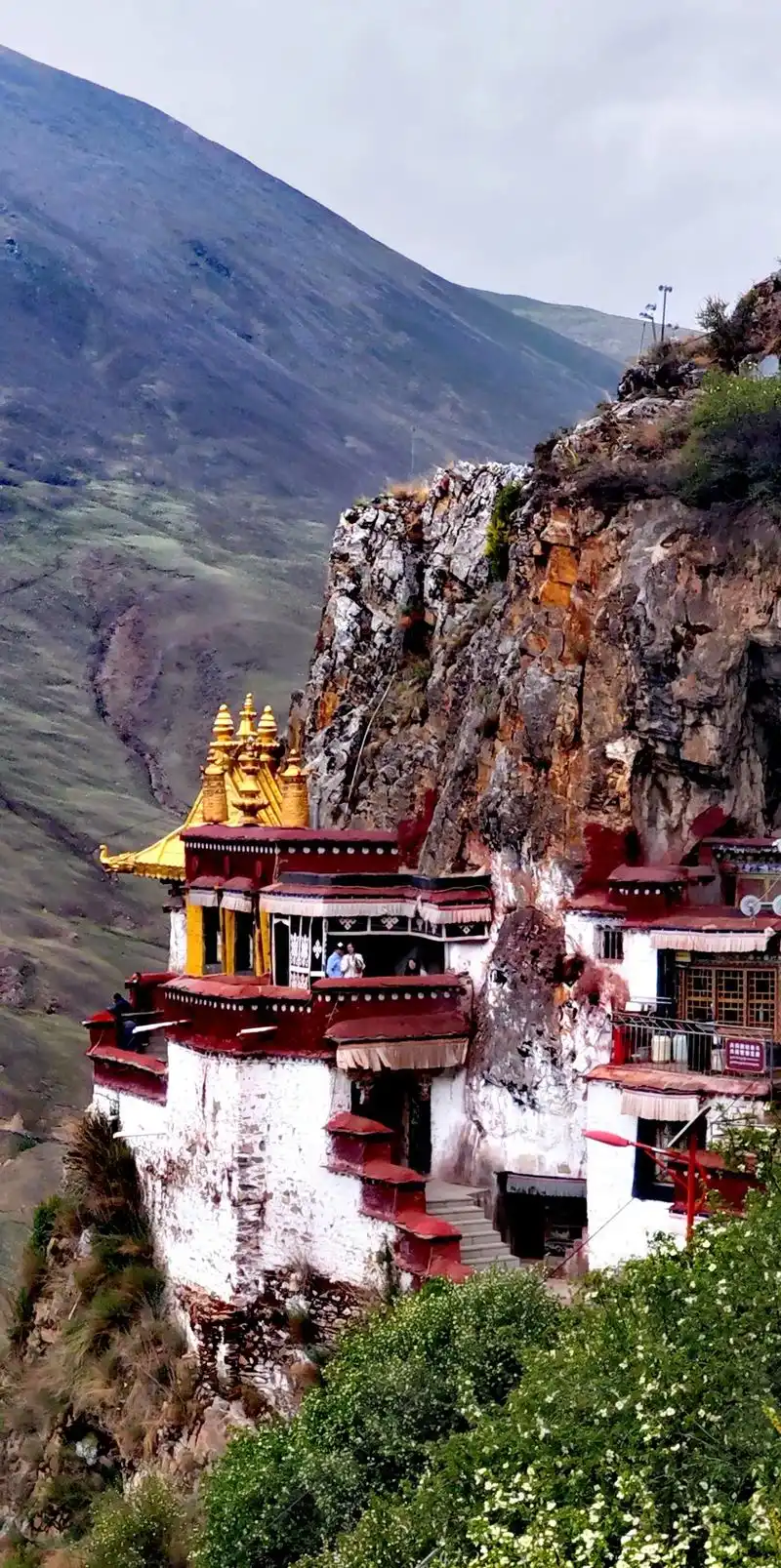
The temple's signature "temple within cave, cave within temple" configuration defies conventional monastery design. Unlike the sprawling horizontal expanse of Drepung, Zhayeba climbs upward—white stupas and crimson walls emerging organically from the mountain's natural fissures, much like swallows' nests pressed against a cathedral wall. Red-and-white prayer walls cascade down the cliff face while prayer flags stretch across narrow ledges, creating ribbons of color against weathered stone. The entire structure reads as a vertical mandala, where every foothold becomes part of the spiritual ascent.
Zhayeba belongs to Tibet's "Four Great Hermitages," a distinction equivalent to Mount Athos in Orthodox Christianity or the desert cells of Mount Sinai. The caves preserve the meditation chambers of Songtsen Gampo, the great tantric master Padmasambhava (Guru Rinpoche), and the 11th-century Indian sage Atisha—figures whose influence rippled across Asia from Bengal to Mongolia. Tibetan wisdom holds that "to visit Lhasa without visiting Zhayeba is like wearing a new robe without a collar." Pilgrims still circumambulate the cliffs, releasing juniper smoke into mountain winds, continuing a tradition unbroken since the seventh century.
The temple lies 20 to 40 kilometers from central Lhasa, roughly an hour by car—private hire or self-drive is strongly recommended, as public buses are infrequent. Visitors must climb 200 to 300 meters of steep stairs from the parking area to reach the upper caves; the altitude makes this climb considerably harder than equivalent European mountain walks, and oxygen cans, sunglasses, and layered windproof clothing are essential. Entry costs 30 to 50 yuan. Foreign travelers must arrange a Tibet Travel Permit through a licensed agency and travel with a guide in a dedicated vehicle.
Photography is forbidden inside the chapels; visitors must walk clockwise around shrines and prayer wheels, never touch ritual objects, and maintain silence near meditating monks. Bring your own water and snacks—facilities on the mountain are minimal. The best windows are May and June, when rhododendrons bloom against the cliffs, and September and October, when autumn light gilds the white stupas. Arrive between 7 and 9 a.m. to catch the morning alpenglow and beat the tour buses.
Zhayeba offers what neither the Potala nor Jokhang can: an unmediated encounter with the raw, cliff-bound origins of Tibetan Buddhism. Where the capital's great monuments feel curated for visitors, this working hermitage retains the austere atmosphere of a true retreat—where prayer flags still snap in Himalayan winds and incense smoke still drifts from caves where masters meditated a millennium before the Vikings reached North America. For travelers seeking the spiritual pulse of Tibet beyond its postcard icons, Zhayeba is the genuine article.
Zhayeba's origins place it in the same epoch as the Tang Dynasty's height under Emperor Taizong, when Buddhism was simultaneously transforming cultures from Chang'an to Rome. The temple was reportedly commissioned by Songtsen Gampo—Tibet's first great unifier, often compared to Charlemagne—for his beloved consort, Princess Mangsa. While Europe's great medieval cathedrals were still centuries away, Tibetan craftsmen were already drilling meditation chambers into vertical cliffs. The cave tradition here predates even the famous rock-cut monasteries of Cappadocia's later expansions, making Zhayeba a genuine ancestor in humanity's lineage of sacred mountain architecture.
The temple's signature "temple within cave, cave within temple" configuration defies conventional monastery design. Unlike the sprawling horizontal expanse of Drepung, Zhayeba climbs upward—white stupas and crimson walls emerging organically from the mountain's natural fissures, much like swallows' nests pressed against a cathedral wall. Red-and-white prayer walls cascade down the cliff face while prayer flags stretch across narrow ledges, creating ribbons of color against weathered stone. The entire structure reads as a vertical mandala, where every foothold becomes part of the spiritual ascent.
Zhayeba belongs to Tibet's "Four Great Hermitages," a distinction equivalent to Mount Athos in Orthodox Christianity or the desert cells of Mount Sinai. The caves preserve the meditation chambers of Songtsen Gampo, the great tantric master Padmasambhava (Guru Rinpoche), and the 11th-century Indian sage Atisha—figures whose influence rippled across Asia from Bengal to Mongolia. Tibetan wisdom holds that "to visit Lhasa without visiting Zhayeba is like wearing a new robe without a collar." Pilgrims still circumambulate the cliffs, releasing juniper smoke into mountain winds, continuing a tradition unbroken since the seventh century.
The temple lies 20 to 40 kilometers from central Lhasa, roughly an hour by car—private hire or self-drive is strongly recommended, as public buses are infrequent. Visitors must climb 200 to 300 meters of steep stairs from the parking area to reach the upper caves; the altitude makes this climb considerably harder than equivalent European mountain walks, and oxygen cans, sunglasses, and layered windproof clothing are essential. Entry costs 30 to 50 yuan. Foreign travelers must arrange a Tibet Travel Permit through a licensed agency and travel with a guide in a dedicated vehicle.
Photography is forbidden inside the chapels; visitors must walk clockwise around shrines and prayer wheels, never touch ritual objects, and maintain silence near meditating monks. Bring your own water and snacks—facilities on the mountain are minimal. The best windows are May and June, when rhododendrons bloom against the cliffs, and September and October, when autumn light gilds the white stupas. Arrive between 7 and 9 a.m. to catch the morning alpenglow and beat the tour buses.
Zhayeba offers what neither the Potala nor Jokhang can: an unmediated encounter with the raw, cliff-bound origins of Tibetan Buddhism. Where the capital's great monuments feel curated for visitors, this working hermitage retains the austere atmosphere of a true retreat—where prayer flags still snap in Himalayan winds and incense smoke still drifts from caves where masters meditated a millennium before the Vikings reached North America. For travelers seeking the spiritual pulse of Tibet beyond its postcard icons, Zhayeba is the genuine article.