Potala Palace
⭐ 4.70
No. 35, Gongqian Alley, Beijing Middle Road, Chengguan District, Lhasa, Tibet Autonomous Region, China
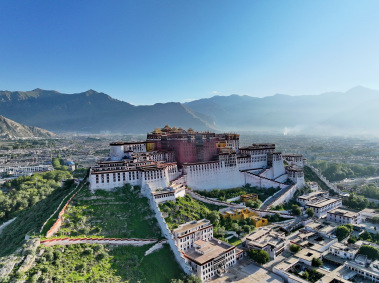 The Potala Palace's origins stretch back to the 7th century, when Tibetan King Songtsen Gampo commissioned the first fortress—roughly contemporary with the rise of Charlemagne's empire in Europe. The complex as it stands today, however, took shape during the 17th century under the Fifth Dalai Lama, who transformed it into the grand seat of both spiritual and political power. Much like Versailles or the Vatican, the palace represented the fusion of religious authority and governmental rule, making it both a monastery and a royal residence rolled into one.
Rising over 300 meters from the base of Red Hill to its summit, the palace appears almost to grow from the mountain itself—a design philosophy that echoes medieval European clifftop castles like Hohensalzburg in Austria. The complex divides into two main sections: the central Red Palace, dedicated to religious rites and housing the elaborate funerary stupas of past Dalai Lamas (the Fifth's tomb alone is encrusted with over 10,000 pearls and gemstones), and the surrounding White Palace, which served as the administrative center and residence of the Dalai Lamas. The harmony of fortress architecture with traditional Tibetan monastic design represents one of the great achievements of sacred architecture.
Beyond its architectural grandeur, the Potala Palace is a vast treasury of Tibetan Buddhist art. Its halls contain tens of thousands of murals, sculptures, thangkas, and ancient scriptures—works created over centuries by master craftsmen whose devotion infuses every detail. Comparable in scale and importance to the Sistine Chapel's frescoes or the manuscripts preserved at Saint Catherine's Monastery in Egypt, these collections document Tibetan religious thought, history, and daily life. Every painting and statue embodies a spiritual offering, making the palace as much a living religious site as a museum.
Visiting the Potala Palace requires advance planning: tickets must be reserved through the official WeChat mini-program up to ten days ahead during peak season, with no on-site sales. Two routes are offered—Line 1 (approximately 200 RMB) and the more economical Line 2 (around 100 RMB)—each strictly one-way and limited to roughly one hour inside. Photography is forbidden within the halls, and hats must be removed as a sign of respect. Visitors should familiarize themselves with Tibetan Buddhist etiquette before arrival.
At 3,700 meters (12,140 feet), the altitude alone demands caution—comparable to high Alpine ski resorts. Travelers are advised to acclimatize in Lhasa for one to two days before visiting, move slowly through the many staircases, and carry portable oxygen. For exterior photography, three classic vantage points await: the Yaowang Mountain observation deck (the iconic postcard view), Zongjiao Lukang Park (offering stunning reflections in the lake), and the broad Potala Palace Square for sweeping panoramas of the entire complex.
Few sites on earth combine such extremes: a working religious center, a royal palace, a fortress, an art gallery, and a mountain stronghold all in one. To stand in its prayer halls is to encounter a civilization that has preserved its traditions against tremendous historical pressures. For Western travelers accustomed to the cathedrals and palaces of Europe, the Potala Palace offers something genuinely different—a place where the medieval and the modern still coexist, and where every stone, painting, and prayer flag speaks to humanity's universal search for meaning beyond the everyday.
The Potala Palace's origins stretch back to the 7th century, when Tibetan King Songtsen Gampo commissioned the first fortress—roughly contemporary with the rise of Charlemagne's empire in Europe. The complex as it stands today, however, took shape during the 17th century under the Fifth Dalai Lama, who transformed it into the grand seat of both spiritual and political power. Much like Versailles or the Vatican, the palace represented the fusion of religious authority and governmental rule, making it both a monastery and a royal residence rolled into one.
Rising over 300 meters from the base of Red Hill to its summit, the palace appears almost to grow from the mountain itself—a design philosophy that echoes medieval European clifftop castles like Hohensalzburg in Austria. The complex divides into two main sections: the central Red Palace, dedicated to religious rites and housing the elaborate funerary stupas of past Dalai Lamas (the Fifth's tomb alone is encrusted with over 10,000 pearls and gemstones), and the surrounding White Palace, which served as the administrative center and residence of the Dalai Lamas. The harmony of fortress architecture with traditional Tibetan monastic design represents one of the great achievements of sacred architecture.
Beyond its architectural grandeur, the Potala Palace is a vast treasury of Tibetan Buddhist art. Its halls contain tens of thousands of murals, sculptures, thangkas, and ancient scriptures—works created over centuries by master craftsmen whose devotion infuses every detail. Comparable in scale and importance to the Sistine Chapel's frescoes or the manuscripts preserved at Saint Catherine's Monastery in Egypt, these collections document Tibetan religious thought, history, and daily life. Every painting and statue embodies a spiritual offering, making the palace as much a living religious site as a museum.
Visiting the Potala Palace requires advance planning: tickets must be reserved through the official WeChat mini-program up to ten days ahead during peak season, with no on-site sales. Two routes are offered—Line 1 (approximately 200 RMB) and the more economical Line 2 (around 100 RMB)—each strictly one-way and limited to roughly one hour inside. Photography is forbidden within the halls, and hats must be removed as a sign of respect. Visitors should familiarize themselves with Tibetan Buddhist etiquette before arrival.
At 3,700 meters (12,140 feet), the altitude alone demands caution—comparable to high Alpine ski resorts. Travelers are advised to acclimatize in Lhasa for one to two days before visiting, move slowly through the many staircases, and carry portable oxygen. For exterior photography, three classic vantage points await: the Yaowang Mountain observation deck (the iconic postcard view), Zongjiao Lukang Park (offering stunning reflections in the lake), and the broad Potala Palace Square for sweeping panoramas of the entire complex.
Few sites on earth combine such extremes: a working religious center, a royal palace, a fortress, an art gallery, and a mountain stronghold all in one. To stand in its prayer halls is to encounter a civilization that has preserved its traditions against tremendous historical pressures. For Western travelers accustomed to the cathedrals and palaces of Europe, the Potala Palace offers something genuinely different—a place where the medieval and the modern still coexist, and where every stone, painting, and prayer flag speaks to humanity's universal search for meaning beyond the everyday.