Guangchuan Ancient City Ruins
⭐ 3.50
Guangchuan Ancient City Ruins, Decheng District, Dezhou City, Shandong Province, China
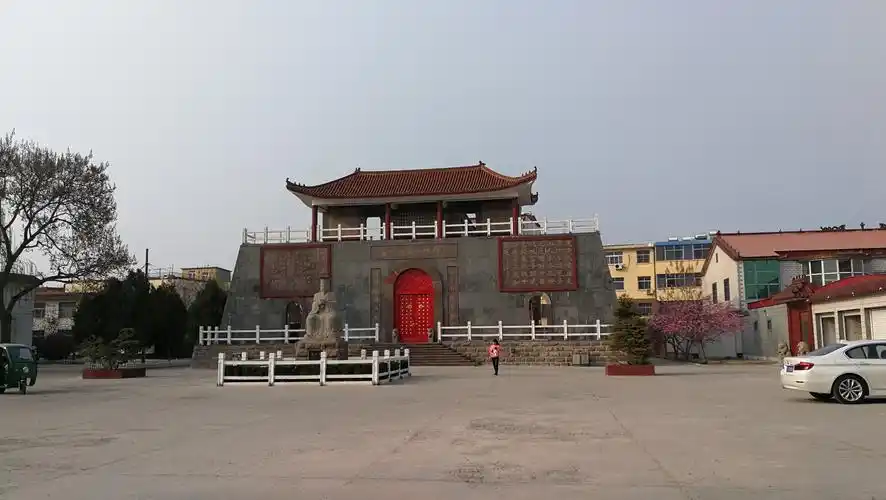 The city wall of Dezhou was raised in 1397 during the founding Hongwu reign of the Ming Dynasty, just as the Renaissance was reshaping Florence and Istanbul was completing its Ottoman fortifications. Stretching around a deliberately elongated footprint that locals likened to a riding boot, the fortress guarded a vital junction on the Grand Canal, then the busiest commercial waterway on Earth, comparable in importance to the Rhine or the Danube. The Grand Canal itself earned UNESCO World Heritage status in 2014, and this wall fragment sits on its historic northern reach. Today, the lone surviving corner tower stands where the northwestern rampart once met the moat, a reminder that even China's largest cities, much like York or Ghent, were once encircled by towering brick ramparts.
The remaining structure measures about 10 meters tall, 10 meters wide, and 15 meters long, with a core of compacted yellow rammed earth faced in fired grey bricks laid in traditional Ming coursing. Six centuries of wind, frost, and cannon fire have not loosened the masonry, which still reads clearly as a textbook example of late-14th-century military engineering. A small white national geodetic marker crowns the walltop, an intriguing meeting point between a satellite-era coordinate and a fortress built when gunpowder warfare was still in its infancy. Visitors cannot climb or touch the wall, but the brick texture and weathering patterns are visible from the perimeter fencing, offering a rare open-air lesson in premodern construction.
The site carries layered memories that span eras. In 1937, just weeks after the Marco Polo Bridge Incident ignited full-scale war with Japan, local resistance fighters fired the first shots of Shandong's anti-Japanese struggle from this very corner. Nine years later, in 1946, the same northwest angle served as a breach point during the battle to liberate Dezhou from Nationalist forces. The location also holds older cultural resonance: the nearby historic watergate, once called Guangchuan Gate and also known as the Little West Gate, takes its name from the ancient Guangchuan County, which is also celebrated as the homeland of the Han Dynasty philosopher Dong Zhongshu, often compared to Aristotle for his influence on Chinese statecraft.
Getting there requires a little initiative. The ruins sit about 300 meters southwest of the intersection of Qingnian Road and Yingbin Avenue in the Decheng District's Xinhu Subdistrict, uncomfortably close to the Beijing-Shanghai railway tracks. There is no entrance fee, no parking, and no visitor services, just a fenced-off preservation zone. Taxis or ride-hailing to either the Xinhu Subdistrict Office or the Jiuda Antique Market are the most practical options, followed by a short five-minute walk. Public buses are infrequent, so checking schedules in advance is wise. Photography is permitted from outside the fence, but drones are strictly prohibited.
Pairing the visit with nearby sites makes the trip worthwhile. Begin the morning at the Dezhou City Museum for context on the Grand Canal, local military history, and the region's celebrated black pottery, then walk or take a short ride to the wall fragment. From there, stroll south to the UNESCO-listed Grand Canal waterfront, pass the ruins of Cisi Temple, and end at the photogenic Jiuda Tianqu Memorial Archway. For travelers drawn to Ming Dynasty fortifications, Sino-Japanese War history, or the philosophical legacy of Dong Zhongshu, this small, unassuming ruin offers something no glossy reconstruction can match: the genuine patina of time.
The city wall of Dezhou was raised in 1397 during the founding Hongwu reign of the Ming Dynasty, just as the Renaissance was reshaping Florence and Istanbul was completing its Ottoman fortifications. Stretching around a deliberately elongated footprint that locals likened to a riding boot, the fortress guarded a vital junction on the Grand Canal, then the busiest commercial waterway on Earth, comparable in importance to the Rhine or the Danube. The Grand Canal itself earned UNESCO World Heritage status in 2014, and this wall fragment sits on its historic northern reach. Today, the lone surviving corner tower stands where the northwestern rampart once met the moat, a reminder that even China's largest cities, much like York or Ghent, were once encircled by towering brick ramparts.
The remaining structure measures about 10 meters tall, 10 meters wide, and 15 meters long, with a core of compacted yellow rammed earth faced in fired grey bricks laid in traditional Ming coursing. Six centuries of wind, frost, and cannon fire have not loosened the masonry, which still reads clearly as a textbook example of late-14th-century military engineering. A small white national geodetic marker crowns the walltop, an intriguing meeting point between a satellite-era coordinate and a fortress built when gunpowder warfare was still in its infancy. Visitors cannot climb or touch the wall, but the brick texture and weathering patterns are visible from the perimeter fencing, offering a rare open-air lesson in premodern construction.
The site carries layered memories that span eras. In 1937, just weeks after the Marco Polo Bridge Incident ignited full-scale war with Japan, local resistance fighters fired the first shots of Shandong's anti-Japanese struggle from this very corner. Nine years later, in 1946, the same northwest angle served as a breach point during the battle to liberate Dezhou from Nationalist forces. The location also holds older cultural resonance: the nearby historic watergate, once called Guangchuan Gate and also known as the Little West Gate, takes its name from the ancient Guangchuan County, which is also celebrated as the homeland of the Han Dynasty philosopher Dong Zhongshu, often compared to Aristotle for his influence on Chinese statecraft.
Getting there requires a little initiative. The ruins sit about 300 meters southwest of the intersection of Qingnian Road and Yingbin Avenue in the Decheng District's Xinhu Subdistrict, uncomfortably close to the Beijing-Shanghai railway tracks. There is no entrance fee, no parking, and no visitor services, just a fenced-off preservation zone. Taxis or ride-hailing to either the Xinhu Subdistrict Office or the Jiuda Antique Market are the most practical options, followed by a short five-minute walk. Public buses are infrequent, so checking schedules in advance is wise. Photography is permitted from outside the fence, but drones are strictly prohibited.
Pairing the visit with nearby sites makes the trip worthwhile. Begin the morning at the Dezhou City Museum for context on the Grand Canal, local military history, and the region's celebrated black pottery, then walk or take a short ride to the wall fragment. From there, stroll south to the UNESCO-listed Grand Canal waterfront, pass the ruins of Cisi Temple, and end at the photogenic Jiuda Tianqu Memorial Archway. For travelers drawn to Ming Dynasty fortifications, Sino-Japanese War history, or the philosophical legacy of Dong Zhongshu, this small, unassuming ruin offers something no glossy reconstruction can match: the genuine patina of time.