Sinüsi Water Conservancy Hub
⭐ 3.20
Sinüsi Water Conservancy Hub, Decheng District, Dezhou City, Shandong Province, China
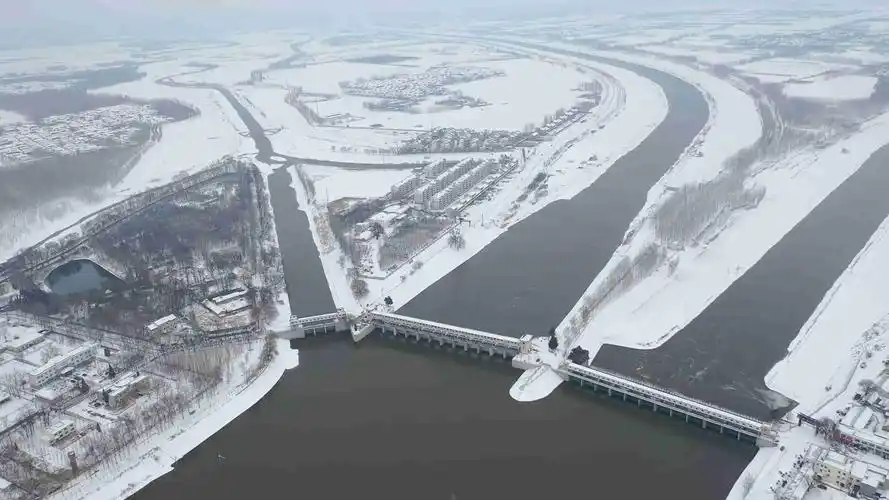 The site traces its origins to a Ming Dynasty spillway, but the modern hub was conceived in the early years of the People's Republic—a period when China, like post-war Europe rebuilding from WWII, embarked on ambitious public works. Construction began in 1957 and finished in 1958, with significant expansion in 1972. The hub controls the lower reaches of the Grand Canal, an artery UNESCO inscribed in 2014 alongside the Suez Canal as one of humanity's greatest navigational achievements. Dutch engineers faced similar challenges taming the Rhine delta; the Four Nunnery Hub plays a comparable protective role for the Hai River Basin.
Four monumental structures stand shoulder-to-shoulder along the Wei Canal: the South and North Flood Gates, the Control Gate, and the historic Ship Lock. Together they form a steel-and-concrete cascade stretching along the waterway, their massive gates capable of releasing 3,800 cubic meters per second—roughly the flow of a medium-sized river. The composition evokes the industrial grandeur of Europe's mid-twentieth-century hydroelectric stations while retaining the linear elegance of Roman aqueduct design. A ship lock, once vital for canal commerce, now stands as a monument to shifting trade patterns on inland waterways.
The site's name honors a local legend of four devoted daughters who cared for their blind father—an act of filial piety celebrated for centuries in Confucian tradition. This narrative anchors the surrounding scenic area, which includes a reconstructed Filial Daughter Temple, the Foguang Buddhist Temple, and a wetland park with traditional boardwalks. In 2013, the hub joined China's National Key Cultural Heritage list, recognized not only as engineering but as a living chapter of the Grand Canal story, comparable to how Venice's hydraulic works are protected as cultural landmarks.
The hub remains an active operating facility, so independent entry to the core zone is not permitted. Visitors must request permission in advance from the Four Nunnery Hub Management Bureau at 0534-6216113, allowing time for security clearance. Located 6-12 kilometers north of Wucheng town center, the site has limited public transport—self-driving or hiring a car is strongly advised. Spring and autumn on clear weekdays offer the best experience; the July-August flood season should be avoided. Photography is restricted inside operational areas without staff approval.
For travelers seeking something beyond China's imperial landmarks, this site offers a rare glimpse into the meeting point of Cold War-era infrastructure and centuries-old waterway heritage. Combine your visit with the wetland boardwalks, the Filial Piety Cultural Square, and the Huaiyin Breeze Wetland Park, then continue to the Wucheng County Museum and the Gubeichun Liquor Culture Hall to round out a thoughtful day. Chinese-language guides are standard—bring a translation app and approach local customs with respect.
The site traces its origins to a Ming Dynasty spillway, but the modern hub was conceived in the early years of the People's Republic—a period when China, like post-war Europe rebuilding from WWII, embarked on ambitious public works. Construction began in 1957 and finished in 1958, with significant expansion in 1972. The hub controls the lower reaches of the Grand Canal, an artery UNESCO inscribed in 2014 alongside the Suez Canal as one of humanity's greatest navigational achievements. Dutch engineers faced similar challenges taming the Rhine delta; the Four Nunnery Hub plays a comparable protective role for the Hai River Basin.
Four monumental structures stand shoulder-to-shoulder along the Wei Canal: the South and North Flood Gates, the Control Gate, and the historic Ship Lock. Together they form a steel-and-concrete cascade stretching along the waterway, their massive gates capable of releasing 3,800 cubic meters per second—roughly the flow of a medium-sized river. The composition evokes the industrial grandeur of Europe's mid-twentieth-century hydroelectric stations while retaining the linear elegance of Roman aqueduct design. A ship lock, once vital for canal commerce, now stands as a monument to shifting trade patterns on inland waterways.
The site's name honors a local legend of four devoted daughters who cared for their blind father—an act of filial piety celebrated for centuries in Confucian tradition. This narrative anchors the surrounding scenic area, which includes a reconstructed Filial Daughter Temple, the Foguang Buddhist Temple, and a wetland park with traditional boardwalks. In 2013, the hub joined China's National Key Cultural Heritage list, recognized not only as engineering but as a living chapter of the Grand Canal story, comparable to how Venice's hydraulic works are protected as cultural landmarks.
The hub remains an active operating facility, so independent entry to the core zone is not permitted. Visitors must request permission in advance from the Four Nunnery Hub Management Bureau at 0534-6216113, allowing time for security clearance. Located 6-12 kilometers north of Wucheng town center, the site has limited public transport—self-driving or hiring a car is strongly advised. Spring and autumn on clear weekdays offer the best experience; the July-August flood season should be avoided. Photography is restricted inside operational areas without staff approval.
For travelers seeking something beyond China's imperial landmarks, this site offers a rare glimpse into the meeting point of Cold War-era infrastructure and centuries-old waterway heritage. Combine your visit with the wetland boardwalks, the Filial Piety Cultural Square, and the Huaiyin Breeze Wetland Park, then continue to the Wucheng County Museum and the Gubeichun Liquor Culture Hall to round out a thoughtful day. Chinese-language guides are standard—bring a translation app and approach local customs with respect.