Dezhou Confucius Temple
⭐ 1.00
No. 88, Dexing Street, Decheng District, Dezhou City, Shandong Province, China
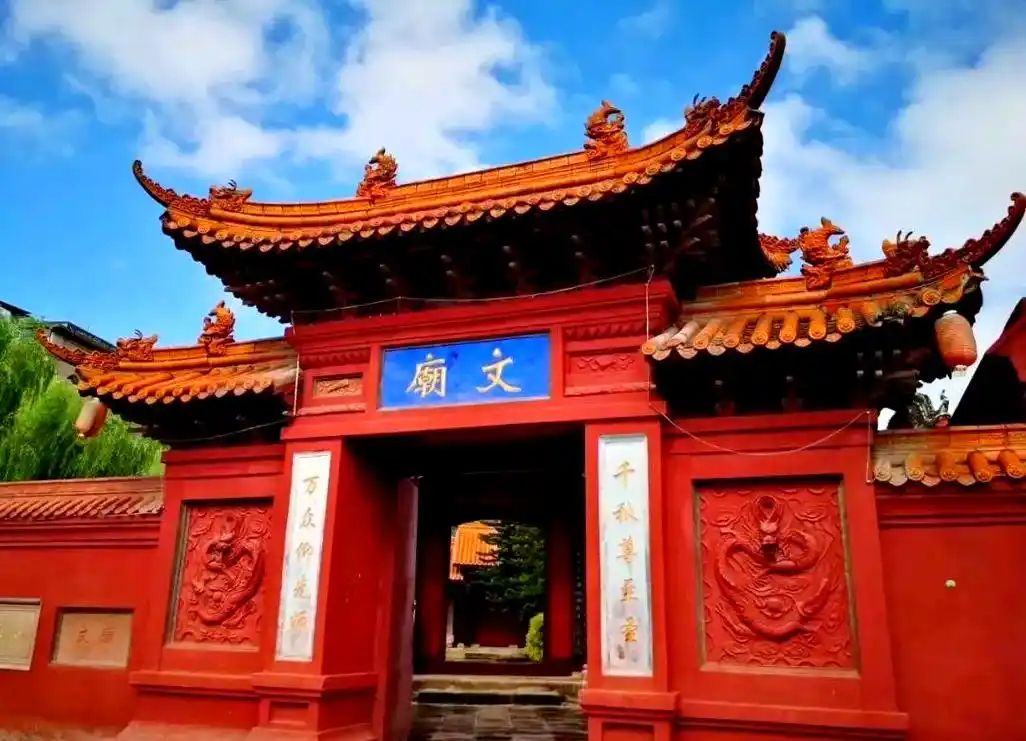 The Leling Confucian Temple was founded in 1369, during the early reign of Ming Emperor Hongwu—just three decades after the Black Death swept Europe and roughly a century before Columbus reached the Americas. It is one of the better-preserved Ming-era county Confucian temples north of the Yangtze and offers a rare glimpse of imperial China's education system, the equivalent of a Renaissance-era cathedral or university in cultural importance. Originally built to honor Confucius and host civil-service training, the complex was repaired through the Ming and Qing dynasties, suffered damage during the Republican era, and underwent a thorough restoration completed in 2007. It is now a Shandong Provincial Cultural Relic Protection Unit and a national AAAA-class site.
Architecturally, the temple follows the strict symmetrical layout found across China's great Confucian shrines, including the iconic Temple of Confucius at Qufu nearby. The centerpiece is the Hall of Great Achievement, a single-eaved wudian-style structure built to official Ming specifications, measuring 11 meters wide and over 20 meters deep. Its most striking feature is the glazed-tile ridge ornament depicting five dragons chasing a flaming pearl—a motif roughly contemporaneous with the decorative sculpture of Tudor palaces in England. The Dougong bracket sets beneath the eaves are textbook examples of early-to-mid Ming carpentry, well worth close inspection by visitors familiar with European timber-frame traditions.
The temple carries an unusual dual heritage. It remains an active place of Confucian commemoration, displaying a Qing-era stele inscribed by the Qianlong Emperor that records imperial restoration grants. But the eastern and western wings have also been repurposed to memorialize the Eighth Route Army's Jilu Border Region military-political cadres' training school, which operated here during the War of Resistance against Japan in the 1940s. This makes the site a compelling two-layered cultural landmark—part classical Confucian academy, part wartime historical exhibit—appealing to travelers interested in both imperial ritual and twentieth-century Chinese history.
The courtyard is anchored by seven ancient trees that lend the complex a meditative, almost monastic atmosphere. Four scholar trees (Sophora) are said to date back over a thousand years to the Tang dynasty, while three pines were planted in the Ming era. Their gnarled trunks contrast beautifully with the vermilion walls and yellow-tiled roofs, much like the old yew trees framing English collegiate quads. Several stone stelae, recording successive restoration campaigns, also stand in a dedicated pavilion, providing valuable primary-source material for those curious about local historiography.
The temple is located at 1 Kaiyuan Road in central Leling and is open daily from 8:00 a.m. to 6:00 p.m., with free admission. From Dezhou city, expect a drive of roughly 1.5 to 2 hours, making a full-day trip advisable. There is no regular English signage or audio guide on site, so foreign visitors are strongly encouraged to arrange a licensed local guide in advance or bring a translation app. Modest dress is requested for entering the main hall; touching artifacts, flash photography, and tripods are prohibited.
Plan to arrive in the morning to enjoy good light on the Dacheng Dian and its dragon ridge ornament before crowds build. Allocate 1.5 to 2 hours for the temple itself, then linger if you can. If your visit coincides with a Confucian ritual day—held on the first Ding (fourth Heavenly Stem) day of each lunar month—you may witness a traditional ceremony. Year-round, the site frequently hosts heritage programs such as paper-cutting workshops and Hanfu dress-up sessions, offering a hands-on window into living Chinese culture that goes well beyond passive sightseeing.
The Leling Confucian Temple was founded in 1369, during the early reign of Ming Emperor Hongwu—just three decades after the Black Death swept Europe and roughly a century before Columbus reached the Americas. It is one of the better-preserved Ming-era county Confucian temples north of the Yangtze and offers a rare glimpse of imperial China's education system, the equivalent of a Renaissance-era cathedral or university in cultural importance. Originally built to honor Confucius and host civil-service training, the complex was repaired through the Ming and Qing dynasties, suffered damage during the Republican era, and underwent a thorough restoration completed in 2007. It is now a Shandong Provincial Cultural Relic Protection Unit and a national AAAA-class site.
Architecturally, the temple follows the strict symmetrical layout found across China's great Confucian shrines, including the iconic Temple of Confucius at Qufu nearby. The centerpiece is the Hall of Great Achievement, a single-eaved wudian-style structure built to official Ming specifications, measuring 11 meters wide and over 20 meters deep. Its most striking feature is the glazed-tile ridge ornament depicting five dragons chasing a flaming pearl—a motif roughly contemporaneous with the decorative sculpture of Tudor palaces in England. The Dougong bracket sets beneath the eaves are textbook examples of early-to-mid Ming carpentry, well worth close inspection by visitors familiar with European timber-frame traditions.
The temple carries an unusual dual heritage. It remains an active place of Confucian commemoration, displaying a Qing-era stele inscribed by the Qianlong Emperor that records imperial restoration grants. But the eastern and western wings have also been repurposed to memorialize the Eighth Route Army's Jilu Border Region military-political cadres' training school, which operated here during the War of Resistance against Japan in the 1940s. This makes the site a compelling two-layered cultural landmark—part classical Confucian academy, part wartime historical exhibit—appealing to travelers interested in both imperial ritual and twentieth-century Chinese history.
The courtyard is anchored by seven ancient trees that lend the complex a meditative, almost monastic atmosphere. Four scholar trees (Sophora) are said to date back over a thousand years to the Tang dynasty, while three pines were planted in the Ming era. Their gnarled trunks contrast beautifully with the vermilion walls and yellow-tiled roofs, much like the old yew trees framing English collegiate quads. Several stone stelae, recording successive restoration campaigns, also stand in a dedicated pavilion, providing valuable primary-source material for those curious about local historiography.
The temple is located at 1 Kaiyuan Road in central Leling and is open daily from 8:00 a.m. to 6:00 p.m., with free admission. From Dezhou city, expect a drive of roughly 1.5 to 2 hours, making a full-day trip advisable. There is no regular English signage or audio guide on site, so foreign visitors are strongly encouraged to arrange a licensed local guide in advance or bring a translation app. Modest dress is requested for entering the main hall; touching artifacts, flash photography, and tripods are prohibited.
Plan to arrive in the morning to enjoy good light on the Dacheng Dian and its dragon ridge ornament before crowds build. Allocate 1.5 to 2 hours for the temple itself, then linger if you can. If your visit coincides with a Confucian ritual day—held on the first Ding (fourth Heavenly Stem) day of each lunar month—you may witness a traditional ceremony. Year-round, the site frequently hosts heritage programs such as paper-cutting workshops and Hanfu dress-up sessions, offering a hands-on window into living Chinese culture that goes well beyond passive sightseeing.