Delingha Grassland
⭐ 3.80
Delingha Grassland, Delingha City, Haixi Mongol and Tibetan Autonomous Prefecture, Qinghai Province, China
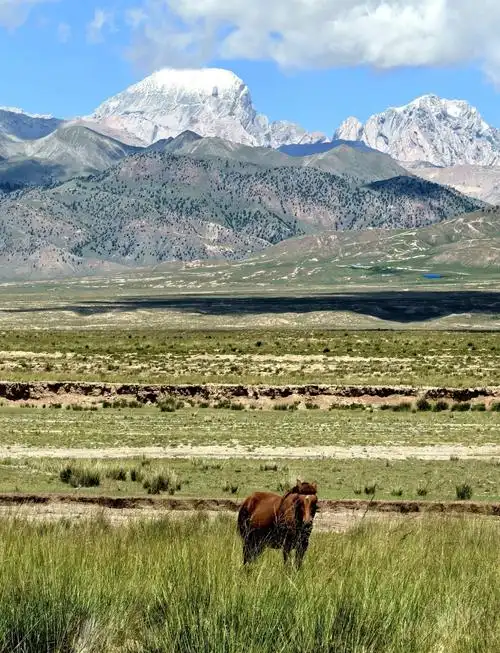 Tucked into the northern reaches of the Qinghai-Tibet Plateau at roughly 3,000 meters elevation, the Delingha grasslands sit within the ancient Qaidam Basin, a region Marco Polo described in the late 13th century as "a great desert with many mountains." The very corridor your vehicle traces echoes northern Silk Road branches that once linked Chang'an to Central Asia, and the cultural fabric still bears that lineage: ethnic Mongol herders, descended from the same steppe confederations that shaped Genghis Khan's empire, share these pastures with Tibetan yak-keepers. The terrain resembles a starker, drier cousin of the Scottish Highlands or Iceland's interior plateaus, yet with peaks soaring above 5,000 meters.
What distinguishes Delingha from the lush green pastures of Inner Mongolia is its hybrid character: high-altitude desert steppe interwoven with narrow riparian meadows along the Bayin River. Summer grasses glow a vivid chartreuse beneath their tawny base tones, while autumn transforms the terrain into gold and ochre waves, evocative of the American Southwest meeting the Patagonian steppe. Snowy ridges from the Qilian range rear up like distant cathedrals, and the Bayin River threads silver through the valleys, creating a setting where visitors may feel they have stepped into one of Earth's last great wildernesses.
Conservation success stories unfold here. Once impacted by unregulated hunting and overgrazing, the area now hosts thriving populations of white-lipped deer (a species endemic to the plateau, ecologically similar to the European ibex), blue sheep, Himalayan marmots, golden eagles, and the elusive Tibetan fox. Early mornings and late afternoons are the prime windows for sightings. Birdwatchers may spot bar-headed geese, the highest-flying migrants on Earth, which cross the Himalayas each spring. Bring telephoto lenses and patience; wildlife encounters here are genuinely wild.
Dotting the meadows are traditional ovoo cairns, sacred stone heaps built by both Mongol and Tibetan herders to honor sky spirits, often strung with prayer flags that flutter in the fierce plateau winds. Travelers should observe quietly, never climbing on or disturbing these spiritual markers. Herders continue seasonal transhumance, moving livestock between summer and winter pastures as their ancestors have for centuries. The proximity of working pastoral life to thriving wildlife habitat makes this one of Asia's finest examples of human-nature coexistence.
Delingha Grassland is firmly an off-road destination. Reaching the core meadows of Yikela village and the upper Bayin River requires an SUV or 4x4, as 40 to 60 kilometers of the route are unpaved gravel and rocky tracks. There are no entry fees, no visitor centers, and essentially zero commercial facilities — bring all water, food, fuel, warm layers, sunscreen (SPF 50+), and trash bags. Connectivity is patchy; download offline maps. June through September offers the greenest grass and most active wildlife, while winter visits reward travelers with some of China's darkest, most spectacular stargazing skies.
Combine the grasslands with neighboring Keluke Lake (a freshwater oasis popular with migratory birds) and Tosu Lake (its briny "sister" saltwater lake on the other side of the road) for a half- or full-day circuit that captures the region's full spectrum: lake, meadow, gobi, and snow mountain in a single sweep. Pine-clad Baishu Mountain adds a final forested touch. For travelers seeking solitude, geological drama, and a sense of vastness that rivals Patagonia or the Karakoram Highway, Delingha delivers — provided you arrive prepared, drive carefully, and leave nothing behind.
Tucked into the northern reaches of the Qinghai-Tibet Plateau at roughly 3,000 meters elevation, the Delingha grasslands sit within the ancient Qaidam Basin, a region Marco Polo described in the late 13th century as "a great desert with many mountains." The very corridor your vehicle traces echoes northern Silk Road branches that once linked Chang'an to Central Asia, and the cultural fabric still bears that lineage: ethnic Mongol herders, descended from the same steppe confederations that shaped Genghis Khan's empire, share these pastures with Tibetan yak-keepers. The terrain resembles a starker, drier cousin of the Scottish Highlands or Iceland's interior plateaus, yet with peaks soaring above 5,000 meters.
What distinguishes Delingha from the lush green pastures of Inner Mongolia is its hybrid character: high-altitude desert steppe interwoven with narrow riparian meadows along the Bayin River. Summer grasses glow a vivid chartreuse beneath their tawny base tones, while autumn transforms the terrain into gold and ochre waves, evocative of the American Southwest meeting the Patagonian steppe. Snowy ridges from the Qilian range rear up like distant cathedrals, and the Bayin River threads silver through the valleys, creating a setting where visitors may feel they have stepped into one of Earth's last great wildernesses.
Conservation success stories unfold here. Once impacted by unregulated hunting and overgrazing, the area now hosts thriving populations of white-lipped deer (a species endemic to the plateau, ecologically similar to the European ibex), blue sheep, Himalayan marmots, golden eagles, and the elusive Tibetan fox. Early mornings and late afternoons are the prime windows for sightings. Birdwatchers may spot bar-headed geese, the highest-flying migrants on Earth, which cross the Himalayas each spring. Bring telephoto lenses and patience; wildlife encounters here are genuinely wild.
Dotting the meadows are traditional ovoo cairns, sacred stone heaps built by both Mongol and Tibetan herders to honor sky spirits, often strung with prayer flags that flutter in the fierce plateau winds. Travelers should observe quietly, never climbing on or disturbing these spiritual markers. Herders continue seasonal transhumance, moving livestock between summer and winter pastures as their ancestors have for centuries. The proximity of working pastoral life to thriving wildlife habitat makes this one of Asia's finest examples of human-nature coexistence.
Delingha Grassland is firmly an off-road destination. Reaching the core meadows of Yikela village and the upper Bayin River requires an SUV or 4x4, as 40 to 60 kilometers of the route are unpaved gravel and rocky tracks. There are no entry fees, no visitor centers, and essentially zero commercial facilities — bring all water, food, fuel, warm layers, sunscreen (SPF 50+), and trash bags. Connectivity is patchy; download offline maps. June through September offers the greenest grass and most active wildlife, while winter visits reward travelers with some of China's darkest, most spectacular stargazing skies.
Combine the grasslands with neighboring Keluke Lake (a freshwater oasis popular with migratory birds) and Tosu Lake (its briny "sister" saltwater lake on the other side of the road) for a half- or full-day circuit that captures the region's full spectrum: lake, meadow, gobi, and snow mountain in a single sweep. Pine-clad Baishu Mountain adds a final forested touch. For travelers seeking solitude, geological drama, and a sense of vastness that rivals Patagonia or the Karakoram Highway, Delingha delivers — provided you arrive prepared, drive carefully, and leave nothing behind.