Delingha Volcanic Field
⭐ 3.00
Delingha Volcanic Field, Delingha City, Haixi Mongol and Tibetan Autonomous Prefecture, Qinghai Province, China
 **A Geological Anomaly in the Qaidam Basin**
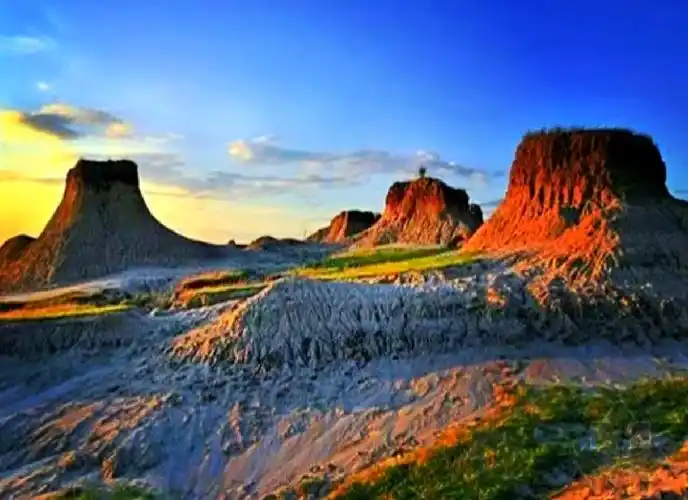
The Delingha region sits at the northeastern rim of the vast Qaidam Basin, a high-altitude desert on the northern Tibetan Plateau that has been tectonically restless for over 200 million years. Mount Baigong itself is a remnant of ancient volcanic activity, where Mesozoic-era lava has been sculpted by unrelenting wind into rust-red mesas, ring-shaped caves, and ridged yardang formations. The resulting landscape resembles Turkey's Cappadocia or the badlands of the American Southwest, but with a thinner atmosphere, deeper silence, and a distinctly otherworldly palette of iron oxide reds and volcanic greys that few Western travelers have ever witnessed firsthand.
**The "Alien Ruins" Mystery**
What truly sets this place apart is the so-called "Alien Ruins"—dozens of iron-rich tubes embedded in the sandstone walls and caves of Mount Baigong, some running parallel, others crossing at right angles. Their symmetrical, almost engineered appearance has fueled decades of speculation, echoing the public fascination once directed at Peru's Nazca Lines or Scotland's Loch Ness. Mainstream geologists lean toward natural explanations—ancient iron-rich sediment deposition, rust fusion, or bacterial iron mineralization—but no consensus exists. For travelers, the appeal lies less in solving the puzzle than in standing before it, measuring the tubes with your own hands, and pondering the unknown.
**The Twin "Lover Lakes"**
Just south of Mount Baigong lie two adjoining lakes that have become symbols of the region's stark contrasts. Tuosu Lake is a vast, hypersaline basin whose turquoise waters mirror the empty sky, while Keluke Lake, connected by a narrow channel, is a freshwater wetland alive with reeds and migratory birds. Locals call them the "Lover Lakes"—one salty and still, one fresh and living—drawing comparisons to the famous paired lakes of East Africa's Rift Valley. Sunset here paints the salt flats in shades of amber and violet, while the absence of light pollution makes the night sky among the clearest on the plateau.
**Cultural Crossroads and Haizi's Poetry**
Delingha is a meeting point of Mongol and Tibetan cultures, where prayer wheels, cairns, and mani stones appear alongside modern infrastructure. The city is also inseparable from the legacy of poet Hai Zi, whose 1988 masterpiece "Hai Zi · Delingha" immortalized the town's lonely romance. A small museum dedicated to him draws literary pilgrims, much like the haunts of Keats in Rome or Pushkin in St. Petersburg. Visitors should respect local customs: avoid photographing worshippers at close range, and never touch prayer flags or ritual objects.
**Practical Information for Travelers**
Mount Baigong lies 40–45 km from downtown Delingha, with no public transit—renting a 4WD vehicle or hiring a driver is essential. Mobile signal is unreliable, so travel in pairs and carry extra water and food. The best season is June through September, when mild daytime temperatures and clear nights create ideal conditions for stargazing. Stay at a hotel in Delingha offering diffused oxygen, as altitude sickness is a real concern at nearly 3,000 meters. Pack SPF 50+ sunscreen, a windproof shell, and layers—diurnal temperature swings can exceed 20°C.
**A Two-Day Itinerary**
On day one, acclimatize in Delingha by visiting the Haizi Poetry Museum and the nearby Baishushan Geological Park to stretch your legs. On day two, hire a 4WD for the drive to Mount Baigong to explore the tube caves and circle the twin lakes, finishing with a sunset shoot over Tuosu or, if conditions allow, an overnight camp beneath the stars. The rewards are intangible yet profound: solitude, scale, and the persistent sense that you are standing at one of Asia's last genuine wilderness frontiers.
**A Geological Anomaly in the Qaidam Basin**
The Delingha region sits at the northeastern rim of the vast Qaidam Basin, a high-altitude desert on the northern Tibetan Plateau that has been tectonically restless for over 200 million years. Mount Baigong itself is a remnant of ancient volcanic activity, where Mesozoic-era lava has been sculpted by unrelenting wind into rust-red mesas, ring-shaped caves, and ridged yardang formations. The resulting landscape resembles Turkey's Cappadocia or the badlands of the American Southwest, but with a thinner atmosphere, deeper silence, and a distinctly otherworldly palette of iron oxide reds and volcanic greys that few Western travelers have ever witnessed firsthand.
**The "Alien Ruins" Mystery**
What truly sets this place apart is the so-called "Alien Ruins"—dozens of iron-rich tubes embedded in the sandstone walls and caves of Mount Baigong, some running parallel, others crossing at right angles. Their symmetrical, almost engineered appearance has fueled decades of speculation, echoing the public fascination once directed at Peru's Nazca Lines or Scotland's Loch Ness. Mainstream geologists lean toward natural explanations—ancient iron-rich sediment deposition, rust fusion, or bacterial iron mineralization—but no consensus exists. For travelers, the appeal lies less in solving the puzzle than in standing before it, measuring the tubes with your own hands, and pondering the unknown.
**The Twin "Lover Lakes"**
Just south of Mount Baigong lie two adjoining lakes that have become symbols of the region's stark contrasts. Tuosu Lake is a vast, hypersaline basin whose turquoise waters mirror the empty sky, while Keluke Lake, connected by a narrow channel, is a freshwater wetland alive with reeds and migratory birds. Locals call them the "Lover Lakes"—one salty and still, one fresh and living—drawing comparisons to the famous paired lakes of East Africa's Rift Valley. Sunset here paints the salt flats in shades of amber and violet, while the absence of light pollution makes the night sky among the clearest on the plateau.
**Cultural Crossroads and Haizi's Poetry**
Delingha is a meeting point of Mongol and Tibetan cultures, where prayer wheels, cairns, and mani stones appear alongside modern infrastructure. The city is also inseparable from the legacy of poet Hai Zi, whose 1988 masterpiece "Hai Zi · Delingha" immortalized the town's lonely romance. A small museum dedicated to him draws literary pilgrims, much like the haunts of Keats in Rome or Pushkin in St. Petersburg. Visitors should respect local customs: avoid photographing worshippers at close range, and never touch prayer flags or ritual objects.
**Practical Information for Travelers**
Mount Baigong lies 40–45 km from downtown Delingha, with no public transit—renting a 4WD vehicle or hiring a driver is essential. Mobile signal is unreliable, so travel in pairs and carry extra water and food. The best season is June through September, when mild daytime temperatures and clear nights create ideal conditions for stargazing. Stay at a hotel in Delingha offering diffused oxygen, as altitude sickness is a real concern at nearly 3,000 meters. Pack SPF 50+ sunscreen, a windproof shell, and layers—diurnal temperature swings can exceed 20°C.
**A Two-Day Itinerary**
On day one, acclimatize in Delingha by visiting the Haizi Poetry Museum and the nearby Baishushan Geological Park to stretch your legs. On day two, hire a 4WD for the drive to Mount Baigong to explore the tube caves and circle the twin lakes, finishing with a sunset shoot over Tuosu or, if conditions allow, an overnight camp beneath the stars. The rewards are intangible yet profound: solitude, scale, and the persistent sense that you are standing at one of Asia's last genuine wilderness frontiers.