Chaerhan Salt Lake
⭐ 4.20
No. 60, Bayi Middle Road, Golmud City, Qinghai Province, China
 Salt has shaped civilizations since antiquity—from the Via Salaria that carried Roman legions across Italy to the salt caravans of Pre-Columbian Peru, where the mineral was literally worth its weight in gold. Qarhan continues this story on a staggering scale. Its deposits of potassium, magnesium, and lithium rank first in China, earning it the title of the country's greatest mineral treasury. Since being officially opened to tourists in 2019 and earning national AAAA status in 2023, the lake has also been recognized as a national mine geological park—part natural wonder, part living industrial landscape.
The lake's signature feature is the Wanzhang Salt Bridge, the world's only road-and-railway causeway built entirely from salt. Stretching across the basin, the Qinghai-Tibet Highway and Railway ride atop a salt crust 2 to 20 meters thick, with no piers, no steel, and no mortar. Seeing freight trains glide across this gleaming white road feels like something out of a sci-fi film—imagine the Rialto Bridge if its stones were edible and you may begin to grasp the strangeness. Engineers have called it a one-of-a-kind feat in the history of roadbuilding.
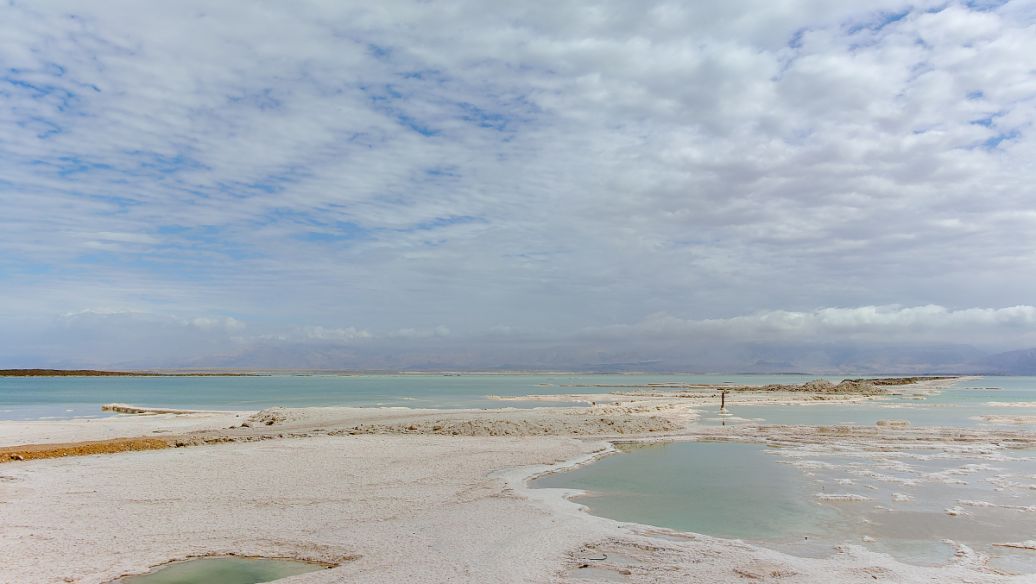
The water itself is the other draw. Covering the lake's surface are salt crystals known as "salt flowers," naturally sculpted into coral, snow lotus, and miniature pavilion shapes—some translucent, some dazzling white. Beyond them stretches the "Jade Terrace," a mirror-flat expanse where the sky and brine meet in gradients of emerald and aquamarine. Photographers prefer the late-August hour after 16:30, when low-angle light turns the surface into a perfect reflective canvas. Those familiar with Bolivia's Salar de Uyuni will find a different flavor here: where Uyuni dazzles with stark whiteness, Qarhan seduces with deep, saturated color.
Practical planning is essential. The lake sits about an hour's drive from Golmud city in the Haixi Mongol and Tibetan Autonomous Prefecture, and visitors must transfer to sightseeing buses at the entrance—tickets and shuttle combined cost roughly 100 yuan. In peak season, the park stays open until 20:00, and three to four hours is the recommended visit length. Facilities on site are sparse: bring your own water, snacks, and any medications, as toilets and restaurants are limited.
From June to September, the weather is mild by plateau standards, but the sun is punishing. Sunscreen rated SPF 50+, polarized sunglasses, a wide-brimmed hat, and sturdy non-slip footwear are all non-negotiable. Walking on the boardwalks is mandatory—entering the water or removing salt crystals is strictly prohibited and damages the fragile crust. For travelers drawn to the raw edges of the world, where geology, industry, and pure spectacle collide, Qarhan Salt Lake offers something rarer than great scenery: an experience that feels genuinely uncharted.
Salt has shaped civilizations since antiquity—from the Via Salaria that carried Roman legions across Italy to the salt caravans of Pre-Columbian Peru, where the mineral was literally worth its weight in gold. Qarhan continues this story on a staggering scale. Its deposits of potassium, magnesium, and lithium rank first in China, earning it the title of the country's greatest mineral treasury. Since being officially opened to tourists in 2019 and earning national AAAA status in 2023, the lake has also been recognized as a national mine geological park—part natural wonder, part living industrial landscape.
The lake's signature feature is the Wanzhang Salt Bridge, the world's only road-and-railway causeway built entirely from salt. Stretching across the basin, the Qinghai-Tibet Highway and Railway ride atop a salt crust 2 to 20 meters thick, with no piers, no steel, and no mortar. Seeing freight trains glide across this gleaming white road feels like something out of a sci-fi film—imagine the Rialto Bridge if its stones were edible and you may begin to grasp the strangeness. Engineers have called it a one-of-a-kind feat in the history of roadbuilding.
The water itself is the other draw. Covering the lake's surface are salt crystals known as "salt flowers," naturally sculpted into coral, snow lotus, and miniature pavilion shapes—some translucent, some dazzling white. Beyond them stretches the "Jade Terrace," a mirror-flat expanse where the sky and brine meet in gradients of emerald and aquamarine. Photographers prefer the late-August hour after 16:30, when low-angle light turns the surface into a perfect reflective canvas. Those familiar with Bolivia's Salar de Uyuni will find a different flavor here: where Uyuni dazzles with stark whiteness, Qarhan seduces with deep, saturated color.
Practical planning is essential. The lake sits about an hour's drive from Golmud city in the Haixi Mongol and Tibetan Autonomous Prefecture, and visitors must transfer to sightseeing buses at the entrance—tickets and shuttle combined cost roughly 100 yuan. In peak season, the park stays open until 20:00, and three to four hours is the recommended visit length. Facilities on site are sparse: bring your own water, snacks, and any medications, as toilets and restaurants are limited.
From June to September, the weather is mild by plateau standards, but the sun is punishing. Sunscreen rated SPF 50+, polarized sunglasses, a wide-brimmed hat, and sturdy non-slip footwear are all non-negotiable. Walking on the boardwalks is mandatory—entering the water or removing salt crystals is strictly prohibited and damages the fragile crust. For travelers drawn to the raw edges of the world, where geology, industry, and pure spectacle collide, Qarhan Salt Lake offers something rarer than great scenery: an experience that feels genuinely uncharted.