Juyan Lake
⭐ 4.20
Juyan Lake, Delingha City, Haixi Prefecture, Qinghai Province, China
 Juyan Lake carries over two millennia of frontier history. Known as "Juyan Marsh" during the Han Dynasty, it guarded the northern Silk Road route where caravans traded silk and spices for Central Asian horses. The Chinese poet Wang Wei and his peers immortalized this region in border poetry, while legendary general Huo Qubing once campaigned here against the Xiongnu nomads. In 1930, the Sino-Swedish Scientific Expedition unearthed the celebrated "Juyan Han bamboo slips," alongside the Dunhuang manuscripts one of the two greatest documentary archaeological finds of twentieth-century China, offering invaluable evidence of Han-era military colonies and frontier administration.
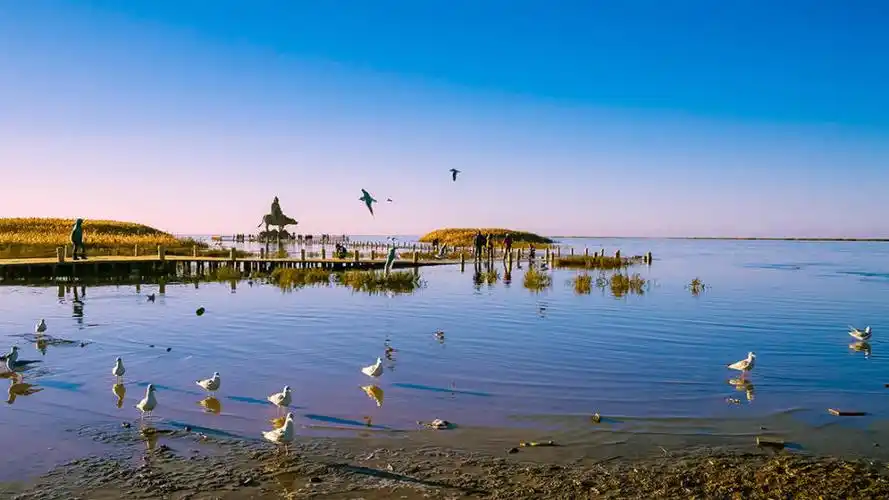
The lake itself spans roughly 40 square kilometers with an average depth of just two meters, fringed by kilometers of whispering reed beds that glow amber at dawn. Wooden boardwalks weave through the marshes, leading to two prime viewing platforms: Xianzhong Pier and Donggui Pier, both oriented to capture the sun rising dramatically over distant sand dunes. The interplay of golden reeds, turquoise water, and shifting desert light creates a scene often compared to the ethereal landscapes of Scotland's Highland lochs meeting Saharan dunes.
Ecologically, Juyan represents something precious and fragile: a thriving wetland ecosystem nestled within one of Asia's harshest desert environments. It now serves as a critical rest stop on major migratory bird flyways, hosting species from Siberian cranes to red-billed gulls, earning its reputation as a paradise for ornithologists and wildlife photographers seeking scenes reminiscent of the Camargue in France or Israel's Hula Valley.
Practical planning is essential. The entrance fee runs about 60 RMB with sightseeing buses costing 10-20 RMB, highly recommended given the distances involved. Most visitors charter vehicles from Dalaihubu Town, 50 kilometers away, departing around 4:30 AM to catch the spectacular sunrise by 5:30. The prime season runs late September through mid-October, when autumn skies remain stable, temperatures are manageable, and migratory birds gather in greatest numbers. Summer brings punishing heat and winter brings brutal cold, both best avoided.
Pack serious cold-weather gear including a heavy down jacket, hat, and gloves, since predawn temperatures can hover near freezing even in autumn, while high-SPF sunscreen, sunglasses, and lip balm protect against intense high-altitude UV. On-site dining is minimal, so bring snacks and hot water. Consider combining Juyan with the legendary Ejina Poplar Forest, the haunting Black City ruins, and the eerie Spooky Forest for an unforgettable two-day immersion in desert landscapes and golden autumn foliage.
Juyan Lake carries over two millennia of frontier history. Known as "Juyan Marsh" during the Han Dynasty, it guarded the northern Silk Road route where caravans traded silk and spices for Central Asian horses. The Chinese poet Wang Wei and his peers immortalized this region in border poetry, while legendary general Huo Qubing once campaigned here against the Xiongnu nomads. In 1930, the Sino-Swedish Scientific Expedition unearthed the celebrated "Juyan Han bamboo slips," alongside the Dunhuang manuscripts one of the two greatest documentary archaeological finds of twentieth-century China, offering invaluable evidence of Han-era military colonies and frontier administration.
The lake itself spans roughly 40 square kilometers with an average depth of just two meters, fringed by kilometers of whispering reed beds that glow amber at dawn. Wooden boardwalks weave through the marshes, leading to two prime viewing platforms: Xianzhong Pier and Donggui Pier, both oriented to capture the sun rising dramatically over distant sand dunes. The interplay of golden reeds, turquoise water, and shifting desert light creates a scene often compared to the ethereal landscapes of Scotland's Highland lochs meeting Saharan dunes.
Ecologically, Juyan represents something precious and fragile: a thriving wetland ecosystem nestled within one of Asia's harshest desert environments. It now serves as a critical rest stop on major migratory bird flyways, hosting species from Siberian cranes to red-billed gulls, earning its reputation as a paradise for ornithologists and wildlife photographers seeking scenes reminiscent of the Camargue in France or Israel's Hula Valley.
Practical planning is essential. The entrance fee runs about 60 RMB with sightseeing buses costing 10-20 RMB, highly recommended given the distances involved. Most visitors charter vehicles from Dalaihubu Town, 50 kilometers away, departing around 4:30 AM to catch the spectacular sunrise by 5:30. The prime season runs late September through mid-October, when autumn skies remain stable, temperatures are manageable, and migratory birds gather in greatest numbers. Summer brings punishing heat and winter brings brutal cold, both best avoided.
Pack serious cold-weather gear including a heavy down jacket, hat, and gloves, since predawn temperatures can hover near freezing even in autumn, while high-SPF sunscreen, sunglasses, and lip balm protect against intense high-altitude UV. On-site dining is minimal, so bring snacks and hot water. Consider combining Juyan with the legendary Ejina Poplar Forest, the haunting Black City ruins, and the eerie Spooky Forest for an unforgettable two-day immersion in desert landscapes and golden autumn foliage.