Qianlong's Temporary Palace
⭐ 3.20
Qianlong's Temporary Palace, Tongshan District, Xuzhou City, Jiangsu Province, China
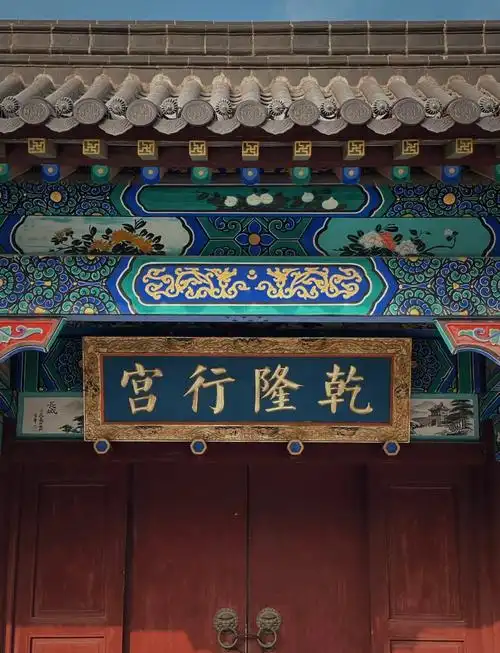 Imagine Europe's eighteenth-century royal progresses—Louis XV touring his provinces or Frederick the Great escaping Sanssouci—and you grasp the scale of Emperor Qianlong's six southern tours. Between 1751 and 1784, the Qing monarch traveled the length of the Grand Canal to inspect flood-control works on the Yellow and Huai rivers, dine with scholars, and absorb the cultural prestige of Jiangnan. Xuzhou, a strategic crossroads where the ancient canal route met the Yellow River's old course, served as a favored overnight stop. In 1757, the imperial workyards erected this elegant lodge so Qianlong could sleep beneath a vermillion-and-gold roof rather than a travel tent. The current hall is the only original structure still standing, a single-eave hip-and-gable building crowned with imperial-yellow glazed tiles and decorated with golden dragon motifs inside—color schemes any visitor to Beijing's Forbidden City will recognize.
Adjacent to the great hall, a beautifully landscaped stele garden was laid out in 1979 in the scholar's-garden tradition of Suzhou and Hangzhou. Winding covered walkways curve past bamboo groves and lotus ponds, while a circular "moon gate" frames a borrowed view of Yunlong Mountain beyond, employing the classic Chinese landscape technique known as jiejing. The garden holds 84 carved stone tablets spanning a thousand years of Chinese calligraphy, with highlights including Song-dynasty literary giant Su Shi. For Western readers who know Su Shi's poetry through Ezra Pound's translations, seeing his brushwork rendered in stone offers an unusually direct encounter with one of China's most beloved artistic voices.
The palace forms a cultural diptych with the main Xuzhou Museum building across the courtyard. Where the main museum dazzles with Han-dynasty funerary art—jade burial suits sewn with golden thread, vivid tomb-relief carvings—the palace brings visitors forward a millennium into the Qing era, illustrating how Xuzhou evolved from an ancient Han stronghold into a node of imperial infrastructure. Walking between them, you traverse roughly two thousand years of Chinese history in a single morning, an experience comparable to moving from the Roman galleries into a Renaissance palace within one museum complex.
Admission is free, but visitors must reserve in advance through the Xuzhou Museum WeChat account using a passport or ID number. Hours run Tuesday through Sunday, 9:00 to 17:00, with last entry at 16:30; the site closes on Mondays. The complex lies in Yunlong District along Heping Road, easily reached by bus to the "Xuzhou Museum" stop. Note that during certain periods the south gate is locked, requiring entry through the north side, and that flash photography and drones are prohibited inside the historic hall.
Plan two to three hours for the combined visit, beginning at the main museum to ground yourself in Han-dynasty Xuzhou before crossing to the palace. Arrive after 15:00, when afternoon light turns the yellow tiles luminous and tour-group crowds thin out. The garden offers minimal shade, so bring water and sun protection in summer, while hanfu photographers will find the bamboo grove beside the covered walkway especially photogenic—a quiet echo of the imperial progresses that once paused here.
Imagine Europe's eighteenth-century royal progresses—Louis XV touring his provinces or Frederick the Great escaping Sanssouci—and you grasp the scale of Emperor Qianlong's six southern tours. Between 1751 and 1784, the Qing monarch traveled the length of the Grand Canal to inspect flood-control works on the Yellow and Huai rivers, dine with scholars, and absorb the cultural prestige of Jiangnan. Xuzhou, a strategic crossroads where the ancient canal route met the Yellow River's old course, served as a favored overnight stop. In 1757, the imperial workyards erected this elegant lodge so Qianlong could sleep beneath a vermillion-and-gold roof rather than a travel tent. The current hall is the only original structure still standing, a single-eave hip-and-gable building crowned with imperial-yellow glazed tiles and decorated with golden dragon motifs inside—color schemes any visitor to Beijing's Forbidden City will recognize.
Adjacent to the great hall, a beautifully landscaped stele garden was laid out in 1979 in the scholar's-garden tradition of Suzhou and Hangzhou. Winding covered walkways curve past bamboo groves and lotus ponds, while a circular "moon gate" frames a borrowed view of Yunlong Mountain beyond, employing the classic Chinese landscape technique known as jiejing. The garden holds 84 carved stone tablets spanning a thousand years of Chinese calligraphy, with highlights including Song-dynasty literary giant Su Shi. For Western readers who know Su Shi's poetry through Ezra Pound's translations, seeing his brushwork rendered in stone offers an unusually direct encounter with one of China's most beloved artistic voices.
The palace forms a cultural diptych with the main Xuzhou Museum building across the courtyard. Where the main museum dazzles with Han-dynasty funerary art—jade burial suits sewn with golden thread, vivid tomb-relief carvings—the palace brings visitors forward a millennium into the Qing era, illustrating how Xuzhou evolved from an ancient Han stronghold into a node of imperial infrastructure. Walking between them, you traverse roughly two thousand years of Chinese history in a single morning, an experience comparable to moving from the Roman galleries into a Renaissance palace within one museum complex.
Admission is free, but visitors must reserve in advance through the Xuzhou Museum WeChat account using a passport or ID number. Hours run Tuesday through Sunday, 9:00 to 17:00, with last entry at 16:30; the site closes on Mondays. The complex lies in Yunlong District along Heping Road, easily reached by bus to the "Xuzhou Museum" stop. Note that during certain periods the south gate is locked, requiring entry through the north side, and that flash photography and drones are prohibited inside the historic hall.
Plan two to three hours for the combined visit, beginning at the main museum to ground yourself in Han-dynasty Xuzhou before crossing to the palace. Arrive after 15:00, when afternoon light turns the yellow tiles luminous and tour-group crowds thin out. The garden offers minimal shade, so bring water and sun protection in summer, while hanfu photographers will find the bamboo grove beside the covered walkway especially photogenic—a quiet echo of the imperial progresses that once paused here.