Hubu Mountain Ancient Architecture Complex
⭐ 4.50
Hubu Mountain Ancient Architecture Complex, Yunlong District, Xuzhou City, Jiangsu Province, China
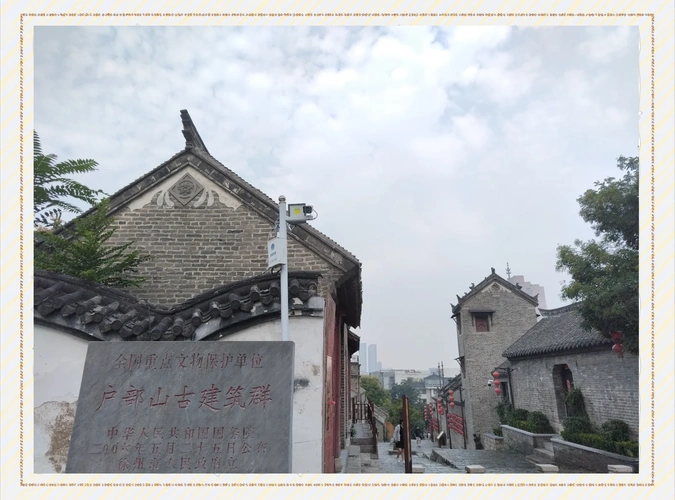 Hubu Mountain's story stretches back over two millennia, gaining mythic stature in 206 BCE when the warlord Xiang Yu—the same conqueror who challenged Julius Caesar's Roman Republic era for control of the known world—built the Xima Terrace here to watch his cavalry parade. Think of it as China's answer to Rome's Palatine Hill, a place where imperial ambition first left its mark. By the Ming Dynasty's Wanli and Tianqi reigns, the slope had become a magnet for officials and merchants. In 1624, when flooding forced government bureaus to relocate here, the name "Hubu" (Ministry of Revenue) was born, cementing the site's status. Over subsequent centuries, scholar-officials and wealthy traders constructed grand residences, creating the layered, mountainside village that survives today.
The architectural genius lies in how builders tamed the steep terrain. Homes rise in cascading tiers following the natural slope, with clever engineering producing the famous "Mandarin Duck Houses"—split dwellings where front and back doors face opposite directions, requiring no interior stairs to move between levels. Like the tiered hillside towns of Italy's Amalfi Coast or Spain's Ronda, the design makes dramatic use of elevation. Yet the decorative vocabulary draws from both traditions: delicate southern garden refinement meets the formal severity of northern official buildings, with exquisite brick carvings on gate towers, intricate woodwork, and rooftop ridges adorned with the rare "five-ridges-six-beasts" imperial ornamentation.
This is where the soul of Chu-Han martial glory meets the bustling commerce of late imperial China. The Xima Terrace still channels Xiang Yu's commanding presence, while the Cui Family Hanlin Residence—mansion to a dynasty of imperial scholars reopened after meticulous 2022 restoration—preserves the refined legacy of examination-culture aristocracy. Surrounding mansions belonging to the Yu, Zhai, and Zheng clans recount the rise and fall of merchant guilds. From the Qing Dynasty through the Republican era, the district pulsed with literary salons and thriving trade, living up to its reputation as "Half the History of Xuzhou." Today, an intangible heritage hall showcases local paper-cutting, stone crafts, porcelain painting, and regional opera traditions.
Practical planning rewards visitors who allow ample time. The Xima Terrace itself is free to enter and crowns the complex with sweeping views over tiled rooftops and winding lanes below. The grandest surviving residence, the Cui Family Hanlin Residence, features rare flagpole stone drums and represents the pinnacle of Qing-era scholarly mansions—comparable in scale to a Florentine palazzo. The Folk Museum quarter, encompassing the Yu, Zhai, and Zheng family compounds, charges approximately 25 RMB for access and preserves complete siheyuan courtyard layouts with original carvings. Begin at the Cui residence, then ascend to Xima Terrace for the panorama.
Located at the intersection of Xiangwang Road and Zhuangyuan Street in Yunlong District, the pedestrian streets are freely accessible, with only the folk museum core requiring admission. Opening hours run 09:00 to 17:00, with last entry at 16:30; expect possible Monday closures for maintenance. Bus routes 14, 32, 33, and 37 all stop at "Hubu Mountain." Plan two to three hours for a thorough visit, and consider linking the trip with the adjacent Huilongwo Historic Block, whose lantern-lit lanes glow especially atmospheric after dark.
Wear sturdy flat shoes with good grip—the steep flagstone lanes can be treacherous, particularly after rain. Bring sun protection and an umbrella, as some courtyards offer limited shade. Certain mansions occasionally close for restoration, so checking current status before departure is wise. Photographers will find endless subjects: narrow alleys framed by carved doorways, weathered brick walls, and the commanding Xima Terrace silhouetted against the skyline. For travelers tracing China's layered past beyond the usual Great Wall and Forbidden City circuits, Hubu Mountain delivers an intimate, lived-in encounter with the country's architectural and merchant heritage.
Hubu Mountain's story stretches back over two millennia, gaining mythic stature in 206 BCE when the warlord Xiang Yu—the same conqueror who challenged Julius Caesar's Roman Republic era for control of the known world—built the Xima Terrace here to watch his cavalry parade. Think of it as China's answer to Rome's Palatine Hill, a place where imperial ambition first left its mark. By the Ming Dynasty's Wanli and Tianqi reigns, the slope had become a magnet for officials and merchants. In 1624, when flooding forced government bureaus to relocate here, the name "Hubu" (Ministry of Revenue) was born, cementing the site's status. Over subsequent centuries, scholar-officials and wealthy traders constructed grand residences, creating the layered, mountainside village that survives today.
The architectural genius lies in how builders tamed the steep terrain. Homes rise in cascading tiers following the natural slope, with clever engineering producing the famous "Mandarin Duck Houses"—split dwellings where front and back doors face opposite directions, requiring no interior stairs to move between levels. Like the tiered hillside towns of Italy's Amalfi Coast or Spain's Ronda, the design makes dramatic use of elevation. Yet the decorative vocabulary draws from both traditions: delicate southern garden refinement meets the formal severity of northern official buildings, with exquisite brick carvings on gate towers, intricate woodwork, and rooftop ridges adorned with the rare "five-ridges-six-beasts" imperial ornamentation.
This is where the soul of Chu-Han martial glory meets the bustling commerce of late imperial China. The Xima Terrace still channels Xiang Yu's commanding presence, while the Cui Family Hanlin Residence—mansion to a dynasty of imperial scholars reopened after meticulous 2022 restoration—preserves the refined legacy of examination-culture aristocracy. Surrounding mansions belonging to the Yu, Zhai, and Zheng clans recount the rise and fall of merchant guilds. From the Qing Dynasty through the Republican era, the district pulsed with literary salons and thriving trade, living up to its reputation as "Half the History of Xuzhou." Today, an intangible heritage hall showcases local paper-cutting, stone crafts, porcelain painting, and regional opera traditions.
Practical planning rewards visitors who allow ample time. The Xima Terrace itself is free to enter and crowns the complex with sweeping views over tiled rooftops and winding lanes below. The grandest surviving residence, the Cui Family Hanlin Residence, features rare flagpole stone drums and represents the pinnacle of Qing-era scholarly mansions—comparable in scale to a Florentine palazzo. The Folk Museum quarter, encompassing the Yu, Zhai, and Zheng family compounds, charges approximately 25 RMB for access and preserves complete siheyuan courtyard layouts with original carvings. Begin at the Cui residence, then ascend to Xima Terrace for the panorama.
Located at the intersection of Xiangwang Road and Zhuangyuan Street in Yunlong District, the pedestrian streets are freely accessible, with only the folk museum core requiring admission. Opening hours run 09:00 to 17:00, with last entry at 16:30; expect possible Monday closures for maintenance. Bus routes 14, 32, 33, and 37 all stop at "Hubu Mountain." Plan two to three hours for a thorough visit, and consider linking the trip with the adjacent Huilongwo Historic Block, whose lantern-lit lanes glow especially atmospheric after dark.
Wear sturdy flat shoes with good grip—the steep flagstone lanes can be treacherous, particularly after rain. Bring sun protection and an umbrella, as some courtyards offer limited shade. Certain mansions occasionally close for restoration, so checking current status before departure is wise. Photographers will find endless subjects: narrow alleys framed by carved doorways, weathered brick walls, and the commanding Xima Terrace silhouetted against the skyline. For travelers tracing China's layered past beyond the usual Great Wall and Forbidden City circuits, Hubu Mountain delivers an intimate, lived-in encounter with the country's architectural and merchant heritage.