Pengzu Tower
⭐ 2.80
Pengzu Tower, Yunlong District, Xuzhou City, Jiangsu Province, China
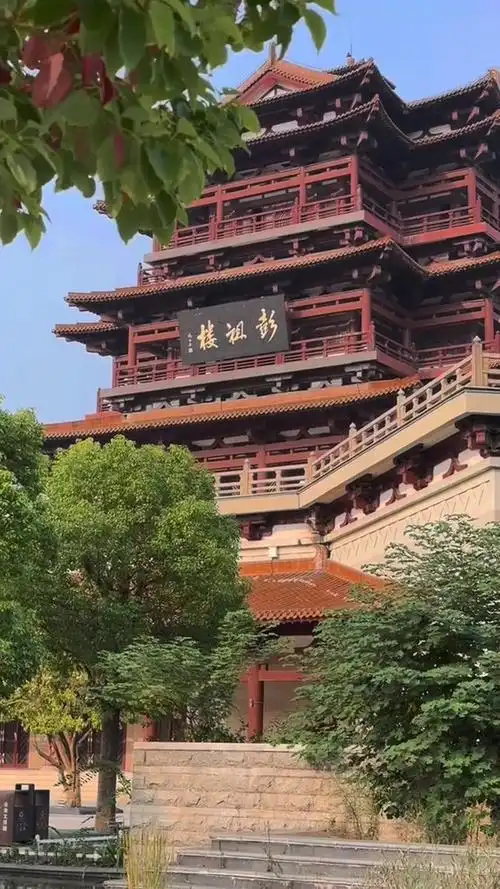 Pengzu Tower takes its name from one of antiquity's most enigmatic figures. Pengzu is celebrated in Chinese legend as the founding master of longevity practices, mythically said to have reached 800 years. He lived, according to tradition, during the late Shang dynasty, roughly contemporary with ancient Egypt's New Kingdom and the early Mediterranean civilizations. His philosophical legacy of cultivating long life through diet, breath, and movement would later influence traditions across East Asia. The original Pengzu Tower stood at Xuzhou's historic northeastern corner where the Bian and Si rivers met, documented since the Northern Wei period and lost to catastrophic Yellow River floods during the Ming dynasty. The present building, reconstructed in 2000, carries forward this venerable cultural memory.
The architecture itself is a thoughtful homage to imperial Chinese grandeur. Built as a reinforced five-story frame structure covering roughly 186,000 square feet, the cross-shaped layout projects the solemn dignity associated with palace buildings of the Han era. Soaring eaves, sturdy colonnaded corridors, and an austere facade evoke the aesthetic vocabulary that ruled an empire stretching from Korea to Central Asia, contemporary with Rome's greatest emperors. Recent restoration work has refreshed the exterior stonework, making it a favorite subject for photographers. In summer, blooming rose walls surrounding the building add a romantic, almost Mediterranean atmosphere.
Inside, the tower houses the Chu Wind Han Jade Museum, one of China's more specialized repositories of carved nephrite and jadeite. Exhibits center on monumental pieces, including an 8.7-ton Hetian jade Buddha and an imposing jade Guanyin figure, whose sheer mass rivals the great stone-carving traditions of European cathedrals. The collection unites Han dynasty aesthetic ideals with exquisite stonecraft, offering visitors a tangible encounter with Xuzhou's deep two-Han cultural heritage. Few Western travelers anticipate encountering jade sculpture on this scale, comparable in ambition to the great lapidary collections of Vienna or St. Petersburg.
Practical visitors should note that entry to Huaihai Cultural Park is free, typically opening between 8:30 and 17:30, though the jade museum may charge separate fees or require advance booking for special exhibitions. The park is often confused with Pengzu Garden, a separate scenic site on Mapeng Mountain in the southern suburbs. Do confirm your destination, as they share a similar name but offer distinct experiences. Public transport access is limited, so taxis, ride-hailing apps, or driving are recommended.
For the best photographic results, plan your visit before 10 AM or after 4 PM, when the light turns soft and golden. If the main tower is undergoing renovation, consider following the Seven Miles of Pengcheng walking route through Hufu Mountain and Huilongwo historic district, or head instead to Pengzu Garden for its grand Dapu Pavilion and ageless longevity pool. Either combination deepens your sense of how Xuzhou weaves ancient legend into contemporary urban life.
Pengzu Tower rewards travelers seeking experiences beyond China's headline destinations. It offers an intimate look at longevity philosophy, monumental jade artistry, and Han architectural revival, all within a single visit. Those who linger will leave with a richer understanding of how Xuzhou, once a strategic Han commandery, continues to honor its extraordinary past.
Pengzu Tower takes its name from one of antiquity's most enigmatic figures. Pengzu is celebrated in Chinese legend as the founding master of longevity practices, mythically said to have reached 800 years. He lived, according to tradition, during the late Shang dynasty, roughly contemporary with ancient Egypt's New Kingdom and the early Mediterranean civilizations. His philosophical legacy of cultivating long life through diet, breath, and movement would later influence traditions across East Asia. The original Pengzu Tower stood at Xuzhou's historic northeastern corner where the Bian and Si rivers met, documented since the Northern Wei period and lost to catastrophic Yellow River floods during the Ming dynasty. The present building, reconstructed in 2000, carries forward this venerable cultural memory.
The architecture itself is a thoughtful homage to imperial Chinese grandeur. Built as a reinforced five-story frame structure covering roughly 186,000 square feet, the cross-shaped layout projects the solemn dignity associated with palace buildings of the Han era. Soaring eaves, sturdy colonnaded corridors, and an austere facade evoke the aesthetic vocabulary that ruled an empire stretching from Korea to Central Asia, contemporary with Rome's greatest emperors. Recent restoration work has refreshed the exterior stonework, making it a favorite subject for photographers. In summer, blooming rose walls surrounding the building add a romantic, almost Mediterranean atmosphere.
Inside, the tower houses the Chu Wind Han Jade Museum, one of China's more specialized repositories of carved nephrite and jadeite. Exhibits center on monumental pieces, including an 8.7-ton Hetian jade Buddha and an imposing jade Guanyin figure, whose sheer mass rivals the great stone-carving traditions of European cathedrals. The collection unites Han dynasty aesthetic ideals with exquisite stonecraft, offering visitors a tangible encounter with Xuzhou's deep two-Han cultural heritage. Few Western travelers anticipate encountering jade sculpture on this scale, comparable in ambition to the great lapidary collections of Vienna or St. Petersburg.
Practical visitors should note that entry to Huaihai Cultural Park is free, typically opening between 8:30 and 17:30, though the jade museum may charge separate fees or require advance booking for special exhibitions. The park is often confused with Pengzu Garden, a separate scenic site on Mapeng Mountain in the southern suburbs. Do confirm your destination, as they share a similar name but offer distinct experiences. Public transport access is limited, so taxis, ride-hailing apps, or driving are recommended.
For the best photographic results, plan your visit before 10 AM or after 4 PM, when the light turns soft and golden. If the main tower is undergoing renovation, consider following the Seven Miles of Pengcheng walking route through Hufu Mountain and Huilongwo historic district, or head instead to Pengzu Garden for its grand Dapu Pavilion and ageless longevity pool. Either combination deepens your sense of how Xuzhou weaves ancient legend into contemporary urban life.
Pengzu Tower rewards travelers seeking experiences beyond China's headline destinations. It offers an intimate look at longevity philosophy, monumental jade artistry, and Han architectural revival, all within a single visit. Those who linger will leave with a richer understanding of how Xuzhou, once a strategic Han commandery, continues to honor its extraordinary past.