Wulingyuan Scenic Area
⭐ 4.60
Wulingyuan Scenic Area, Wulingyuan District, Zhangjiajie City, Hunan Province, China
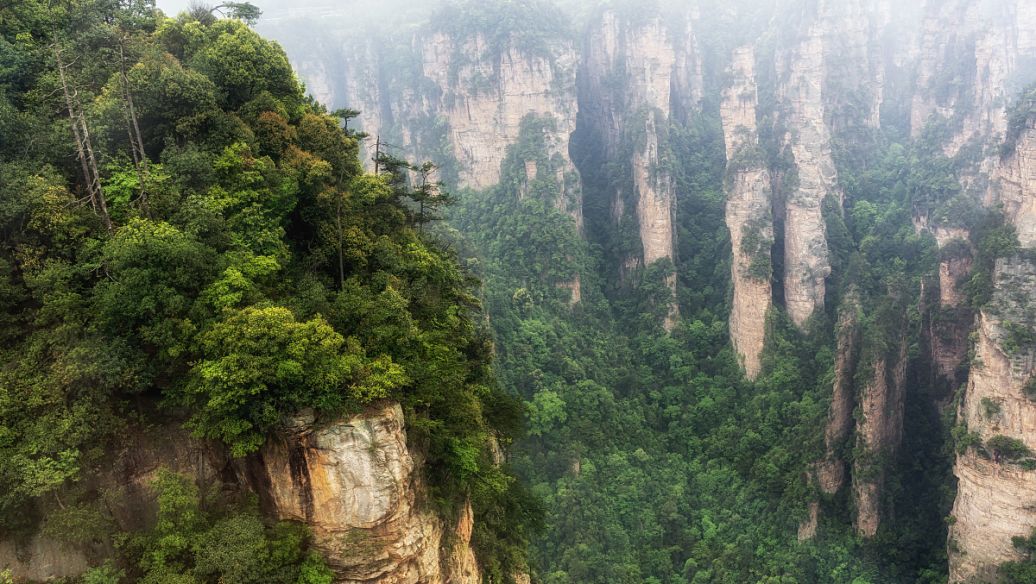 Wulingyuan joined UNESCO's World Natural Heritage list in 1992, joining the ranks of Yellowstone and Australia's Great Barrier Reef as a landscape of global geological importance. Its quartzite sandstone peak forest was formally recognized by the International Union of Geological Sciences as a unique landform type found almost nowhere else on Earth. The pillars formed over 380 million years when ancient seabeds were uplifted and eroded by wind and water, leaving vertical columns that rise up to 200 meters—taller than Big Ben—punctuating a terrain that feels almost prehistoric.
The four zones offer strikingly different atmospheres. Zhangjiajie National Forest Park, the oldest and most visited, features the iconic Yellow Dragon Cave and the vertiginous Tianmen Mountain cable car. Tianzi Mountain, named after a rebellious Song Dynasty prince who declared himself "Son of Heaven" here, provides panoramic viewpoints often compared to Yosemite's grandeur but with an Asian sensibility. Suoxi Valley charms with its babbling brooks and hanging coffins—an ancient burial custom of the Tujia minority—while Yangjiajie delivers the rawest, least-crowded wilderness.
Culturally, Wulingyuan lies at the heart of Tujia and Bai minority territory, whose stilted wooden houses and hand-stitched brocade textiles provide a human counterpoint to the geological drama. Local legends speak of mountain spirits, and traditional festivals like the Tujia Lantern Festival bring the valleys alive with fire and song each spring. For Western visitors, the cultural layering adds depth to what might otherwise feel like pure spectacle.
Plan for at least three to four days to do the area justice, as the park spans a staggering 397 square kilometers—roughly the size of Singapore. The Zhangjiajie Hehua International Airport receives daily flights from Beijing, Shanghai, and Guangzhou, while high-speed rail connects the city to Changsha in under three hours. Within the park, an efficient network of shuttle buses, cable cars, and the famous glass-bottomed Bailong Elevator—the world's tallest outdoor lift—makes even the most remote viewpoints accessible. Spring (April–May) and autumn (October–November) offer the clearest skies and most photogenic mist; summer is lush but rainy, while winter occasionally dusts the peaks with snow, transforming them into a Chinese ink painting.
Come to Wulingyuan for the simple reason that no photograph truly prepares you for it. Where Bryce Canyon offers red amphitheaters of stone and Cappadocia offers scattered fairy chimneys, Wulingyuan offers an entire lost world: a sea of green-clad monoliths rising through perpetual mist, silent, colossal, and utterly unlike anywhere else on the planet. For travelers seeking the sublime in nature, it ranks among the most extraordinary landscapes Asia has to offer.
Wulingyuan joined UNESCO's World Natural Heritage list in 1992, joining the ranks of Yellowstone and Australia's Great Barrier Reef as a landscape of global geological importance. Its quartzite sandstone peak forest was formally recognized by the International Union of Geological Sciences as a unique landform type found almost nowhere else on Earth. The pillars formed over 380 million years when ancient seabeds were uplifted and eroded by wind and water, leaving vertical columns that rise up to 200 meters—taller than Big Ben—punctuating a terrain that feels almost prehistoric.
The four zones offer strikingly different atmospheres. Zhangjiajie National Forest Park, the oldest and most visited, features the iconic Yellow Dragon Cave and the vertiginous Tianmen Mountain cable car. Tianzi Mountain, named after a rebellious Song Dynasty prince who declared himself "Son of Heaven" here, provides panoramic viewpoints often compared to Yosemite's grandeur but with an Asian sensibility. Suoxi Valley charms with its babbling brooks and hanging coffins—an ancient burial custom of the Tujia minority—while Yangjiajie delivers the rawest, least-crowded wilderness.
Culturally, Wulingyuan lies at the heart of Tujia and Bai minority territory, whose stilted wooden houses and hand-stitched brocade textiles provide a human counterpoint to the geological drama. Local legends speak of mountain spirits, and traditional festivals like the Tujia Lantern Festival bring the valleys alive with fire and song each spring. For Western visitors, the cultural layering adds depth to what might otherwise feel like pure spectacle.
Plan for at least three to four days to do the area justice, as the park spans a staggering 397 square kilometers—roughly the size of Singapore. The Zhangjiajie Hehua International Airport receives daily flights from Beijing, Shanghai, and Guangzhou, while high-speed rail connects the city to Changsha in under three hours. Within the park, an efficient network of shuttle buses, cable cars, and the famous glass-bottomed Bailong Elevator—the world's tallest outdoor lift—makes even the most remote viewpoints accessible. Spring (April–May) and autumn (October–November) offer the clearest skies and most photogenic mist; summer is lush but rainy, while winter occasionally dusts the peaks with snow, transforming them into a Chinese ink painting.
Come to Wulingyuan for the simple reason that no photograph truly prepares you for it. Where Bryce Canyon offers red amphitheaters of stone and Cappadocia offers scattered fairy chimneys, Wulingyuan offers an entire lost world: a sea of green-clad monoliths rising through perpetual mist, silent, colossal, and utterly unlike anywhere else on the planet. For travelers seeking the sublime in nature, it ranks among the most extraordinary landscapes Asia has to offer.