Dajingmen
⭐ 4.20
Dajingmen Scenic Area, Qiaoxi District, Zhangjiakou City, Hebei Province, China
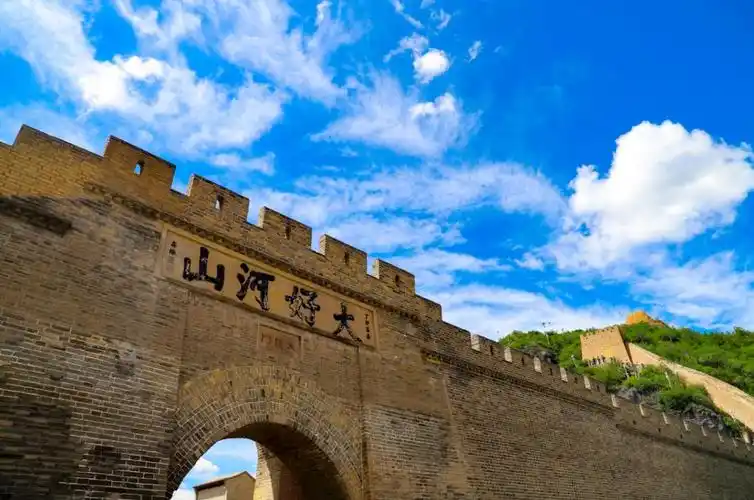 **Historical Context.** Dajingmen was raised in 1644, the very year the Ming dynasty collapsed and the Manchus seized Beijing — an era when, across the globe, the Peace of Westphalia was reshaping Europe and Louis XIV was ascending the French throne. The gate quickly became the southern terminus of the Zhangku Trade Road, a 4,000-kilometer caravan artery stretching from Zhangjiakou through Ulan Bator to Kyakhta on the Russian border. For nearly three centuries it functioned much like the Hanseatic towns of northern Germany or Venice's trading houses: a customs hub where Chinese tea, silk, and porcelain exchanged hands with Siberian furs, hides, and rhubarb, generating fortunes that bankrolled the early Qing economy.
**Architecture.** Unlike most Chinese passes — and unlike Europe's ornate gatehouses such as Carcassonne's Narbonne Gate — Dajingmen is strikingly austere: a single stone-and-brick arch measuring roughly 12 meters high and 13 meters across, deliberately built without a watchtower on top. This minimalist silhouette gives it a martial, almost Roman-portal quality reminiscent of fortified Alpine passes like Austria's Burg Ehrenberg. The original Qing-era iron-banded wooden doors survive intact, their rivets and weathered grain serving as a tactile timeline of three centuries of foot traffic.
**Cultural Significance.** Beyond its mercantile legacy, the gate bears layered historical memory. In 1933, patriot Feng Yuxiang mustered his Anti-Japanese Allied Army here before marching into the occupied northeast — a chapter that mirrors the resistance networks of occupied Europe in the same decade. The bold inscription "Great Rivers and Mountains," brushed by general Gao Weiyue in 1927, ranks among the most emotionally resonant calligraphic works along the entire Wall, comparable in cultural weight to the dedications carved into European cathedral portals. Neighboring relics — the ruins of Laiyuanbao fortress and a Guandi temple dedicated to the god of war and loyalty — add further depth.
**Practical Visit Information.** The open plaza facing the gate is freely accessible at any hour. Climbing the tower and adjacent wall sections costs around 12 RMB, with seniors aged 70 and above typically admitted free. Opening hours generally run 07:30 to 18:30, though seasonal variations occur — check on arrival. The site sits at the far northern end of Qiaoxi District in central Zhangjiakou, about two hours by high-speed train from Beijing, and is well-signposted for taxi or ride-hailing drop-off.
**Visitor Tips.** Aim to arrive around 17:30 in summer so you can photograph the inscription in warm late light, then ascend the wall to watch the sun dip behind the layered ridges. Afterwards, wander the Mingdekou historic block, where lantern-lit lanes host folk performances and vendors hawk local lamb skewers and oat noodles — a culinary scene with no real European parallel. Pack a light jacket even in July (the wall catches cool mountain breezes), and wear grippy soles in winter when stone steps can ice over. Allow 1.5 to 2 hours for a satisfying visit, longer if you add a walk along the unrestored wall sections nearby.
**Why Visit.** For travelers who have already ticked off the crowded, cable-car-laden Badaling or Mutianyu sections, Dajingmen offers something rarer: an unscripted, authentically weathered frontier outpost where the Wall still feels like a working relic rather than a theme park. It is, quite simply, one of the best places in China to stand on a 380-year-old battlement, gaze out at the Mongolian steppe in the distance, and grasp why emperors fought so fiercely to hold this single stretch of mountain.
**Historical Context.** Dajingmen was raised in 1644, the very year the Ming dynasty collapsed and the Manchus seized Beijing — an era when, across the globe, the Peace of Westphalia was reshaping Europe and Louis XIV was ascending the French throne. The gate quickly became the southern terminus of the Zhangku Trade Road, a 4,000-kilometer caravan artery stretching from Zhangjiakou through Ulan Bator to Kyakhta on the Russian border. For nearly three centuries it functioned much like the Hanseatic towns of northern Germany or Venice's trading houses: a customs hub where Chinese tea, silk, and porcelain exchanged hands with Siberian furs, hides, and rhubarb, generating fortunes that bankrolled the early Qing economy.
**Architecture.** Unlike most Chinese passes — and unlike Europe's ornate gatehouses such as Carcassonne's Narbonne Gate — Dajingmen is strikingly austere: a single stone-and-brick arch measuring roughly 12 meters high and 13 meters across, deliberately built without a watchtower on top. This minimalist silhouette gives it a martial, almost Roman-portal quality reminiscent of fortified Alpine passes like Austria's Burg Ehrenberg. The original Qing-era iron-banded wooden doors survive intact, their rivets and weathered grain serving as a tactile timeline of three centuries of foot traffic.
**Cultural Significance.** Beyond its mercantile legacy, the gate bears layered historical memory. In 1933, patriot Feng Yuxiang mustered his Anti-Japanese Allied Army here before marching into the occupied northeast — a chapter that mirrors the resistance networks of occupied Europe in the same decade. The bold inscription "Great Rivers and Mountains," brushed by general Gao Weiyue in 1927, ranks among the most emotionally resonant calligraphic works along the entire Wall, comparable in cultural weight to the dedications carved into European cathedral portals. Neighboring relics — the ruins of Laiyuanbao fortress and a Guandi temple dedicated to the god of war and loyalty — add further depth.
**Practical Visit Information.** The open plaza facing the gate is freely accessible at any hour. Climbing the tower and adjacent wall sections costs around 12 RMB, with seniors aged 70 and above typically admitted free. Opening hours generally run 07:30 to 18:30, though seasonal variations occur — check on arrival. The site sits at the far northern end of Qiaoxi District in central Zhangjiakou, about two hours by high-speed train from Beijing, and is well-signposted for taxi or ride-hailing drop-off.
**Visitor Tips.** Aim to arrive around 17:30 in summer so you can photograph the inscription in warm late light, then ascend the wall to watch the sun dip behind the layered ridges. Afterwards, wander the Mingdekou historic block, where lantern-lit lanes host folk performances and vendors hawk local lamb skewers and oat noodles — a culinary scene with no real European parallel. Pack a light jacket even in July (the wall catches cool mountain breezes), and wear grippy soles in winter when stone steps can ice over. Allow 1.5 to 2 hours for a satisfying visit, longer if you add a walk along the unrestored wall sections nearby.
**Why Visit.** For travelers who have already ticked off the crowded, cable-car-laden Badaling or Mutianyu sections, Dajingmen offers something rarer: an unscripted, authentically weathered frontier outpost where the Wall still feels like a working relic rather than a theme park. It is, quite simply, one of the best places in China to stand on a 380-year-old battlement, gaze out at the Mongolian steppe in the distance, and grasp why emperors fought so fiercely to hold this single stretch of mountain.