Iron Pagoda
⭐ 3.80
Iron Pagoda Park, Longting District, Kaifeng City, Henan Province, China
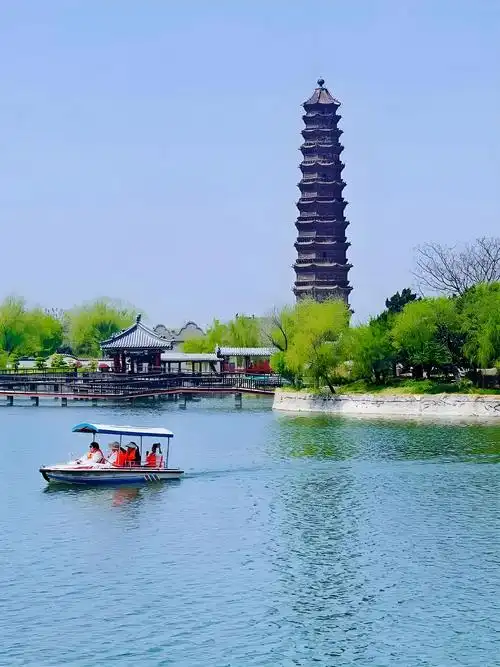 The Iron Tower was erected in 1049 CE, during the Northern Song Dynasty's Kaibao era, when Kaifeng (then called Bianliang) was among the world's largest and most prosperous cities, with a population exceeding one million—surpassing contemporary London, Paris, or Rome. At a time when Europe was building its first Romanesque cathedrals and Norman keeps, this royal pagoda rose as part of the imperial Kaibao Temple. Having witnessed the city's golden age, Mongol invasions, devastating Yellow River floods, and modern conflicts, the tower remains a tangible link to a civilization that pioneered printing, paper currency, and the compass—roughly half a millennium before such innovations reached Europe.
Standing 55.08 meters tall, the octagonal thirteen-story structure mimics traditional wooden pavilion architecture—comparable in height to Italy's Leaning Tower of Pisa, though built more than a century earlier. Yet despite its wooden appearance, the tower uses no wood at all: craftsmen employed 28 types of specially shaped bricks locked together with mortise-and-tenon joints, a technique reminiscent of European Romanesque brickwork but executed with far greater precision. The brown glazed brick surfaces feature over fifty relief designs, including flying apsaras, qilin (mythical beasts), and seated Buddhas. Its ingenious seismic and wind-resistant engineering has helped it survive nearly ten centuries intact.
Nicknamed "First Pagoda Under Heaven," the Iron Tower was inscribed among China's first batch of nationally protected cultural relics in 1961. The surrounding 51-hectare park extends this cultural narrative through several notable features: the Jieyin Hall houses a Northern Song bronze Amitabha Buddha, while the Linggan Hall enshrines a Burmese jade Buddha. The Bonsai Garden, the largest in Henan Province, showcases the refined aesthetics of Song-era garden design. Iron Tower Lake, with its pavilions like He Gong Xuan reflecting on the water, recreates the contemplative atmosphere that scholars and officials once sought in this ancient capital.
Since October 1, 2024, the park has charged an admission fee of 30 yuan (approximately $4 USD) for adults, though certain festival periods offer free entry. Note that visitors can only view the tower's interior ground-floor hall—climbing the upper stories is not permitted—meaning you should take time to circle the exterior and admire the brickwork details up close. Bring your passport or ID card, and prepare mobile payment apps such as Alipay or WeChat Pay, though carrying small cash remains advisable. The site is partially accessible; visitors with mobility issues should be aware of the park's uneven historic pathways.
Plan a clockwise exploration lasting 1.5 to 2 hours: enter through the "First Pagoda Under Heaven" stone stele, visit the Jieyin Hall, circle the main tower to study its glazed brick reliefs, pause at Zhizhi Pavilion, wander through the Bonsai Garden, then stroll along Iron Tower Lake toward He Gong Xuan. Arrive at 8:30 AM when gates open to beat the tour-bus crowds, or visit in late afternoon when the soft light brings out the tower's signature bronze hues. For a fuller sense of Kaifeng's layered history, combine your visit with the nearby Dragon Pavilion and the early twentieth-century architectural ensemble of Henan University.
The Iron Tower was erected in 1049 CE, during the Northern Song Dynasty's Kaibao era, when Kaifeng (then called Bianliang) was among the world's largest and most prosperous cities, with a population exceeding one million—surpassing contemporary London, Paris, or Rome. At a time when Europe was building its first Romanesque cathedrals and Norman keeps, this royal pagoda rose as part of the imperial Kaibao Temple. Having witnessed the city's golden age, Mongol invasions, devastating Yellow River floods, and modern conflicts, the tower remains a tangible link to a civilization that pioneered printing, paper currency, and the compass—roughly half a millennium before such innovations reached Europe.
Standing 55.08 meters tall, the octagonal thirteen-story structure mimics traditional wooden pavilion architecture—comparable in height to Italy's Leaning Tower of Pisa, though built more than a century earlier. Yet despite its wooden appearance, the tower uses no wood at all: craftsmen employed 28 types of specially shaped bricks locked together with mortise-and-tenon joints, a technique reminiscent of European Romanesque brickwork but executed with far greater precision. The brown glazed brick surfaces feature over fifty relief designs, including flying apsaras, qilin (mythical beasts), and seated Buddhas. Its ingenious seismic and wind-resistant engineering has helped it survive nearly ten centuries intact.
Nicknamed "First Pagoda Under Heaven," the Iron Tower was inscribed among China's first batch of nationally protected cultural relics in 1961. The surrounding 51-hectare park extends this cultural narrative through several notable features: the Jieyin Hall houses a Northern Song bronze Amitabha Buddha, while the Linggan Hall enshrines a Burmese jade Buddha. The Bonsai Garden, the largest in Henan Province, showcases the refined aesthetics of Song-era garden design. Iron Tower Lake, with its pavilions like He Gong Xuan reflecting on the water, recreates the contemplative atmosphere that scholars and officials once sought in this ancient capital.
Since October 1, 2024, the park has charged an admission fee of 30 yuan (approximately $4 USD) for adults, though certain festival periods offer free entry. Note that visitors can only view the tower's interior ground-floor hall—climbing the upper stories is not permitted—meaning you should take time to circle the exterior and admire the brickwork details up close. Bring your passport or ID card, and prepare mobile payment apps such as Alipay or WeChat Pay, though carrying small cash remains advisable. The site is partially accessible; visitors with mobility issues should be aware of the park's uneven historic pathways.
Plan a clockwise exploration lasting 1.5 to 2 hours: enter through the "First Pagoda Under Heaven" stone stele, visit the Jieyin Hall, circle the main tower to study its glazed brick reliefs, pause at Zhizhi Pavilion, wander through the Bonsai Garden, then stroll along Iron Tower Lake toward He Gong Xuan. Arrive at 8:30 AM when gates open to beat the tour-bus crowds, or visit in late afternoon when the soft light brings out the tower's signature bronze hues. For a fuller sense of Kaifeng's layered history, combine your visit with the nearby Dragon Pavilion and the early twentieth-century architectural ensemble of Henan University.