Changbai Mountain Heavenly Lake (Yanbian Section)
⭐ 4.60
Changbai Mountain Heavenly Lake, Helong County, Yanbian Korean Autonomous Prefecture, Jilin Province, China
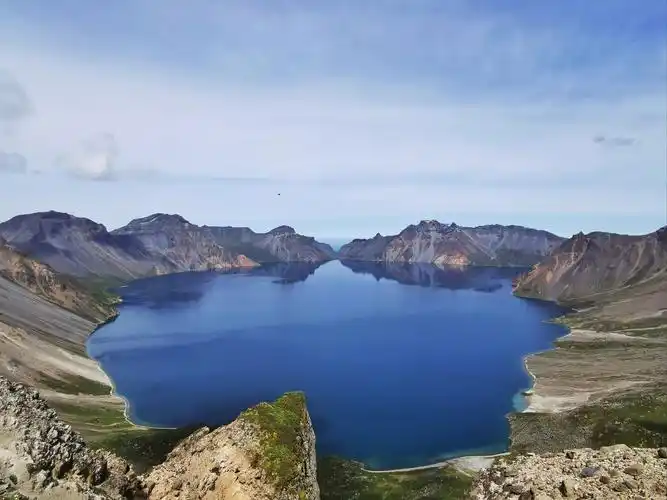 Heaven Lake fills the collapsed caldera of a volcano that last erupted around 1702, though its origins stretch back millennia. Western travelers will recognize the geological kinship with Oregon's Crater Lake, though Tianchi is larger, deeper, and crowned by sixteen jagged peaks that tower up to 2,500 meters. The water, fed by snowmelt and underground springs, glows an almost surreal cobalt depending on the light. Beneath its surface lies an average depth of 204 meters, plunging to 373 meters at its deepest point, making it both China's deepest crater lake and one of the deepest lakes in the world.
Geographically, the lake holds an outsized importance: it is the headwater source for three of Northeast Asia's great rivers, the Songhua, Tumen, and Yalu, which together have shaped regional history from Manchurian imperial dynasties to the Korean War of 1950–53. Today, the lake straddles the China–North Korea frontier, lending it a geopolitical intrigue rare among natural sites. The surrounding slopes preserve a remarkable vertical ecosystem, from temperate broadleaf forests at the base to fragile alpine tundra at the summit, an outdoor laboratory for anyone curious about subarctic botany.
Visitors entering the Yanbian section choose between two contrasting experiences. The North Slope, accessed through the well-developed gateway town of Erdao Baihe, offers coach transfers that whisk travelers directly to the main viewpoint, eliminating any climbing. Families and older visitors will appreciate the cascading Changbai Waterfall, the emerald Green Abyss Pool, the eerie Underground Forest, and the chance to boil eggs in bubbling volcanic springs. The West Slope, based in Songjianghe, demands stamina: a grueling 1,442-step staircase leads to the lake's widest, most cinematic angle, a pilgrimage favored by serious hikers and photographers. Its Alpine Garden, blooming in August, is the crown jewel.
Practical planning is essential. Reserve tickets one to seven days in advance through the official Changbai Mountain WeChat account, as walk-up tickets vanish in peak season. North Slope visitors must additionally purchase shuttle tickets for the final ascent. Aim to arrive before 7 a.m., when clear-sky chances peak; even in August, summit temperatures hover between 8 and 12°C, so pack a windbreaker or light down jacket, waterproof hiking shoes, and rain gear. Main-peak closures due to fog, lightning, or wind occur frequently, with sunny visibility averaging only 60–70% of days.
Beyond the mountain, Yanbian's Korean Autonomous Prefecture offers rich cultural rewards. Yanji, two to three hours by road, beckons with cold noodles, charcoal-grilled beef, and a vibrant border-city atmosphere where Chinese-Korean traditions blend seamlessly. Leisurely travelers can stroll the美人松 (Beauty Pine) boardwalk or photograph rare Scaly-sided Merganser ducks in Erdao Baihe's town park. Those with extra days may extend to Tumen and Hunchun, watching ships ply the Tumen River toward the Sea of Japan, though border zones prohibit drones and photography of military installations, a sobering reminder of this region's complex past and present.
Heaven Lake fills the collapsed caldera of a volcano that last erupted around 1702, though its origins stretch back millennia. Western travelers will recognize the geological kinship with Oregon's Crater Lake, though Tianchi is larger, deeper, and crowned by sixteen jagged peaks that tower up to 2,500 meters. The water, fed by snowmelt and underground springs, glows an almost surreal cobalt depending on the light. Beneath its surface lies an average depth of 204 meters, plunging to 373 meters at its deepest point, making it both China's deepest crater lake and one of the deepest lakes in the world.
Geographically, the lake holds an outsized importance: it is the headwater source for three of Northeast Asia's great rivers, the Songhua, Tumen, and Yalu, which together have shaped regional history from Manchurian imperial dynasties to the Korean War of 1950–53. Today, the lake straddles the China–North Korea frontier, lending it a geopolitical intrigue rare among natural sites. The surrounding slopes preserve a remarkable vertical ecosystem, from temperate broadleaf forests at the base to fragile alpine tundra at the summit, an outdoor laboratory for anyone curious about subarctic botany.
Visitors entering the Yanbian section choose between two contrasting experiences. The North Slope, accessed through the well-developed gateway town of Erdao Baihe, offers coach transfers that whisk travelers directly to the main viewpoint, eliminating any climbing. Families and older visitors will appreciate the cascading Changbai Waterfall, the emerald Green Abyss Pool, the eerie Underground Forest, and the chance to boil eggs in bubbling volcanic springs. The West Slope, based in Songjianghe, demands stamina: a grueling 1,442-step staircase leads to the lake's widest, most cinematic angle, a pilgrimage favored by serious hikers and photographers. Its Alpine Garden, blooming in August, is the crown jewel.
Practical planning is essential. Reserve tickets one to seven days in advance through the official Changbai Mountain WeChat account, as walk-up tickets vanish in peak season. North Slope visitors must additionally purchase shuttle tickets for the final ascent. Aim to arrive before 7 a.m., when clear-sky chances peak; even in August, summit temperatures hover between 8 and 12°C, so pack a windbreaker or light down jacket, waterproof hiking shoes, and rain gear. Main-peak closures due to fog, lightning, or wind occur frequently, with sunny visibility averaging only 60–70% of days.
Beyond the mountain, Yanbian's Korean Autonomous Prefecture offers rich cultural rewards. Yanji, two to three hours by road, beckons with cold noodles, charcoal-grilled beef, and a vibrant border-city atmosphere where Chinese-Korean traditions blend seamlessly. Leisurely travelers can stroll the美人松 (Beauty Pine) boardwalk or photograph rare Scaly-sided Merganser ducks in Erdao Baihe's town park. Those with extra days may extend to Tumen and Hunchun, watching ships ply the Tumen River toward the Sea of Japan, though border zones prohibit drones and photography of military installations, a sobering reminder of this region's complex past and present.