Hailan River Ecological Park
⭐ 3.60
Hailan River Ecological Park, Tumen City, Yanbian Korean Autonomous Prefecture, Jilin Province, China
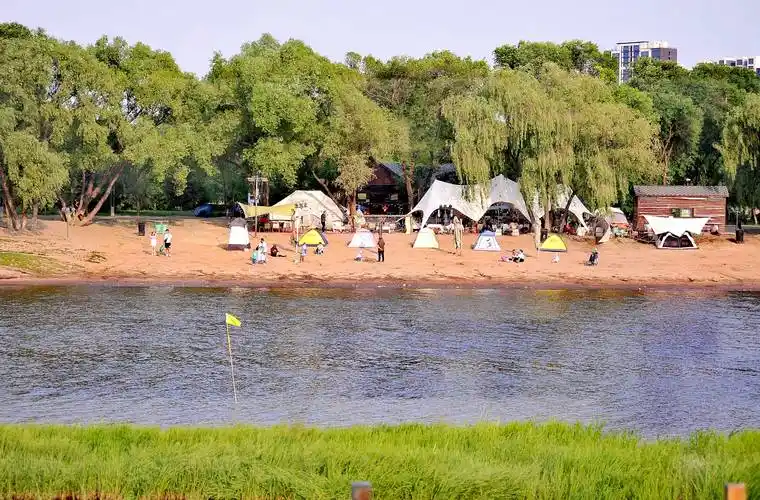 Longjing sits at a crossroads of empires. The surrounding Yanbian region was once part of the ancient Goguryeo kingdom (37 BCE–668 CE), one of the Three Kingdoms that shaped the Korean peninsula, and later absorbed successive waves of Korean migration during the Japanese colonial era (1910–1945). The park itself, however, is thoroughly modern: built atop engineered flood-control levees completed in recent decades, it reflects China's contemporary ambition to combine water management, ecological restoration, and tourism. Think of it as a rural, rice-growing cousin to Seoul's Cheonggyecheon stream restoration, or to the regenerated riverbanks along the Seine in Paris.
The river is the park's spine, flanked for kilometers by rice fields that ripple outward toward hazy ridgelines. A timber boardwalk and a glass-floored suspension bridge lift visitors above the paddies, evoking the elevated paths through Tuscany's Val d'Orcia or Bali's Tegallalang rice terraces. At the river's bend rises the Hailantai Resort, whose grey-tiled roofs, whitewashed walls, and gently upturned eaves borrow directly from Joseon-era Korean architecture. The ensemble feels like a slice of Gyeongju transplanted into the Chinese countryside — though here, working tractors and flooded fields remind you that this landscape is very much alive.
Yanbian's Koreans belong to one of China's 56 officially recognized ethnic minorities and have preserved folkways that bridge two cultures. At Hailantai, open-air shows like "Children of Hailan" dramatize themes of family loyalty and homeland, while the Six-Fork Market peddles spicy pickled cabbage, blood sausage, and pounded rice cake — staples that pair naturally with cold beer or soju. Visitors can rent hanbok-inspired robes for photo sessions, sample rice-wine brewing, or join craft workshops rooted in intangible heritage. Compared with the polished folk villages of Bavaria or open-air museums like Skansen in Stockholm, the experience here feels less choreographed and more genuinely contemporary.
For active travelers, the park strings together cycling paths, jogging trails, and the Hailanjiang Football Industry Park, a cluster of 47 standard pitches that recalls the sprawling training complexes around Madrid or London's club academies. Within the resort, the Changgaeong Palace and Datong Street serve Korean-style meals in courtyards where you settle onto heated ondol floors. After dark, lantern-lit walkways line the embankment and the river mirrors the lights — a scene as photogenic as the quais of Paris or the lamps along Prague's Vltava, but framed by rice paddies rather than centuries-old stone.
Admission is free and the park never closes, though the Hailantai Resort operates from 10:00 to 22:00 and individual performances follow published schedules. Plan for May through October, when the rice turns from emerald to gold and evenings glow soft pink. Taxis or hired cars from Yanji reach the park in 20–30 minutes. Because Yanbian abuts North Korea, foreign visitors should carry valid passports and confirm with local police whether a Border Pass is required. Wear removable shoes for traditional interiors, carry small bills, and pair this stop with Piyan Mountain or the rice-paddy railway at Guang Dong Village for a full day out.
Longjing sits at a crossroads of empires. The surrounding Yanbian region was once part of the ancient Goguryeo kingdom (37 BCE–668 CE), one of the Three Kingdoms that shaped the Korean peninsula, and later absorbed successive waves of Korean migration during the Japanese colonial era (1910–1945). The park itself, however, is thoroughly modern: built atop engineered flood-control levees completed in recent decades, it reflects China's contemporary ambition to combine water management, ecological restoration, and tourism. Think of it as a rural, rice-growing cousin to Seoul's Cheonggyecheon stream restoration, or to the regenerated riverbanks along the Seine in Paris.
The river is the park's spine, flanked for kilometers by rice fields that ripple outward toward hazy ridgelines. A timber boardwalk and a glass-floored suspension bridge lift visitors above the paddies, evoking the elevated paths through Tuscany's Val d'Orcia or Bali's Tegallalang rice terraces. At the river's bend rises the Hailantai Resort, whose grey-tiled roofs, whitewashed walls, and gently upturned eaves borrow directly from Joseon-era Korean architecture. The ensemble feels like a slice of Gyeongju transplanted into the Chinese countryside — though here, working tractors and flooded fields remind you that this landscape is very much alive.
Yanbian's Koreans belong to one of China's 56 officially recognized ethnic minorities and have preserved folkways that bridge two cultures. At Hailantai, open-air shows like "Children of Hailan" dramatize themes of family loyalty and homeland, while the Six-Fork Market peddles spicy pickled cabbage, blood sausage, and pounded rice cake — staples that pair naturally with cold beer or soju. Visitors can rent hanbok-inspired robes for photo sessions, sample rice-wine brewing, or join craft workshops rooted in intangible heritage. Compared with the polished folk villages of Bavaria or open-air museums like Skansen in Stockholm, the experience here feels less choreographed and more genuinely contemporary.
For active travelers, the park strings together cycling paths, jogging trails, and the Hailanjiang Football Industry Park, a cluster of 47 standard pitches that recalls the sprawling training complexes around Madrid or London's club academies. Within the resort, the Changgaeong Palace and Datong Street serve Korean-style meals in courtyards where you settle onto heated ondol floors. After dark, lantern-lit walkways line the embankment and the river mirrors the lights — a scene as photogenic as the quais of Paris or the lamps along Prague's Vltava, but framed by rice paddies rather than centuries-old stone.
Admission is free and the park never closes, though the Hailantai Resort operates from 10:00 to 22:00 and individual performances follow published schedules. Plan for May through October, when the rice turns from emerald to gold and evenings glow soft pink. Taxis or hired cars from Yanji reach the park in 20–30 minutes. Because Yanbian abuts North Korea, foreign visitors should carry valid passports and confirm with local police whether a Border Pass is required. Wear removable shoes for traditional interiors, carry small bills, and pair this stop with Piyan Mountain or the rice-paddy railway at Guang Dong Village for a full day out.