Ancient Villages of Helong County
⭐ 4.20
Helong County, Yanbian Korean Autonomous Prefecture, Jilin Province, China
 **Historical Context**
The Korean communities of Helong trace their origins to the late Qing Dynasty's "Chuang Guandong" migration, when tens of thousands of Koreans crossed the Yalu and Tumen rivers seeking farmland in Manchuria during the 1860s–1880s. Parallel to the great European diasporas of the 19th century—Irish fleeing the famine or Poles seeking new horizons—these settlers transformed the region's wetlands into productive rice paddies. Guangdong and Jindalai villages, both founded between the 1880s and 1910s, remain living laboratories for studying how the Korean diaspora preserved language, customs, and identity across more than a century of frontier life.
**Architecture**
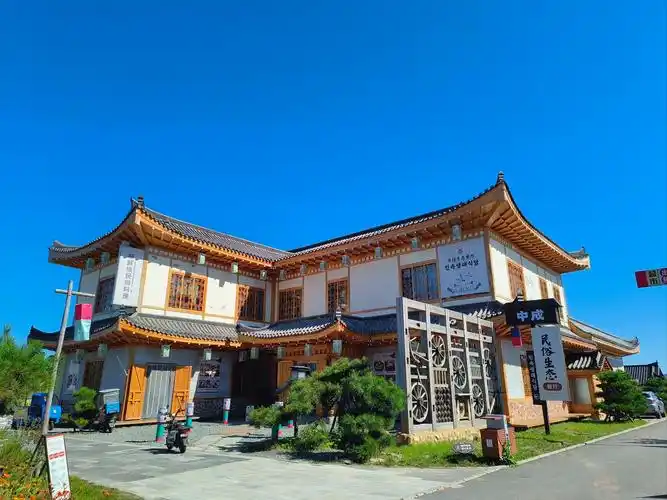
The villages showcase classic Korean vernacular architecture, with low-slung whitewashed homes crowned by dark gray tile roofs—a palette that echoes the hanok districts of Seoul's Bukchon or the preserved villages of South Korea's Jeonju. Buildings feature timber post-and-beam construction, sliding paper-and-wood doors, and the signature ondol underfloor heating system, where smoke from the kitchen stove circulates beneath raised platforms. Jindalai Village, officially recognized on China's Traditional Villages list, retains particularly intact spatial layouts, with century-old homes nestled among ancient trees and narrow lanes that reveal the organic growth of a true frontier settlement.
**Cultural Significance**
Both villages function as open-air stages for intangible cultural heritage, with year-round performances of the acrobatic Sangmo hat-twirling dance, the rhythmic long-drum dance, and Samulnori—Korea's iconic four-instrument percussion ensemble that gained nationwide fame during the 1980s democratization movement. Visitors can participate in hands-on workshops for tteok rice cake pounding and kimchi preparation, both UNESCO-recognized Korean culinary traditions. Because the population remains overwhelmingly ethnic Korean, daily life—from weddings to ancestral rites—unfolds in authentic fashion, offering irreplaceable insight into a culture that otherwise exists only behind glass in most museums.
**Practical Visit Information**
Guangdong Village sits about 40 minutes' drive west of Yanji city, while Jindalai Village lies another 40 minutes further along rural roads—ideal for a linked day trip, though public buses are infrequent and early-ending, so renting a car or hiring a driver is strongly recommended. Entrance is free to both villages, though attractions like the rice paddy miniature train, cable car, and hanbok costume rental charge separately. The optimal visiting window runs May through October, when paddies shift from emerald green to harvest gold. Because Helong lies within a frontier management zone, all visitors must carry valid passport or ID at all times.
**Photography and Family Tips**
Early morning and late afternoon bathe the whitewashed walls in warm light, with the Hailan River near Jindalai offering mirror-perfect reflections for photographers. Families with children will find Guangdong's rice cake pounding sessions and paddy train rides especially rewarding—an experience comparable to agritourism in Tuscany or the hands-on farm stays of rural France. Advance booking of guesthouses is essential during summer and harvest festivals, and travelers should verify folk performance schedules before arrival, as timing varies by season. Pack slip-resistant shoes for rainy periods and carry a small amount of cash, as some village shops rely on mobile payment only.
**Historical Context**
The Korean communities of Helong trace their origins to the late Qing Dynasty's "Chuang Guandong" migration, when tens of thousands of Koreans crossed the Yalu and Tumen rivers seeking farmland in Manchuria during the 1860s–1880s. Parallel to the great European diasporas of the 19th century—Irish fleeing the famine or Poles seeking new horizons—these settlers transformed the region's wetlands into productive rice paddies. Guangdong and Jindalai villages, both founded between the 1880s and 1910s, remain living laboratories for studying how the Korean diaspora preserved language, customs, and identity across more than a century of frontier life.
**Architecture**
The villages showcase classic Korean vernacular architecture, with low-slung whitewashed homes crowned by dark gray tile roofs—a palette that echoes the hanok districts of Seoul's Bukchon or the preserved villages of South Korea's Jeonju. Buildings feature timber post-and-beam construction, sliding paper-and-wood doors, and the signature ondol underfloor heating system, where smoke from the kitchen stove circulates beneath raised platforms. Jindalai Village, officially recognized on China's Traditional Villages list, retains particularly intact spatial layouts, with century-old homes nestled among ancient trees and narrow lanes that reveal the organic growth of a true frontier settlement.
**Cultural Significance**
Both villages function as open-air stages for intangible cultural heritage, with year-round performances of the acrobatic Sangmo hat-twirling dance, the rhythmic long-drum dance, and Samulnori—Korea's iconic four-instrument percussion ensemble that gained nationwide fame during the 1980s democratization movement. Visitors can participate in hands-on workshops for tteok rice cake pounding and kimchi preparation, both UNESCO-recognized Korean culinary traditions. Because the population remains overwhelmingly ethnic Korean, daily life—from weddings to ancestral rites—unfolds in authentic fashion, offering irreplaceable insight into a culture that otherwise exists only behind glass in most museums.
**Practical Visit Information**
Guangdong Village sits about 40 minutes' drive west of Yanji city, while Jindalai Village lies another 40 minutes further along rural roads—ideal for a linked day trip, though public buses are infrequent and early-ending, so renting a car or hiring a driver is strongly recommended. Entrance is free to both villages, though attractions like the rice paddy miniature train, cable car, and hanbok costume rental charge separately. The optimal visiting window runs May through October, when paddies shift from emerald green to harvest gold. Because Helong lies within a frontier management zone, all visitors must carry valid passport or ID at all times.
**Photography and Family Tips**
Early morning and late afternoon bathe the whitewashed walls in warm light, with the Hailan River near Jindalai offering mirror-perfect reflections for photographers. Families with children will find Guangdong's rice cake pounding sessions and paddy train rides especially rewarding—an experience comparable to agritourism in Tuscany or the hands-on farm stays of rural France. Advance booking of guesthouses is essential during summer and harvest festivals, and travelers should verify folk performance schedules before arrival, as timing varies by season. Pack slip-resistant shoes for rainy periods and carry a small amount of cash, as some village shops rely on mobile payment only.